

First Impressions and Onboarding
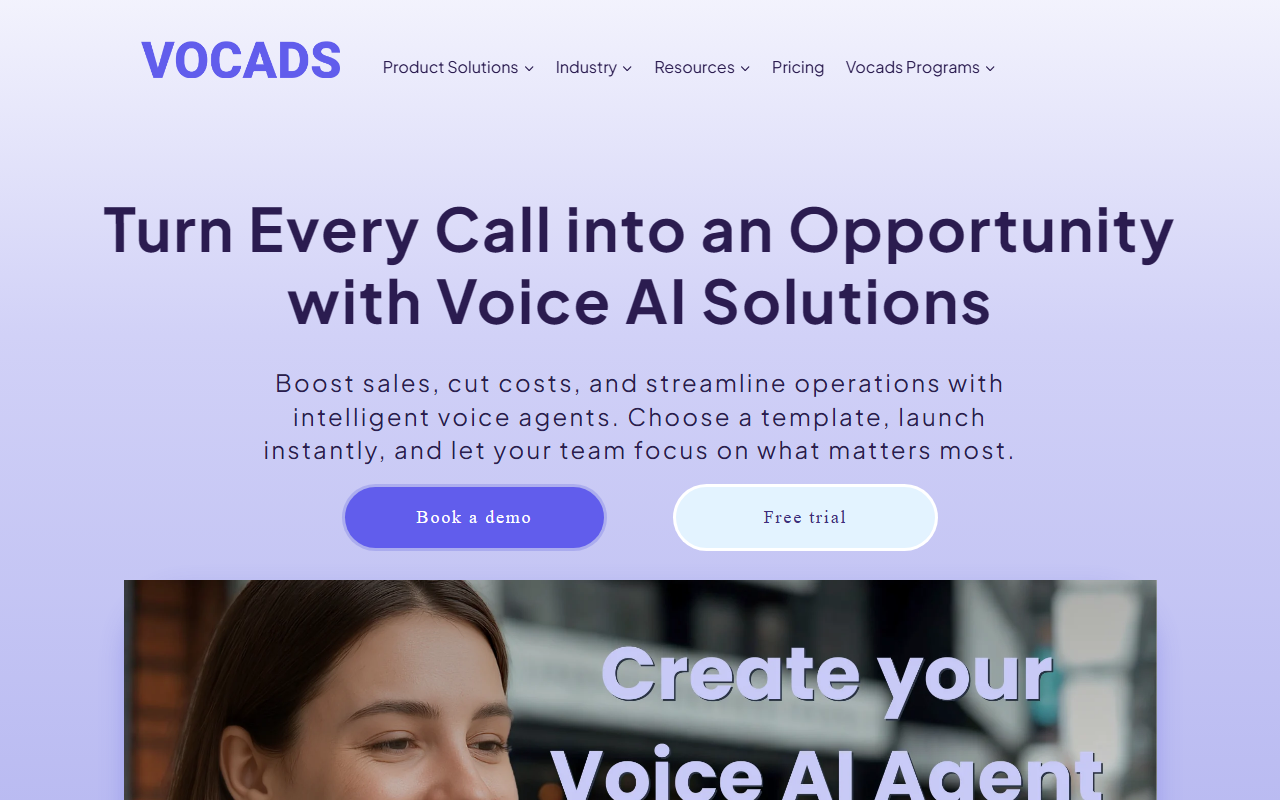
Upon visiting vocads.com, you are greeted with a clean, modern interface that immediately pushes you toward action: “Turn Every Call into an Opportunity with Voice AI Solutions.” The landing page highlights three key pain points—missed opportunities, high call center costs, and customer frustration—which sets the stage for what this tool promises. A prominent “Free Trial” button and “Book a Demo” call-to-action are the primary onboarding paths. I clicked through to the demo request flow; it requires filling in basic contact details and choosing a use case (Smart Voicemail, Customer Follow-Up Assistant, or Smart Survey). The free trial seems to grant immediate access to a template-driven agent builder, though I wasn’t able to test the full workflow without submitting a form. The dashboard, as glimpsed in product screenshots on the site, presents a simple studio where you create voice agents by selecting a template, plugging in a database (CRM, CSV, or API), and deploying via phone or web widget. The entire process is advertised as taking “minutes,” and given the template-first approach, that claim feels plausible for basic use cases.
Features and Technical Depth
VOCADS is a cross-border AI voice agent platform designed to handle inbound and outbound calls across multiple channels—phone and website embedded agents. The standout feature is its multilingual capability: over 12 languages, which is a clear differentiator for global businesses. During my exploration of the “How It Works” section, I noticed four steps: Create (templated agent), Plug (integrate data sources), Deploy (inbound/outbound), and Analyze (real-time reports). The agent types include Smart Voicemail (handles high call volumes and schedules meetings), Customer Follow-Up Assistant (re-engages dormant leads), and Smart Survey (voice-powered surveys for insights and testimonials). These are pre-built solutions, not a generic voice bot builder—meaning you trade customization for speed. The technology likely leverages a mix of ASR, NLU, and TTS from major providers, though the website doesn’t specify the underlying model. There’s a Help Center with articles on Nodes and User Variables, suggesting some degree of conversational flow design via a visual node editor, but the complexity seems aimed at non-technical users. Integrations are hinted at (“Plug any database”), but no specific CRM names are listed. For developers, a “Developers” section exists in the footer, which may contain API documentation, but I did not explore that further.
A concrete interaction I observed from the included testimonial: a real estate agent uses Smart Voicemail to free up time, and an e-commerce owner runs automated voice surveys. These use cases show real-world utility. The platform also emphasizes data compliance (“Protected Data” and “Data-compliant infrastructure”), which is important for regulated industries like healthcare and insurance (listed in the Industry section). The analysis node promises real-time monitoring and instant analysis, which could be valuable for sales teams wanting to track conversion metrics from outbound campaigns.
Pricing and Market Positioning
Notably, pricing is not publicly listed on the website. The only options presented are a free trial and a demo booking. This suggests a sales-led model, typical for enterprise or usage-based pricing. Competitors in the voice AI space include Retell AI (per-minute pricing, heavy customization), Play.ht’s voice agents (developer-focused), and Air.ai (highly conversational but expensive). VOCADS positions itself as a fast-deployment, template-driven solution for SMBs and mid-market companies that lack in-house AI expertise. It also targets specific verticals (real estate, transport, insurance, healthcare, hospitality, HR) with ready-made use cases. The presence of a “Cross-border AI” category in its site title hints at a focus on multilingual, international deployments. The site features several trust logos and testimonials from real businesses (e.g., Transdev, an innovation project manager), adding credibility. However, the lack of transparent pricing and limited customization features may deter power users who need fine-grained control over conversation flows.
Final Verdict and Recommendations
After spending time with the VOCADS website and understanding its capabilities, I believe it is a solid choice for small-to-medium businesses looking to quickly deploy voice AI for outbound lead qualification, inbound call handling, or automated surveys—especially if they require multilingual support. The template-first approach lowers the barrier to entry, and the free trial lets you test efficacy risk-free. However, if you need deep customization, complex IVR logic, or a pay-as-you-go model, you might find VOCADS too restrictive. Also, the lack of public pricing means you’ll need to engage with sales, which may be a hurdle for some. I’d recommend this tool to real estate agents, e-commerce store owners, and market research firms who want a no-fuss voice agent. For enterprises requiring enterprise-grade control, consider evaluating alternatives like Retell AI or Air.ai. Overall, VOCADS delivers on its promise of turning calls into opportunities, but be prepared to book that demo to get the full picture.
Visit VOCADS at https://vocads.com/ to explore it yourself.













Comments