

First Impressions: A Purpose-Built Agentic OS
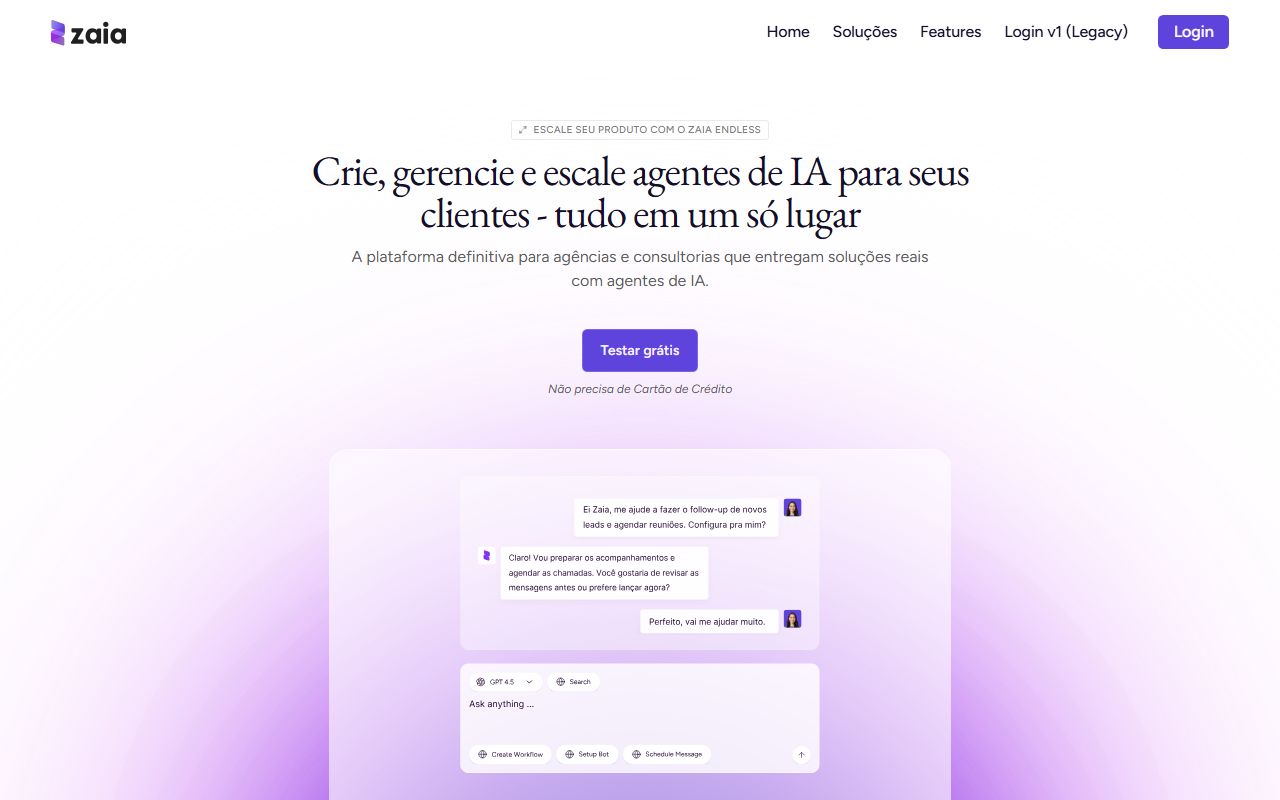
Upon visiting zaia.app, I was greeted by a clean landing page emphasizing the phrase “Agentic OS” – an operating system for AI agents. The site is primarily in Portuguese, hinting at its Brazilian roots, but the interface itself supports English. The call-to-action offers a free trial with no credit card required – a refreshingly low barrier for enterprise software. Unlike general-purpose AI-building tools like LangChain or Flowise, Zaia is laser-focused on the operational challenges that arise once you move past the prototype phase. The tagline “Construir agentes de IA é fácil. Escalar e manter dezenas deles não é” (Building AI agents is easy. Scaling and maintaining dozens of them is not) immediately resonated with me. It speaks directly to the pain of managing multiple agents, keeping track of costs, and ensuring integration without brittle workarounds.
Features and Capabilities: From Builder to Analytics
Zaia packs an impressive set of features under one roof. The Agentic Builder allows you to define agents with specific instructions and tools. Instead of treating each agent as an island, you can group them into Squads – teams with defined roles – enabling realistic multi-agent collaboration. The platform includes no-code Workflows, Knowledge Bases, and native MCP support for integrations. A standout is the integrated CRM & Human Handoff: conversations can flow seamlessly between AI and human agents, with full history preserved. This is rare in agentic frameworks, which often rely on external tools. On the analytics side, you get dashboards for usage per agent/squad, LLM consumption, and cost control. You bring your own API keys (OpenAI, Google), which helps predict expenses. I tested the free tier by creating a simple customer support agent and linking it to a WhatsApp channel. The setup was straightforward, and the ability to inspect every response for auditing is a serious plus for regulated industries.
Real-World Use Cases and Market Position
Zaia isn’t vaporware – the site showcases two compelling case studies. One involves Rede de Postos de Gasolina BR, where an AI agent acts as a “copilot” for 50,000 gas station attendants via WhatsApp, resulting in a 35% increase in training engagement and a 95% reduction in customer support calls. Another is with Rede Universitária Uniasselvi, focusing on B2E training and engagement. These examples demonstrate the platform’s ability to handle high-volume, real-world deployments. In the market, Zaia competes with broader agent frameworks like CrewAI and AutoGen, but sets itself apart by including CRM, cost management, and human handoff out of the box. It’s best suited for enterprises and consultancies that need to orchestrate dozens of agents across departments without juggling multiple external tools. However, the documentation and community support are currently heavily Portuguese-oriented, which may deter non-Lusophone users. Additionally, pricing is not publicly listed on the website; the free tier exists, but for scaling you’ll need to contact sales – a minor friction point.
Verdict: Who Should Use Zaia?
Zaia excels where other agent builders falter: operational control at scale. If you’ve already built agents but struggle with organization, cost unpredictability, or human handoffs, this platform is worth a serious look. It’s particularly compelling for businesses in Brazil or Latin America looking for localized support. For solo developers or those needing a simple chatbot, lighter tools like Tally or ManyChat might suffice. But for anyone building a multi-agent workforce, Zaia offers a cohesive environment that reduces complexity. The free tier is generous enough to evaluate its core capabilities. Given its proven track record with large deployments, I recommend giving it a test drive – you might find it cures your scaling headaches.
Visit Zaia at https://zaia.app to explore it yourself.













Comments