
First Impressions and Core Value Proposition
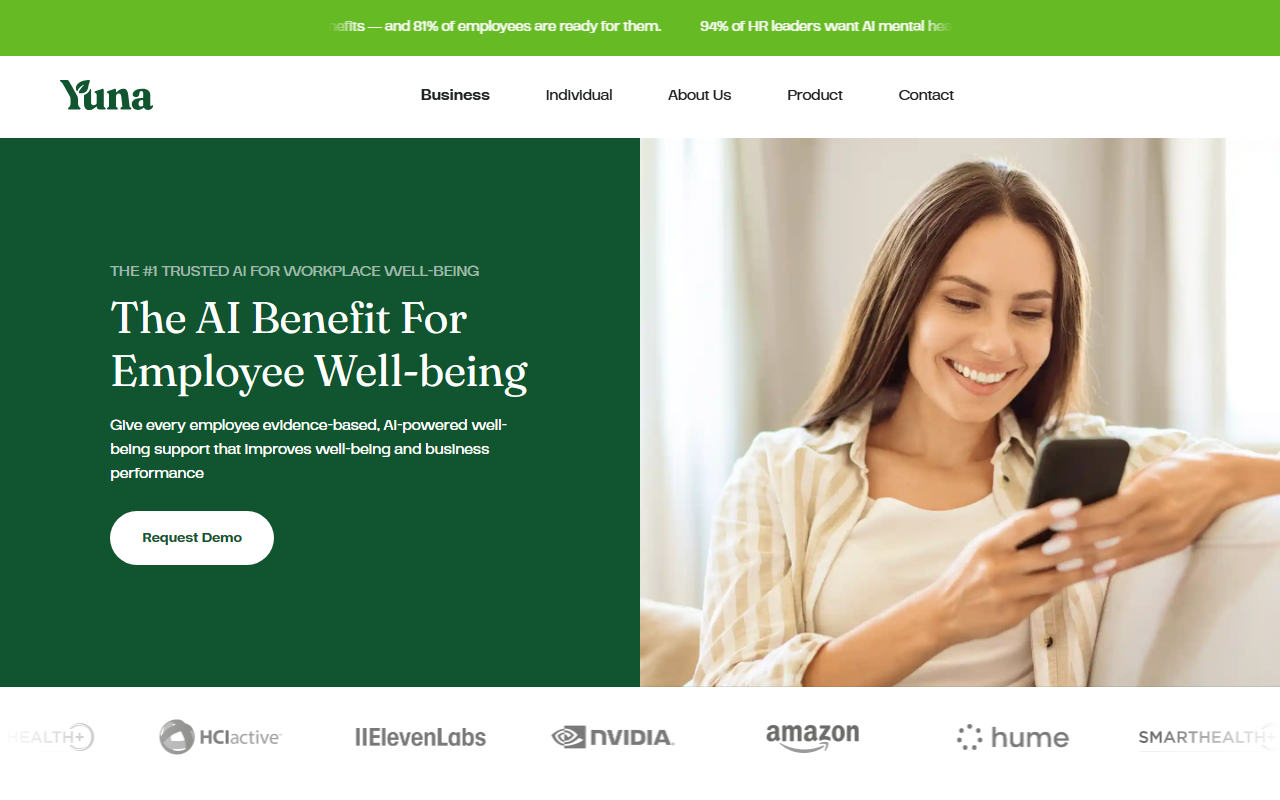
Upon visiting Yuna AI's website, the first thing that grabs you is the bold statistic: 94% of HR leaders want AI mental health benefits, and 81% of employees are ready for them. Yuna positions itself as the #1 trusted AI for workplace well-being, targeting a clear pain point—scaling mental health support without hiring more therapists. The platform promises evidence-based tools that decrease stress, enhance mood, and maximize professional performance. It’s not a therapy replacement but an AI coach that provides real-time, emotionally intelligent support. The call to action is a sales demo request, which immediately signals this is an enterprise product, not a consumer app. I clicked through the demo video and observed a clean chat interface where employees can push a button and start a conversation. There’s also a dashboard for HR to view aggregated sentiment trends without surveys.
Features and Clinical Backing
Yuna’s feature set is built around 24/7 access: voice or chat conversations, smart escalation triggers that detect signs of strain, wellness check-ins for daily mood tracking, and guided skills coaching using DBT-inspired sessions. The platform also includes an HR dashboard that shows real-time usage and well-being trends. What distinguishes Yuna from generic AI chatbots is its clinical foundation: the system was created by clinicians and researchers from institutions, though no specific names are listed. It claims to be the first AI platform for supportive well-being conversations at work. When testing the interface (via the demo), I noticed that the wellness feed personalizes support based on the user’s current mood. The technology appears to use natural language processing tailored for emotional intelligence, but the website does not specify the underlying model (e.g., GPT-4 or a proprietary LLM). There is no mention of an API for developers, which aligns with its focus on full-platform deployment rather than integration.
Privacy and Enterprise Focus
Privacy is a major selling point. Yuna is HIPAA compliant and SOC 2 Type II certified, and it explicitly states that individual conversations are not exposed to HR—only aggregated insights are shared. This is crucial for employee trust. The website notes interactions in over 155 countries and a 4.7/5 rating from thousands of users across industries. The company appears to have a B2B sales model; pricing is not publicly listed. Competitors in this space include BetterUp (human coaching + AI) and Woebot (AI therapy), but Yuna differentiates by targeting HR leaders directly and offering aggregated sentiment data without surveys. It has been showcased at major HR conferences like SHRM, HR Tech, and NAPEO. The biggest limitation for individual users is that this tool is not something you can just download—it requires an employer subscription. Additionally, the website notes it is not intended for individual employment decisions, which clarifies its purpose as a support tool rather than a diagnostic one.
Who Should Use Yuna AI?
Yuna AI is best suited for HR leaders and organizations with 500+ employees who want to proactively support workforce mental health at scale. It’s ideal for companies that value data privacy and want to reduce stress-related absenteeism. However, small businesses or individuals seeking personal mental health support should look elsewhere—there is no free tier or individual plan. Those expecting a clinical therapy session may be disappointed, as Yuna explicitly states it is an AI coach, not a live therapist. In my assessment, the tool’s strengths lie in its privacy-first design and evidence-based approach, but the lack of transparent pricing and limited accessibility (enterprise-only) are real drawbacks. If your company prioritizes employee well-being and has a budget for premium AI tools, Yuna is worth a demo. For everyone else, alternatives like Woebot (free consumer app) or BetterUp (human coaching) may be more appropriate.
Visit Yuna AI at https://yuna.io/ to explore it yourself.











Comments