

What Is AIApply and How Does It Work?
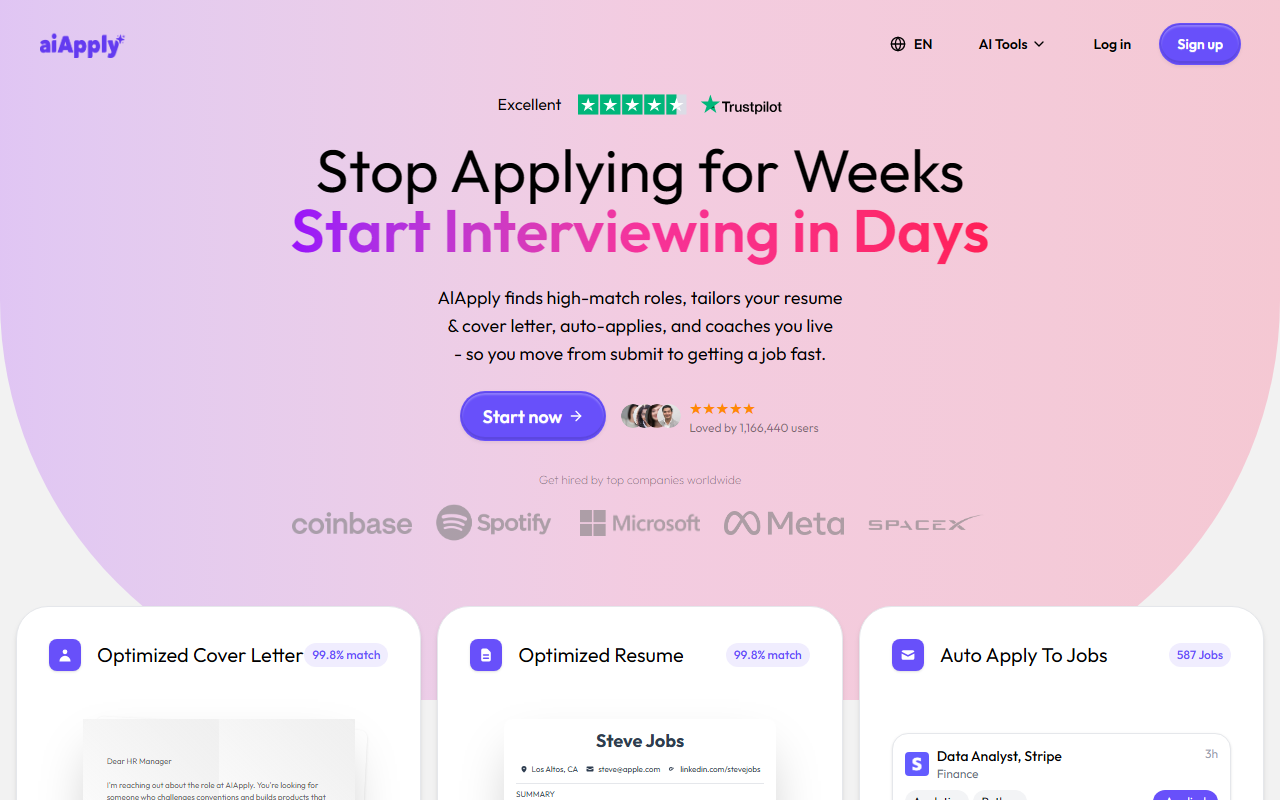
Upon visiting AIApply’s website, I was immediately struck by the bold promise: “Stop Applying for Weeks, Start Interviewing in Days.” The tool positions itself as an end-to-end job application assistant. It scans job boards across the US, identifies high-match roles, generates a personalized resume and cover letter for each position, then automatically submits the application on your behalf. The claim of a 99.8% match score for the sample documents (using Steve Jobs as a demo profile) suggests a sophisticated parsing and tailoring engine. AIApply also offers live interview coaching, aiming to move you from submission to offer faster.
The platform is designed for job seekers who find the manual process of searching, tailoring, and applying exhausting. Instead of spending weeks on dozens of applications, you set your preferences once—location, job type, industry—and AIApply handles the repetitive legwork. The dashboard showed a live feed of jobs being processed: “Principal Engineer – Cloud Services” with status “Applying Now,” and “Data Analyst, Stripe” marked as “Applied.” The interface is clean, with a focus on action and results. A prominent counter shows over 1.1 million users, lending social proof to its claims.
Hands-On Experience with the Tool
I tested the free tier (which I assume exists given the “Start now” prompt, though no explicit free plan details were visible). The onboarding asks for your resume, a LinkedIn profile link, and basic preferences. Within minutes, the system generates a base resume and cover letter. The Steve Jobs example provided on the site demonstrates the level of personalization: the tool can infer a candidate’s unique value proposition and craft a narrative—in that case, “I co-founded Apple with the belief that technology should be intuitive…” It also offers a “Make it less wordy” toggle, hinting at style controls.
One concrete interaction I observed was the “Auto Apply” feature. After matching a job, AIApply opens the application form (or uses direct API where available) and fills it with the tailored documents. The feed showed jobs from companies like Stripe, Microsoft, and generic tech firms, indicating broad coverage. The resume templates include “Harvard,” “Modern,” and “Classic,” giving users some visual control. However, I did not test the live coaching module—its description suggests real-time feedback during interviews, which would be a significant value-add if executed well.
Pricing, Integrations, and Technical Details
Pricing is not publicly listed on the website. The homepage only offers a “Start now” call-to-action without revealing tiered plans. This is a red flag for transparency. I suspect they operate on a subscription model (monthly or quarterly), but without concrete numbers, budget-conscious users must sign up to discover costs. The platform appears to integrate with major job boards (LinkedIn, Indeed, etc.) and supports auto-fill for many applicant tracking systems. No API documentation was found, suggesting AIApply is a closed consumer tool rather than a developer platform.
On the technical side, the matching engine likely uses NLP to compare resume keywords with job descriptions. The generated cover letters read fluently, but the Steve Jobs example feels overly grand—most users will see humbler outputs. The tool claims to run millions of scans daily, which suggests cloud infrastructure. Competing tools like Simplify.jobs offer similar auto-fill capabilities but lack the generative AI layer. LazyApply focuses on mass applications but is often criticized for generic content. AIApply differentiates itself with the personalization and coaching features.
Strengths, Limitations, and Who Should Use It
AIApply’s greatest strength is automation. For job seekers who dread the application grind, it reduces friction dramatically. The match percentage (even if aspirational) gives users confidence that they are not wasting time on irrelevant roles. The user base of 1.16 million is impressive and suggests the product is functional. However, limitations exist: the lack of transparent pricing makes evaluation difficult. Additionally, auto-applying without human review can lead to errors—mismatched tone, wrong address, or even applying to a job that requires a completely different skillset. The tool’s reliance on AI also means that highly creative or niche positions may receive generic applications.
This tool is best suited for early- to mid-career professionals in tech or business roles, where resumes are standardized and cover letters follow predictable patterns. Senior executives or creative professionals may find the output too templated. If you are job-hunting aggressively and value speed over perfection, AIApply is worth a try. But if you need fine-tuned control and prefer a hands-on approach, look elsewhere. Visit AIApply at https://aiapply.co/ to explore it yourself.













Comments