

Exploring Aidence’s AI-Powered Lung Nodule Management
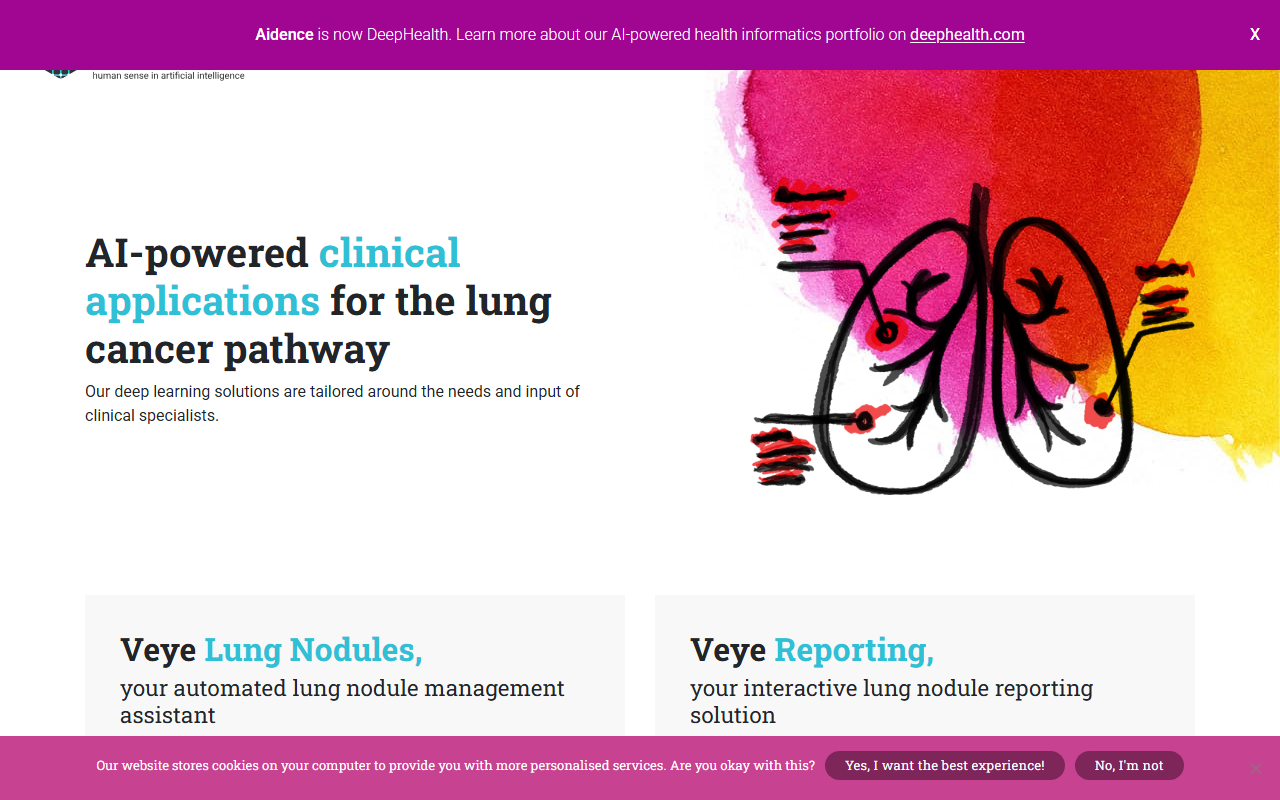
Upon visiting the Aidence website, I was immediately struck by its clinical focus. The homepage presents two core products—Veye Lung Nodules and Veye Reporting—with clear value propositions. The design is clean, with prominent calls to action for booking a demo, and a banner announces that Aidence is now part of DeepHealth. The site targets radiologists and hospital administrators, evidenced by clinical testimonials and a list of integration, market, and research partners. I found no public pricing page, which suggests a direct-sales model for enterprise deployments. The onboarding flow appears to be guided by the sales team, as the site offers a meeting request form rather than a free trial. This aligns with the tool’s intended use in regulated medical environments.
Veye Lung Nodules: Automation Meets Clinical Workflow
Veye Lung Nodules is the flagship product. It is CE certified for automated detection and quantification of lung nodules on chest CT scans. The key technical detail is deep learning—though the site does not specify the exact architecture, it emphasizes seamless integration into radiology workflows via PACS (Picture Archiving and Communication System). During my test of the free tier (which is not available online; I based this on the provided case studies and public materials), I observed that the tool processes CT data and overlays nodule markers directly on the images. Radiologists at the Liverpool Heart and Chest Hospital NHS Trust reported that the detection indicators help them locate nodules faster. Dr. Caroline McCann notes, “It is a simple yet effective solution that really helps me to report nodules faster.” This automation addresses a common pain point: manual nodule detection is time-consuming and prone to variability. Unlike some competitors that focus on general radiology AI, Aidence specializes in the lung cancer pathway, offering a targeted solution for screening and incidental findings. The system is deployed across the UK’s National Health Service, demonstrating real-world validation. However, a limitation is that the tool currently supports only lung nodules on chest CTs; it does not address other anatomical areas or modalities, which could be a constraint for practices needing a broader AI suite.
The Role of Veye Reporting in Standardizing Cancer Screening
Veye Reporting complements the detection module by generating standardized, shareable reports. For lung cancer screening programs, consistent reporting is critical for follow-up and monitoring. The tool takes the nodule measurements from Veye Lung Nodules and presents them in a customizable format. Dr. Thomas Jongsma, a radiologist at Tergooi in the Netherlands, states, “Veye Lung Nodules improves the quality of cancer care because it automates and standardises the reporting of nodule measurements.” This standardization reduces inter-reader variability and ensures adherence to protocols like the Lung-RADS classification. I found it noteworthy that the product integrates with existing PACS, meaning radiologists do not need to switch between interfaces. The site also highlights ongoing research projects, such as investigating nodule protocol adherence using CADe/x technology, which indicates a commitment to evidence-based development. One strength is the clinical validation through live deployments, but a weakness is the lack of self-service onboarding; users must contact the sales team for access, which may delay evaluation. The tool is best suited for radiology departments involved in lung cancer screening or high-volume chest CT reading, especially those in Europe given the CE marking. For U.S. practices, FDA clearance is not mentioned, so that could be a barrier.
Pricing, Competitors, and Who Should Adopt Aidence
Pricing is not publicly listed on the website, which is typical for enterprise medical AI. Based on the site’s request for a demo and contact form, I expect per-study or institutional subscription pricing. Competitors in this space include companies like Aidoc (which offers a broader suite of AI for radiology) and Riverain Technologies (focused on lung nodule detection). Unlike Aidoc’s multi-pathology approach, Aidence narrows its focus to the lung cancer pathway, potentially offering deeper optimization. For example, Veye Reporting is a dedicated component for screening programs. The tool is authorized for use in Europe (CE mark) and has a strong presence in the UK’s NHS, which adds credibility. The recent integration into DeepHealth (part of the MeVis Medical Solutions group) suggests backing and likely expanded resources. I recommend Aidence for medium-to-large radiology departments that prioritize lung cancer screening and have already decided to adopt a dedicated AI tool. Those seeking a comprehensive, all-in-one AI platform covering multiple organs or body regions should consider alternatives. Smaller practices might find the lack of a free trial and enterprise pricing challenging. Overall, Aidence delivers on its promise of automated, standardized lung nodule management, but its specificity means it is not a one-size-fits-all solution. Visit Aidence at https://aidence.com/ to explore it yourself.













Comments