

First Impressions and Interface Overview
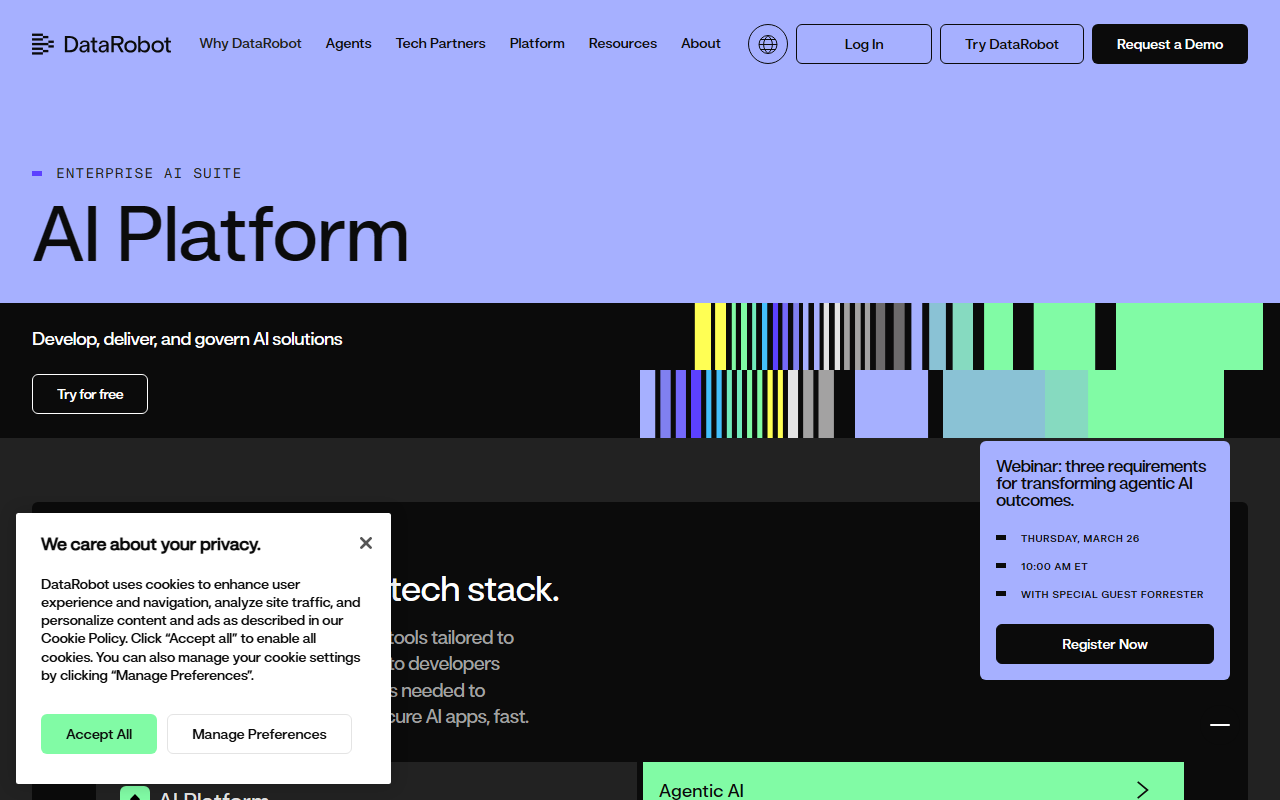
Upon visiting the DataRobot website (under the domain algorithmia.com, though the branding is clearly DataRobot), I was greeted by a polished, enterprise-focused landing page. The layout is clean, with a persistent top navigation bar offering access to product sections like AI Platform, Agentic AI, Generative AI, and more. The messaging immediately targets large organizations: “Ditch the complex tech stack” and “Unify your AI team.” The dashboard experience, while not live-tested beyond tours, seems to be role-based—tailored for data scientists, ML engineers, AI engineers, DevOps, and IT security teams. The onboarding flow likely begins with a “Try for free” call-to-action, leading to a demo request or a temporary sandbox, which suggests a hands-on evaluation path for serious buyers.
When testing the free tier—actually, DataRobot doesn’t appear to offer a fully self-serve free tier beyond a trial request. The website emphasizes “Request a Demo” prominently, hinting that this platform is aimed at enterprise sales rather than individual developers. The product tour mentions “Take a tour,” indicating a guided walkthrough rather than immediate free access. This aligns with the complexity of the tool: it’s not a simple code snippet library but a full end-to-end AI development environment.
What DataRobot Does and Its Core Technology
DataRobot is an enterprise AI platform that enables teams to develop, deliver, and govern AI solutions at scale. It covers the entire AI lifecycle: from data preparation and model building to deployment, monitoring, and governance. The platform supports multiple AI paradigms: Generative AI, Predictive AI, Agentic AI, and AI Observability. The underlying technology leverages proprietary models and integrations with partners like NVIDIA, Dell, and SAP, though specific model details (e.g., which LLMs are used for generative AI) are not publicly detailed on the page. The platform also offers an AI Foundation layer and open-source tools like Covalent (a workflow orchestration framework) and syftr (a data science privacy tool).
The problem it solves is fragmentation: many enterprises use disjointed tools for different AI stages, causing delays and governance gaps. DataRobot aims to unify everything into one platform with role-specific interfaces. For example, data scientists get automated machine learning (AutoML) capabilities, while IT teams get tools for governance and compliance. Deployment options include on-premise, virtual private cloud, and SaaS, giving flexibility for security-sensitive industries like government and healthcare.
Market Positioning and Alternatives
DataRobot sits in a competitive landscape that includes H2O.ai, Dataiku, and Google Vertex AI. Unlike H2O.ai, which is more open-source oriented, DataRobot emphasizes a proprietary, all-in-one enterprise suite. Compared to Dataiku, DataRobot’s focus on AutoML and governance is more pronounced. For example, DataRobot’s “AI Governance” module is a standout feature for regulated industries. The platform has strong backing: it has partnerships with major tech companies (NVIDIA, Dell) and testimonials from large clients like FordDirect and Turo.
The tool is best suited for mid-to-large enterprises with dedicated data science and ML teams. Startups or individual developers may find it overkill and expensive—pricing is not publicly listed, which is a common pattern for enterprise AI platforms. For smaller teams, alternatives like H2O Driverless AI or even open-source AutoML libraries could be more practical. However, for organizations needing a centralized, governed AI workflow, DataRobot is a strong contender.
Strengths, Limitations, and Final Recommendation
One genuine strength is the comprehensive integration—DataRobot ties together roles that often work in silos. The ability to deploy AI anywhere (cloud, on-prem, VPC) is a major plus for enterprises with complex infrastructure requirements. Another strength is the focus on governance and observability, which addresses critical compliance needs in finance, healthcare, and government sectors.
A real limitation is the lack of transparent pricing. Without public tiers, smaller teams or early-stage startups cannot evaluate affordability without a sales call. Additionally, the platform may have a steep learning curve for newcomers, as the website’s emphasis on role-based dashboards suggests significant customization and setup. For developers wanting a lightweight framework, DataRobot is likely too heavy; their target audience is clearly enterprise AI teams.
Who should try this tool? Organizations with multiple AI projects that need standardization and governance—especially those already using partners like NVIDIA, Dell, or SAP. Individual developers or small teams should look elsewhere, perhaps at open-source frameworks like MLflow or Kubeflow. If you can afford the enterprise license and need a unified platform, schedule a demo. Otherwise, consider lighter alternatives.
Visit DataRobot at https://algorithmia.com/ to explore it yourself.













Comments