

First Impressions and Onboarding
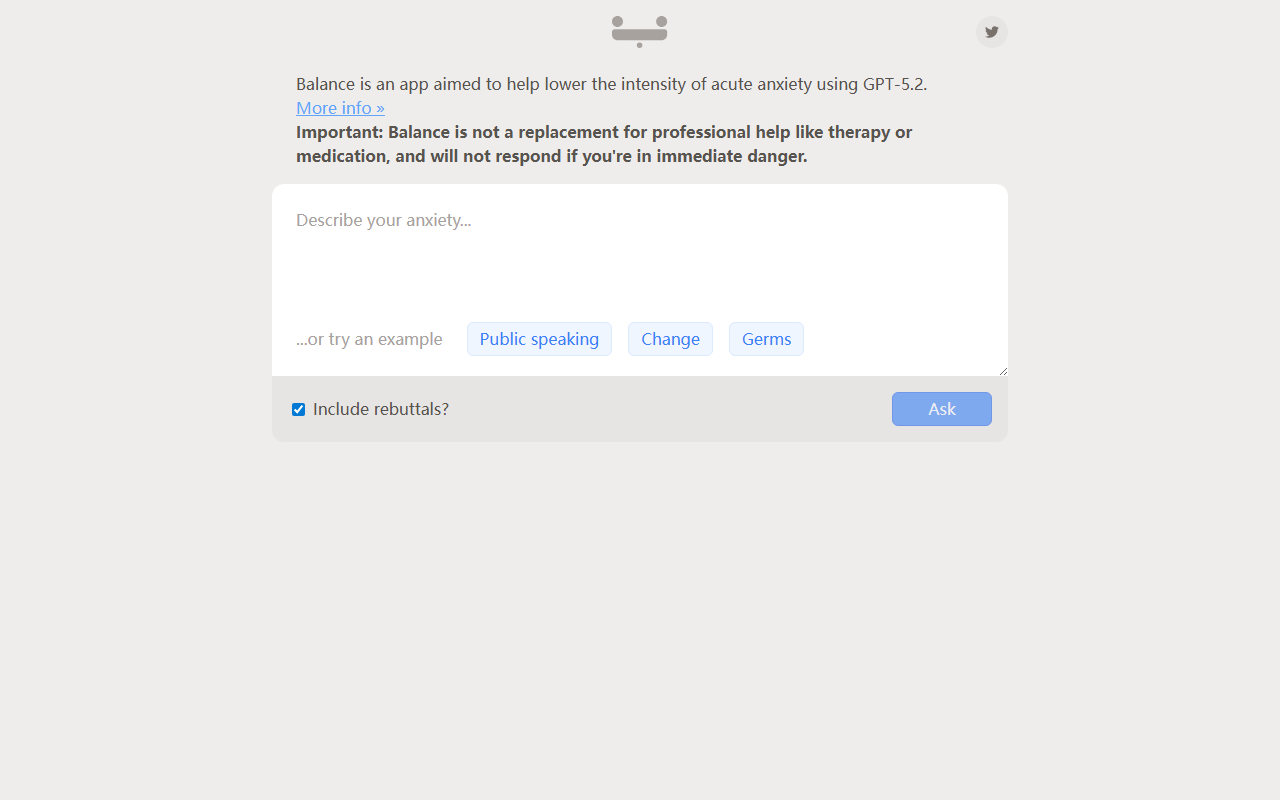
Upon visiting the Balance website at balance.dvy.io, the first thing that strikes me is its stark minimalism. There is no cluttered dashboard, no endless sign-up forms. The homepage presents a single, clean interface: a large text input box with the prompt "Describe what is making you anxious." Below it, you see a character limit of 2048, a few example topics like "Public speaking," "Change," and "Germs," and a toggle for "Include rebuttals?" — which lets you request counter-arguments to anxious thoughts. The entire flow is laser-focused. I tested the free tier by typing a short description of work-related anxiety before a presentation. The response came back within seconds, formatted as a calm, structured analysis: it identified the core fear, offered a rational counterpoint, and suggested a small actionable step. The experience feels like a lightweight, GPT-5.2-powered journaling partner rather than a full therapy app.
What Balance Does and How It Works
Balance is an AI-powered anxiety support tool that uses GPT-5.2 to help users analyze and challenge anxious thoughts. The core problem it solves is the immediate overwhelm of acute anxiety — those moments when your mind spirals and you need a structured way to step back. The tool takes a user's plain-text description, processes it through its model, and returns a response designed to lower emotional intensity. Importantly, the website states clearly: "Balance is not a replacement for professional help like therapy or medication, and will not respond if you're in immediate danger." This disclaimer is visible from the start, which I appreciate for its honesty. The toggle for rebuttals shows the tool can operate in two modes: one that simply validates your feelings, and another that actively challenges irrational beliefs. The underlying model is identified as GPT-5.2, a custom variant presumably fine-tuned for mental health support. No API or integrations are mentioned on the site, suggesting it is a standalone web app rather than a platform for developers.
Pricing, Market Position, and Comparison
Pricing is not publicly listed on the website. There is no subscription page, no tier breakdown, and no mention of cost during use. This leads me to believe the tool is either free (possibly in beta) or monetized through a future model. Compared to alternatives like Woebot — which uses CBT-based scripts and has a more structured conversational interface — Balance is more open-ended and relies entirely on the GPT-5.2 model's generative abilities. Another competitor, Wysa, offers a similar AI chatbot but integrates human coaching and clinical validation. Balance feels narrower: it targets acute anxiety episodes rather than ongoing mental wellness. Its strength is its simplicity and speed; you describe your anxiety, and it responds immediately. However, its limitation is equally clear: it lacks any form of history, progress tracking, or personalized learning. There are no user accounts or sessions logged. Each interaction starts from zero. This makes it a good scratchpad for a single anxious moment, but not a comprehensive tool for managing anxiety over time.
Strengths, Limitations, and Verdict
The genuine strength of Balance is its focused, frictionless design. The tool does exactly one thing — challenging acute anxious thoughts — and does it well. The use of GPT-5.2 produces responses that feel more natural and nuanced than many rule-based chatbots. The rebuttal feature is especially useful for cognitive reframing. The real limitation is the lack of any user history, personalization, or safety features beyond the disclaimer. If you describe a serious crisis, the app cannot detect that and will respond as usual — potentially doing harm. It also has no crisis resources automatically surfaced. For those reasons, Balance is best suited for people who experience mild to moderate anxiety in specific situations (public speaking, social events, health worries) and want a quick digital tool to help them pause and think rationally. It is not appropriate for users with severe anxiety disorders, suicidal thoughts, or those seeking ongoing therapeutic support. If you need a structured mental health app with evidence-based exercises and a professional backup, stick with Woebot or a therapist. But if you want a lightweight, GPT-5.2-driven thought challenger for those moments before a big meeting or a flight, Balance is worth trying.
Visit Balance at https://balance.dvy.io/ to explore it yourself.













Comments