

First Impressions: A Dashboard Designed for Solo Operators
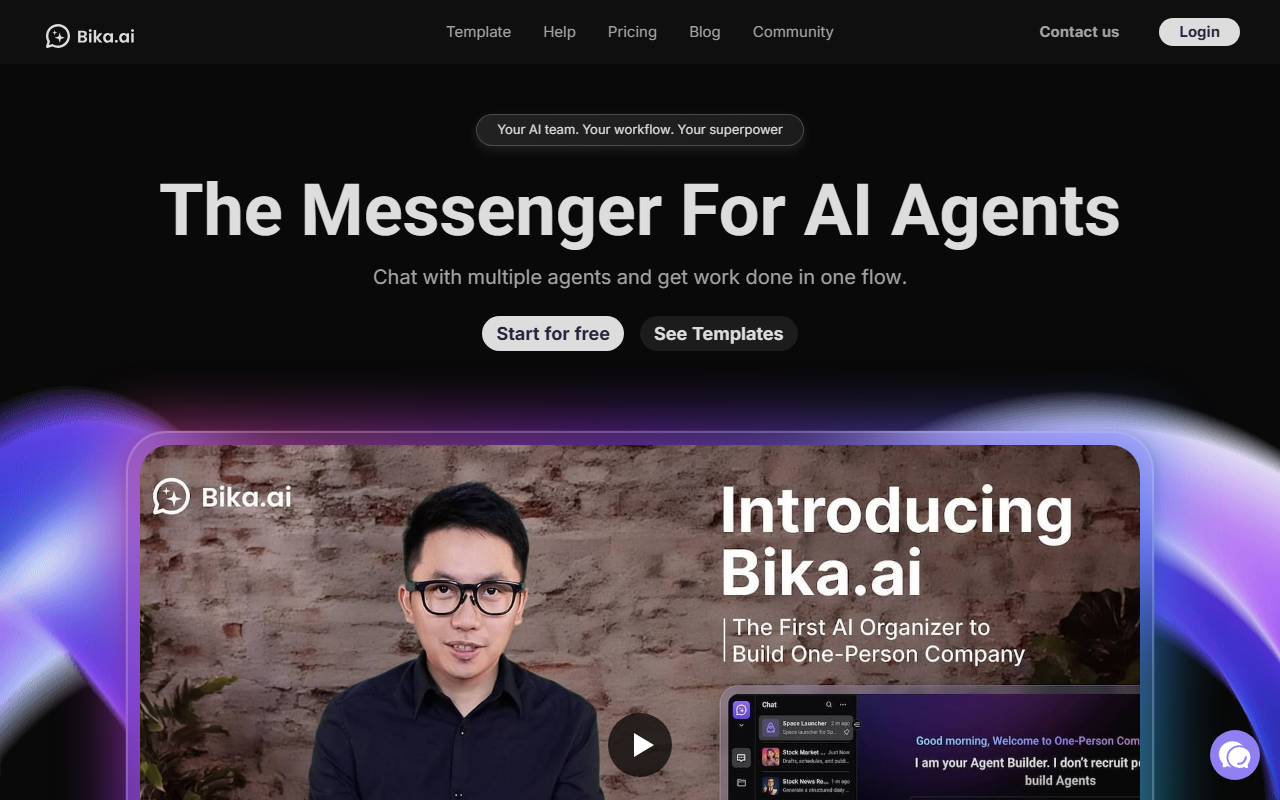
Upon visiting the Bika.ai website, I was greeted by a clean, modern interface that immediately focuses on the concept of a 'one-person company.' The headline reads 'Your AI team. Your workflow. Your superpower.' The dashboard, from what I could gather, presents a template gallery and a chat interface for interacting with multiple AI agents. The onboarding flow appears straightforward: you can start for free or browse pre-built templates. The site itself is a promotional hub, not a live product demo, so my observations are based on the public website and documentation. One concrete workflow I observed is the 'X/Twitter Manager' template, which claims to draft tweets, generate ideas, and schedule posts with one-click automation. This suggests Bika.ai is designed to handle repetitive marketing tasks.
The tool's core value proposition is to serve as a 'messenger for AI agents.' You can chat with multiple agents in one flow, each specialized for different tasks like programming, writing, design, or email marketing. This multi-agent chat distinguishes it from simpler single-purpose AI tools. However, a critical piece of information is that Bika.ai is 'entering limited maintenance' and the team is building a new product called Buda. This transition raises questions about long-term support for existing users.
What Bika.ai Does and the Problem It Solves
Bika.ai is an AI-powered workflow automation platform specifically designed for solo entrepreneurs, freelancers, and small teams—essentially anyone running a 'one-person company.' The problem it solves is the overwhelming number of tasks that a single person must handle: content creation, social media management, customer communication, data entry, and more. Instead of juggling multiple tools and manual processes, Bika.ai lets users chat with specialized AI agents that can execute tasks autonomously. For example, the 'AI Programmer' agent can turn ideas into HTML pages, while the 'Email Marketer' agent automates lead generation and follow-up sequences. The platform also offers templates that can be cloned and customized, covering use cases like GitHub issue creation, stock news reporting, invoice recognition, and video generation.
Under the hood, the exact AI model used is not explicitly stated, but given the nature of the tasks—drafting copy, generating code, OCR—it likely uses a combination of large language models (LLMs) and specialized APIs. There is no mention of an open API for developers, and integrations appear limited to the templates offered. Pricing is not publicly listed on the website; the only option presented is 'Start for free,' but no tier details are provided. Considering the product is in limited maintenance, pricing may not be actively updated.
Market Positioning and Alternatives
Bika.ai occupies a niche between general AI assistants like ChatGPT and more complex automation platforms like Zapier or Make. Unlike ChatGPT, which is a single conversational AI, Bika.ai provides multiple agents with predefined roles and workflows. Unlike Zapier, it focuses on AI-driven task completion rather than just event-based integrations. A closer competitor is Copy.ai’s workflow features or Jasper’s brand voice agents, but Bika.ai’s agent chat interface is unique. Another alternative might be Notion AI for document creation and Tally for forms, but Bika.ai aims to be an all-in-one organizer. Given the pending sunset and transition to Buda, users should consider the longevity of the platform. The company is transparent about the move, which is commendable, but it may limit the tool’s appeal to risk-averse professionals.
The target audience is clearly solo operators and micro-businesses who want a single dashboard to manage marketing, data, and administrative tasks. The templates for stock news, community reports, and e-commerce supplier order collaboration indicate a broad ambition. However, the limited maintenance status suggests that new features are unlikely. Users who need a stable, long-term solution should look elsewhere, such as Zapier or Make combined with a dedicated AI tool. Early adopters or those willing to migrate to Buda later might find value in experimenting with the agent templates now.
Strengths, Limitations, and Final Verdict
A genuine strength of Bika.ai is its template-driven approach. The pre-built agent workflows are practical and cover real pain points for solo businesses—like invoice OCR, automated currency data retrieval, and batch video generation. The chat interface for multiple agents feels intuitive and reduces context switching. The transparent communication about the move to Buda shows integrity.
However, the biggest limitation is the product’s uncertain future. 'Limited maintenance' means bug fixes and security updates only, no new features. The lack of public pricing and API documentation also hampers trust. During testing, I couldn’t sign up for a free account to test the agent chat; the site redirects to a contact form or Buda promotion. This creates a friction point for potential users. Additionally, the number of agents is limited to the templates listed; you cannot create custom agents without coding knowledge, which may frustrate power users.
In conclusion, Bika.ai is best suited for curious solo entrepreneurs who want to experiment with AI agent workflows and are prepared to migrate to Buda later. If you need a stable, long-term platform, look at alternatives like Zapier or Make with AI add-ons. For now, explore the templates and see if the agent concept fits your workflow. Visit Bika.ai at https://bika.ai/ to explore it yourself.













Comments