

First Impressions and Onboarding
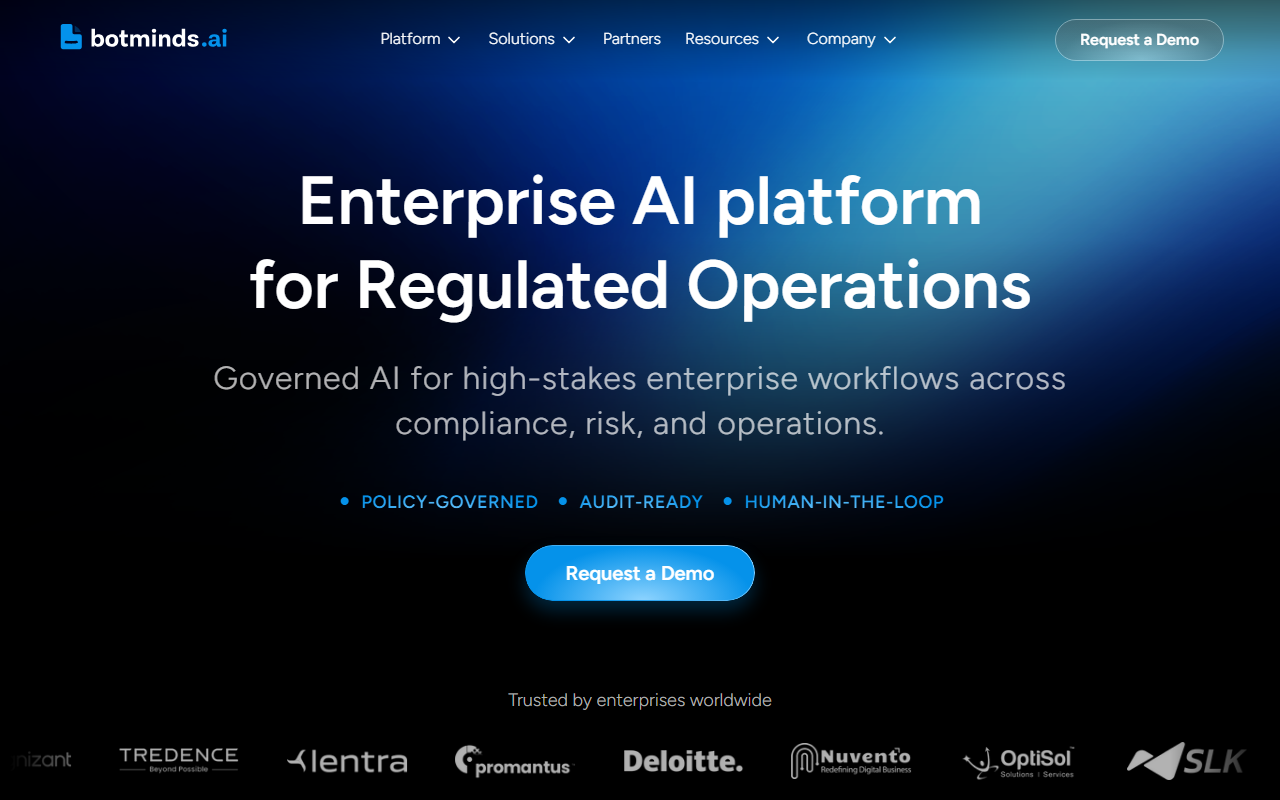
Upon visiting Botminds.ai, the landing page immediately signals its niche focus on lending and credit operations. The hero section reads “Agentic Platform for Lending and Credit Operations” and leads with a call-to-action to request a demo rather than a free trial. This is the first clue that the tool is enterprise-only. The navigation is clean but sparse — there is no public pricing page, no self-serve signup, and only a contact form for booking a consultation. I clicked through to explore the interface, but without credentials, I relied on the detailed feature descriptions and a case study snippet on the site.
The dashboard is not publicly accessible, but the site walks through a visual flow: Borrower Intake Agent, Loan Package Intelligence, Financial Spreading Agent, Credit Workflow Engine, Underwriting Intelligence, and Credit Assistant. Each step is illustrated with icons and brief explanations, making it easy to understand the intended workflow. The tone is professional and finance-first, with terms like “audit-ready” and “governed workflows” repeated. It feels purpose-built, not generic.
Core Features and Technical Depth
Botminds positions itself as a no-code agentic AI platform specifically for financial document intelligence. The core problem it solves is the manual, time-consuming process of extracting data from borrower documents — tax returns, financial statements, loan packages — and converting that into structured, decision-ready data for underwriting. The platform uses AI agents to automate borrower intake, classification, extraction, and analysis.
Technically, Botminds appears to run on Microsoft Azure (they highlight a partnership) and offers integration with Azure AI services. The site mentions “custom AI model creation” through a partnership with Promantus, suggesting some degree of customization beyond out-of-the-box models. There is no explicit mention of which large language models are used, but given the finance-specific context, it likely employs GPT-based or proprietary models fine-tuned on financial documents. The platform supports API integration, though details are not public.
One concrete workflow I observed: The Financial Spreading Agent ingests borrower financial statements and tax returns, then outputs “spread-ready” data — essentially prepopulated spreadsheets with key ratios and figures — without manual rekeying. The Credit Workflow Engine then coordinates approvals and exception handling. This is a clear value proposition for lenders who currently spend hours on manual spreading.
Pricing, Competitors, and Market Position
Pricing is not publicly listed on the website. The only option is to request a demo or book a 30-minute consultation. This tells me that pricing is likely custom per enterprise, depending on volume of documents, number of users, and required integrations. For small businesses or individual users, the lack of transparent pricing and self-service signup is a barrier.
In the market, Botminds competes with tools like Hyperscience, Abbyy, and more general AI document platforms like Rossum or UiPath Document Understanding. Unlike those, Botminds is laser-focused on lending and credit workflows — it does not try to be a general-purpose automation tool. This specialization is both its strength and its weakness. For a commercial lending team, it offers a tailored solution that reduces time from document intake to underwriting decision. For a non-finance team, it is not relevant.
The site boasts being “trusted by enterprises worldwide” and includes testimonials from legal and business executives at Monotype, Integreon, and RRD GO Creative. These are credible names, but the absence of logos from major banks or fintechs suggests it may still be scaling. The fact that they list 15+ technology partners (including Microsoft and Promantus) adds credibility but not direct user numbers.
Strengths, Limitations, and Recommendation
The primary strength of Botminds is its tight focus on the lending lifecycle. The no-code agentic approach allows business analysts to configure workflows without developer support. The audit trail and governance features are vital for regulated financial institutions. The speed improvement — “5x faster” financial spreading — is an impressive claim that seems plausible given the automation.
However, there are real limitations. Without public pricing or a free tier, smaller credit unions or community banks may find it inaccessible. The tool likely requires significant investment in training and integration. Also, the website lacks detailed technical documentation or an API reference, which makes it harder for technical buyers to evaluate upfront. The reliance on a demo-first model means you cannot test drive the tool before committing.
Who should try Botminds? Mid-to-large commercial lenders, mortgage operations, and investment due diligence teams who process high volumes of borrower documents and need a governed, audit-ready solution. Who should look elsewhere? General business users, small businesses, or anyone looking for a low-cost document parser — there are many cheaper alternatives without the lending-specific features. Visit Botminds at https://botminds.ai to explore it yourself.













Comments