

Build or Skip Review: Finding Products That Already Make Money
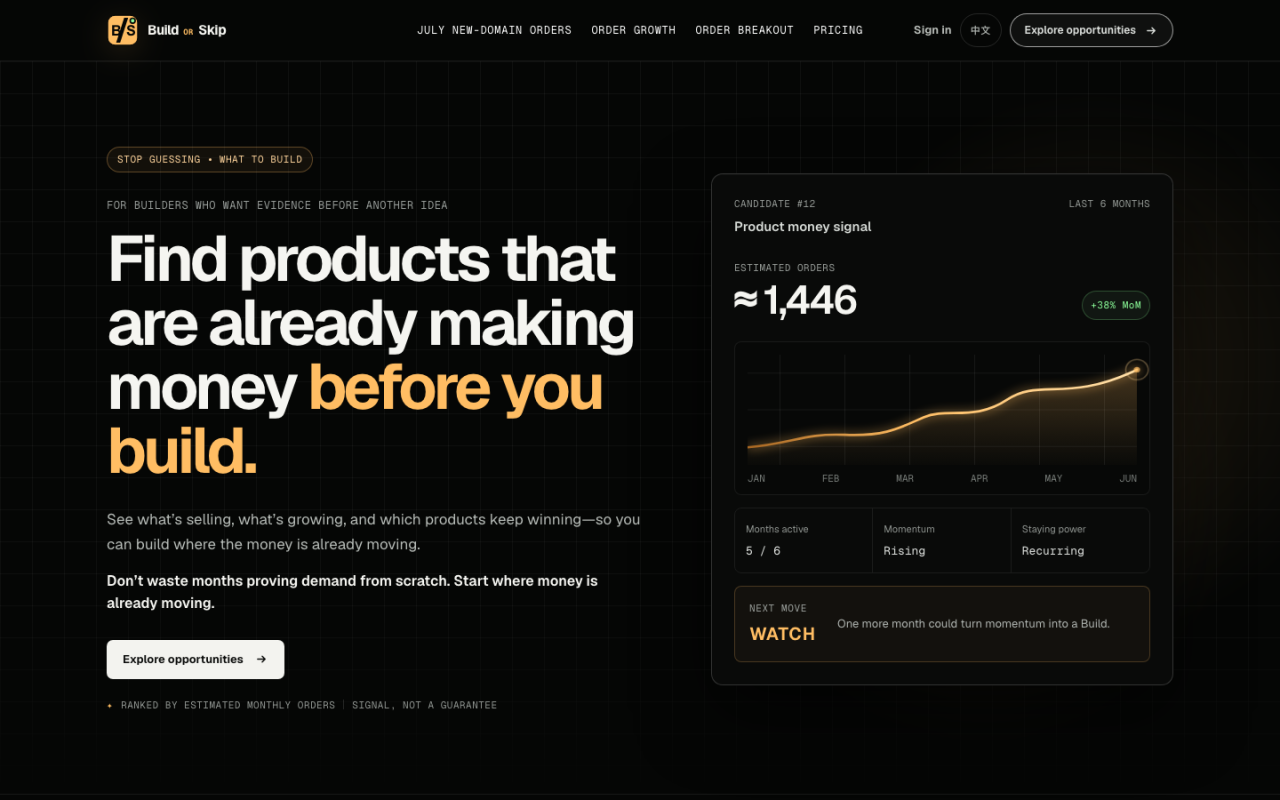
Upon visiting Build or Skip at buildorskip.dev, the pitch lands before you have time to scroll: stop guessing what to build, and start where money is already moving. The site positions itself as a product opportunity research tool for indie developers, small startup teams, and website owners who would rather validate demand with evidence than spend three months building something nobody pays for. Underneath the bold headline sits a live dashboard of numbers — payment signals, domain ages, domain rating scores, and monthly momentum — that I spent time clicking through to understand exactly what is being measured and what is being inferred.
What Build or Skip Actually Does
Build or Skip is a research layer, not a product database with verified financials. The company is explicit about this: what it calls payment signals are traffic estimates, not verified orders, revenue, or customer counts, and revenue rankings follow calendar-month reporting rather than real-time checkout data. What the platform does is pull together several distinct datasets — newly registered domains that show payment activity, product-level revenue rankings you can filter by category, payment channel, domain rating and registration date, public Buy Me a Coffee tip totals with six-month amount trends, and two curated backlink libraries. On the homepage, the counters read roughly 130,000 money-making sites tracked, more than 6,000 AI tool sites, 300-plus Buy Me a Coffee sites, and 200-plus entries in both the comment and AI tool backlink libraries, all continuously updated.
The practical workflow is a three-step funnel the site labels Signal to Decision: find opportunities showing observable payment signals, read the trend by comparing scale, growth, and persistence, then make the call — Build, Watch, or Skip. It is a disciplined framing that pushes you away from the big-idea instinct and toward ranking pages you can actually interrogate.
Inside the Dashboard: What I Saw When I Tested It
When I opened the ranking preview, the default view was the August 2026 New Site Revenue Ranking, listing 185 sites for that month with an updated date of September 8, 2026. The table is dense in a good way: rank, favicon, domain, DR, domain creation date, estimated payment signals, supported payment channels such as Stripe, Dodo Payments, and Polar, plus primary and secondary categories, product type, and capability tags. Sorting and filtering dimensions are visible but locked behind the paid tier on the free preview.
The top of the board was a snapshot of the current pay-to-rank micro-economy. Outbid.lol held first place with a domain registered August 19, 2026 and an estimated 14K+ signal, followed by a Hungarian-language eyewear shop on Stripe at 7.4K+, then topfloor.company — a leaderboard where companies pay to outrank competitors, with no votes or algorithm involved — at 1.7K+. Rounding out the top ten were mocklive.ai, a voice-driven interview and negotiation simulator, several bid-leaderboard and pay-to-rank directories, and milliondollarsaas.club. The recurring pattern is unmistakable: cheap-to-launch, payment-native web apps that monetize attention or placement directly.
One honest observation: several DR values render oddly, including a striking -74 next to the top-ranked domain. It reads like a data artifact rather than a genuine authority score, and it is a reminder that these are third-party estimates assembled from multiple sources, not audited numbers. Registration dates also come from RDAP records, which the site correctly notes do not establish an actual launch date.
Pricing: What Build or Skip Costs
Pricing is publicly listed and refreshingly simple. There is a Free Preview tier that lets you browse before committing, and Pro Monthly at $19 per month. The Pro Yearly plan works out to $15.83 per month, billed as $190 yearly, which effectively gives you two months free. A banner warns that Standard Pro pricing will increase after the next feature release, so early subscribers lock in today's rate.
Both paid tiers unlock the same feature set: every published revenue ranking, the full tip revenue ranking, the complete comment backlink library, the complete AI tool backlink library, every filtering and sorting dimension, unlimited API queries for DR, registration, traffic and site data, unlimited MCP calls, and access to a VIP member community. Prices are in USD. There is no publicly listed enterprise or team plan, and the site does not spell out a refund policy.
API, MCP Access, and Data Freshness
Two integration paths stand out. The API lets you query domain rating, domain registration, monthly traffic, and structured homepage data through a single account, which makes it feasible to pipe Build or Skip signals into your own scoring spreadsheet or internal vetting tool. The MCP endpoint goes further for anyone working inside an AI client: it exposes a dataset catalog, product discovery, site snapshots, and usage checks, so an assistant can pull candidate lists and site context directly into a research conversation.
Data freshness is handled honestly and unevenly by design. Revenue rankings follow calendar-month reporting; comment and AI tool backlink resources update daily; other site attributes display their own relevant date on the page. If you need same-day revenue truth, this is not that product. The practical implication is that Build or Skip is a monthly cadence tool rather than a live ticker — you check in, review what changed, and move on.
Who Build or Skip Is For — and Its Honest Limitations
The competitive frame is clear enough. Ahrefs and Semrush remain the deeper backlink and DR platforms, but they are built for SEO analysis rather than product-opportunity hunting. Exploding Topics and Product Hunt surface momentum in categories, yet neither puts payment-channel evidence and Buy Me a Coffee tipping behavior next to domain age in one ranked table. Build or Skip's niche is the overlap: a vetting layer for people deciding what to ship next.
Best suited for indie hackers, micro-SaaS builders, directory and leaderboard operators, domain investors, and SEOs who want a monthly list of newly registered domains already showing payment activity. Look elsewhere if you need verified revenue, audited financials, or enterprise-grade market sizing — the platform itself warns that signals are research inputs, not confirmed orders. The small-but-real friction points are the occasional odd DR value, the locked filters on the free tier, and the fact that a $19 monthly commitment only pays off if you genuinely act on the data.
The free preview is the honest test. If you find yourself opening three or four candidate domains and digging into their categories and payment channels, the Pro tier earns its keep quickly. If you want someone to hand you a finished idea, Build or Skip will only hand you evidence.
Visit Build or Skip at https://buildorskip.dev to explore it yourself.













Comments