
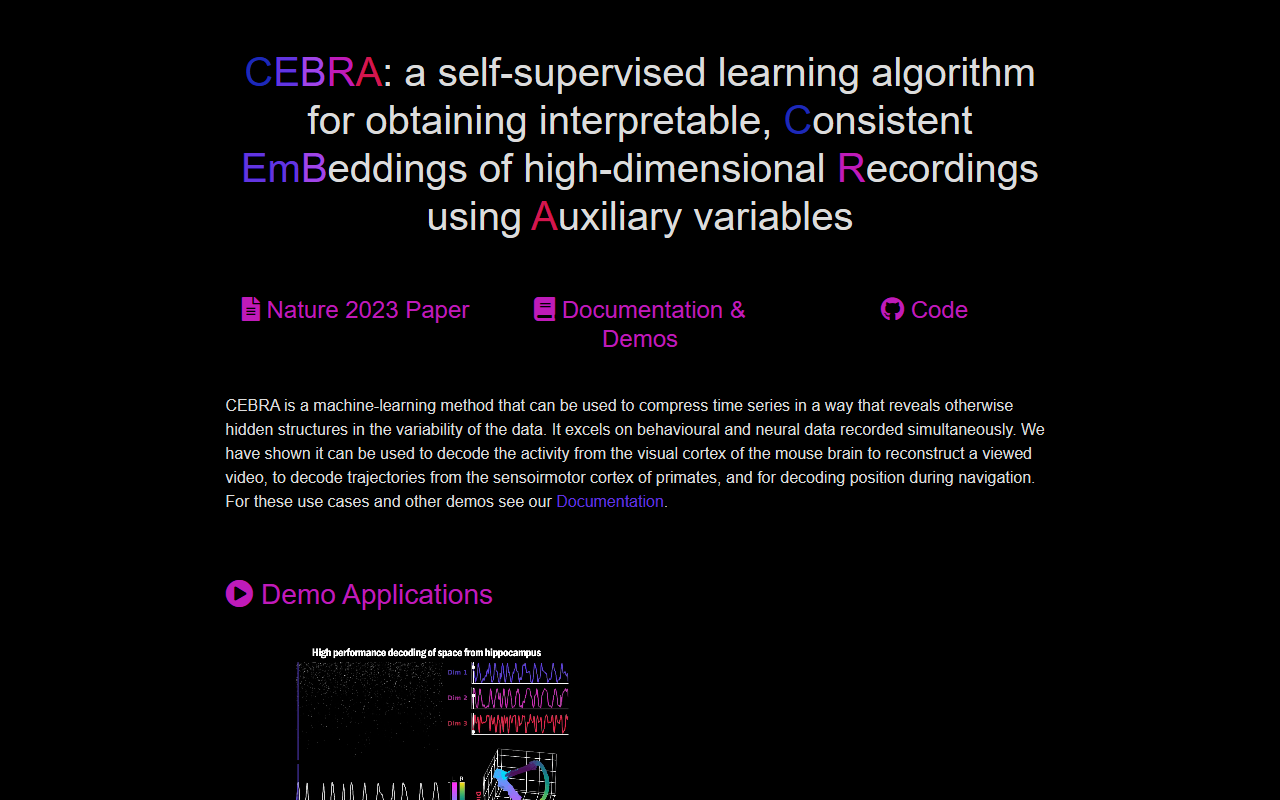
What Is CEBRA and What Problem Does It Solve?
Upon visiting cebra.ai, you are greeted not with a typical SaaS interface but a research project page showcasing CEBRA—a self-supervised learning algorithm designed to produce interpretable, consistent embeddings from high-dimensional time-series data, particularly neural and behavioral recordings. The core problem it addresses is the difficulty of extracting meaningful latent structures from complex, multi-channel neural data (e.g., calcium imaging, electrophysiology) recorded alongside behavioral variables. Traditional dimensionality reduction techniques like PCA or t-SNE often ignore auxiliary information or fail to enforce temporal consistency. CEBRA bridges this gap by leveraging both neural activity and behavioral tags (e.g., position, movement direction) in a contrastive learning framework that can be supervised, self-supervised, or hybrid.
The website highlights its Nature 2023 publication and provides links to code, documentation, and demo notebooks. While CEBRA is not a plug-and-play app for non-experts, it is a powerful open-source library (Python, PyTorch) that researchers can integrate into their analysis pipelines. The page includes interactive Colab notebooks and video examples showing CEBRA decoding mouse visual cortex activity to reconstruct video frames and decoding rat hippocampus data to predict position with a median error of just 5 cm over a 160 cm track. These demos give a vivid impression of its real-world capability, though they require some neuroscience background to fully appreciate.
Technical Deep Dive: Models, Data, and Performance
CEBRA stands for Consistent Embeddings of high-dimensional Recordings using Auxiliary variables. It uses a contrastive loss function that pulls together neural activity patterns that correspond to similar behavioral states while pushing apart dissimilar ones, optionally conditioned on time. The algorithm can be applied to single or multi-session recordings and works across species, brain regions, and recording modalities (calcium imaging, Neuropixels). The site reports that CEBRA produces latent spaces that are not only interpretable but also highly performant for decoding tasks—such as reconstructing natural movies from mouse visual cortex activity.
From a technical standpoint, CEBRA is implemented in PyTorch and distributed via GitHub under an open-source license. The repository includes comprehensive documentation, tutorials, and Jupyter notebooks. The model uses a neural network encoder (configurable architecture) that maps high-dimensional input to a lower-dimensional embedding. Training is self-supervised when using only temporal proximity as the auxiliary variable, or supervised when using explicit behavioral labels. The Nature paper validates its accuracy on both calcium and electrophysiology datasets, across sensory and motor tasks, and across species including mice, rats, and primates. Notably, the site also mentions a pending patent by EPFL for non-academic use, which may limit commercial applications without licensing.
Pricing is not publicly listed on the website, as CEBRA is free for academic research use. For non-academic use, contacting EPFL's Tech Transfer Office is recommended. This openness is a strength, but it also means that enterprise support or cloud APIs are not available. Compared to alternatives like UMAP or jPCA, CEBRA offers the unique advantage of leveraging auxiliary behavioral variables to enforce consistency, resulting in embeddings that are more aligned with underlying neural dynamics.
Strengths, Limitations, and Who Should Use It
CEBRA's greatest strength is its ability to reveal hidden structures in neural data that other methods miss, while providing a clear metric for consistency. The demo with rat hippocampus decoding and mouse visual cortex reconstruction is compelling evidence of its utility. Additionally, being published in Nature and cited extensively in neuroscience, machine learning, and brain-computer interface literature gives it strong academic credibility. The codebase is well-documented and actively maintained by the Mathis Lab at EPFL.
However, there are real limitations. First, CEBRA is a research tool, not a product. It requires significant Python proficiency and familiarity with neural data pipelines. There is no graphical interface or no-code option. Second, the algorithm's performance depends heavily on the quality and alignment of behavioral labels—it may not work well for purely discovery-driven tasks without any auxiliary variables. Third, computational resources can be substantial: training on large-scale Neuropixels datasets may require GPU acceleration. Finally, the pending patent and academic licensing model could be a barrier for startups or commercial BCI applications.
This tool is best suited for neuroscience researchers, computational neuroscientists, and data scientists working with neural time series who need to decode behavior or discover latent neural dynamics. Those looking for a general-purpose time-series embedding tool without domain-specific constraints may find UMAP or t-SNE more accessible. For anyone serious about joint neural-behavioral analysis, CEBRA is a must-explore resource. Visit cebra.ai to explore it yourself.










Comments