

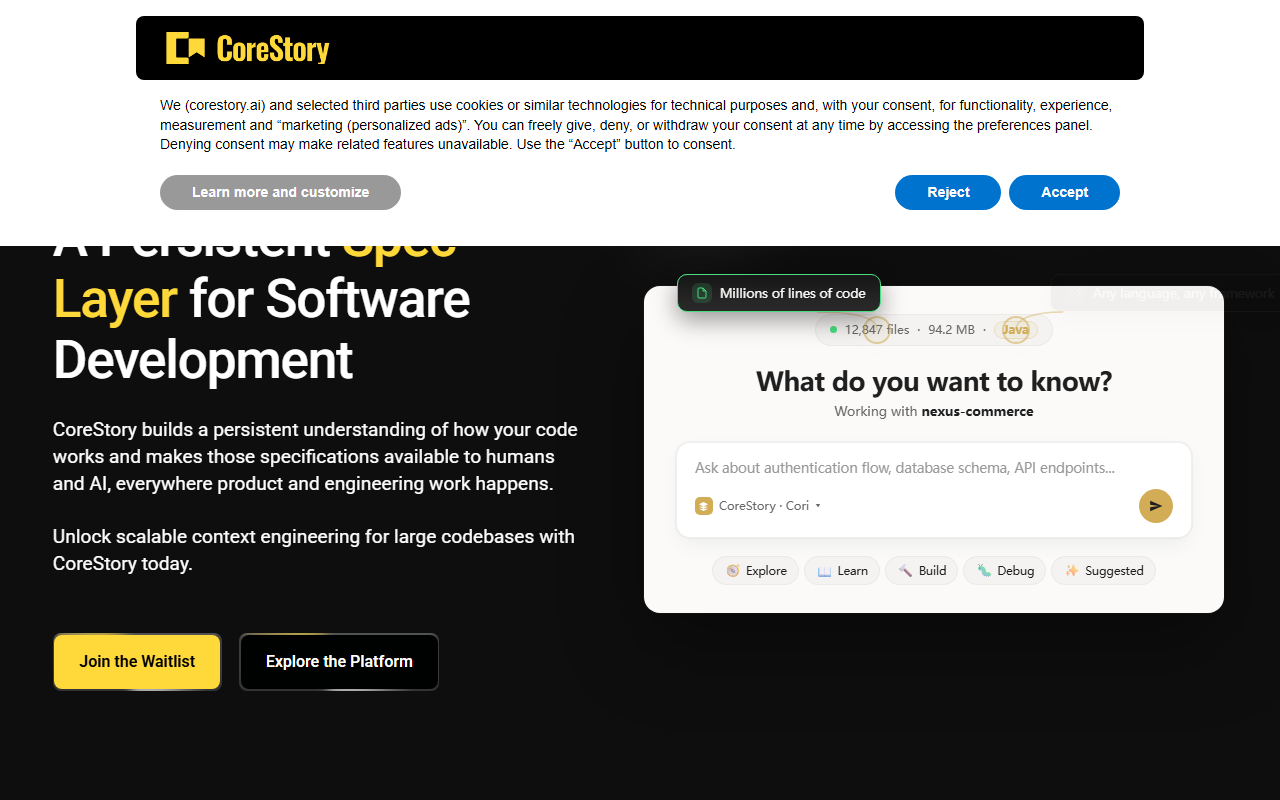
First Impressions and Onboarding
Upon visiting the CoreStory website at corestory.ai, I was greeted by a clean, minimalist interface that immediately showcased a live demo. The dashboard displays a sample codebase labeled "nexus-commerce" — 12,847 files, 94.2 MB, written in Java. A natural language query bar invites you to "Ask about authentication flow, database schema, API endpoints..." I typed a quick question about the authentication flow, and the response appeared within seconds, citing specific files and architectural components. The onboarding is straightforward but currently gated behind a waitlist. Signing up takes only an email address, after which you receive a confirmation that CoreStory will notify you when access opens. For now, the demo gives a convincing taste of the platform’s capabilities.
How CoreStory Works: Persistent Code Intelligence
CoreStory positions itself as a "Persistent Spec Layer" for software development. Unlike typical AI tools that generate disposable context per session, CoreStory continuously ingests source code from your repositories and builds a sustained intelligence model. This model captures architecture, behavior, and intent — not just syntactic facts. The result is a shared system understanding accessible to both humans (developers, architects, PMs) and AI agents (like Claude Code, GitHub Copilot, or Droid). The platform sits between your codebase and everyone interacting with it, serving accurate context on demand. It supports any language and framework, making it suitable for large, multi-language monorepos. The persistence means that knowledge compounds over time, surviving employee turnover and tool changes.
Technical Depth and Integrations
CoreStory offers MCP (Model Context Protocol) and API integrations, enabling AI-powered coding agents to query its intelligence during planning and implementation. The website claims up to 44% better results when using their "ready-to-use playbooks" with agents like Claude Code, Codex, Devin, and Cursor Composer. For enterprise use cases, it targets legacy app modernization, maintenance, technical debt from AI-generated code, and developer onboarding. The platform ingests static documentation and custom inputs alongside source code, feeding into an "Intelligence Model" that outputs architectural insights, workflows, and business rules. Pricing is not publicly listed on the website; you must join the waitlist to learn more. This suggests an enterprise-focused, likely custom-pricing model.
Strengths, Limitations, and Recommendations
CoreStory’s primary strength is its persistent, shared context — a genuine differentiator from tools like Sourcegraph’s Cody or GitHub Copilot Chat, which often reset context per session. It addresses the real problem of tribal knowledge loss and misalignment between teams. The demo performance was impressive and responsive. However, limitations are clear: the product is in early access (waitlist-only), lacks public pricing, and its value proposition shines mostly for large, complex codebases; smaller projects may not justify the overhead. Additionally, the sample demo is static and Java-only, so confidence in multi-language support is based on claims rather than hands-on testing. I recommend this tool for engineering organizations maintaining multi-million-line codebases, especially those with high turnover or heavy AI agent usage. Architects, staff engineers, and PMs will find the most immediate value. If your team struggles with onboarding or context fragmentation across tools, CoreStory is worth the wait. Visit CoreStory at https://corestory.ai/ to explore it yourself.













Comments