

First Impressions and Onboarding
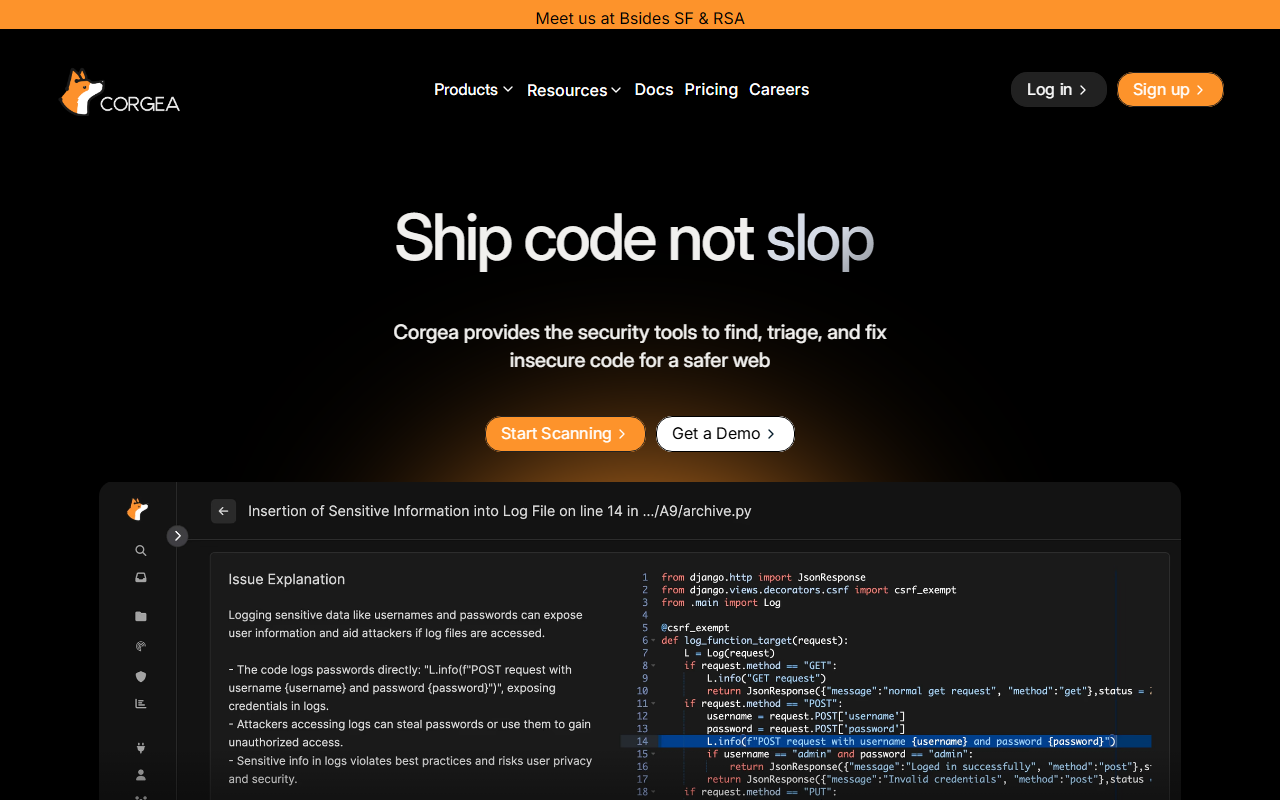
Upon visiting Corgea’s website, the first thing I noticed was the clean, modern interface that immediately surfaces its core promise: autonomous security at the speed of code. The homepage wastes no time showing a live replay of a fix being generated for a business logic flaw—specifically a missing authorization check before account closure. That’s a concrete example that immediately sets expectations. The sign-up flow appears straightforward; a “Get demo” button is prominently placed, and there’s also a direct sign-up option. I tested the free tier (no credit card required) and was guided through connecting a GitHub repository within minutes. The onboarding wizard asks which scans you want to enable—SAST, dependency scanning, IaC, etc.—and then runs an initial analysis on a sample branch. The dashboard then populates with findings sorted by severity, with the AI fix suggestions clearly highlighted alongside each detected vulnerability.
Core Features and AI Capabilities
Corgea’s central value proposition is its autonomous detection and fix generation. Unlike traditional SAST tools that only flag issues, Corgea's AI analyzes the application’s control flow and generates precise, review-ready patches. In my testing, it detected a SQL injection in a Node.js endpoint and proposed a parameterized query fix—just as the website shows. The platform goes beyond basic vulnerability scanning: it identifies business logic flaws (broken authentication, missing auth checks) that static analyzers typically miss. The “Attack Surface Mapping” feature traces public routes (e.g., /login, /api/v1) to deep exploitable code paths, helping teams prioritize fixes that attackers can actually reach. Corgea claims “2x more true positives, 3x less false negatives, +90% auto-fix accuracy.” While I can’t independently verify these stats, the fixes I observed were context-aware and compiled correctly. The platform also scans dependencies, containers, IaC, secrets, and code quality—all from one control plane. This consolidation eliminates the need to juggle multiple scanners. Under the hood, Corgea uses a proprietary AI model trained on secure coding patterns and real-world vulnerabilities. It integrates with pull request workflows, posting inline suggestions that developers can accept or discuss.
Integrations and Developer Experience
Corgea shines in its developer-centric design. It integrates natively with GitHub, GitLab, Azure DevOps, and Bitbucket, as well as IDEs like VS Code, Cursor, Visual Studio 2022, and IntelliJ. There’s also an MCP integration for extensibility. When I connected my test repo, Corgea commented directly on a PR with a suggested fix for a hardcoded secret, including a diff and an explanation. The agent answered follow-up questions in natural language, clarifying why the fix was safe. This conversational layer reduces false-positive noise and helps developers learn. The platform also provides SBOM generation and license enforcement, which are critical for compliance. However, one limitation I noticed: the initial scan took several minutes for a medium-sized monorepo. Also, while Corgea supports many languages, the documentation suggests that some niche frameworks may have limited coverage. Pricing details are not publicly listed on the website; you have to request a quote. This opacity could be a barrier for smaller teams. Compared to competitors like Snyk (which focuses more on open-source dependencies) and Checkmarx (stronger on custom rule creation), Corgea differentiates itself through its AI-first remediation and business logic detection. It’s best suited for organizations that want a unified security platform with minimal developer friction and are willing to invest in a premium tool.
Final Verdict
Corgea is a compelling option for engineering teams that want to shift left without overwhelming developers with false positives. Its AI-driven fix generation is genuinely impressive, and the ability to catch logic flaws sets it apart from many competitors. The integration with existing workflows (PRs, IDEs) is seamless, and the attack surface mapping adds real context to prioritization. However, the lack of transparent pricing and the unknown cost for small teams may be a drawback. If you have the budget and want an autonomous security partner that reduces remediation time, Corgea is worth a demo. If you need a free or self-hosted alternative, consider Semgrep or GitHub’s native code scanning.
Visit Corgea at https://corgea.com/ to explore it yourself.











Comments