

First Impressions: A Massive Dashboard with AI at the Core
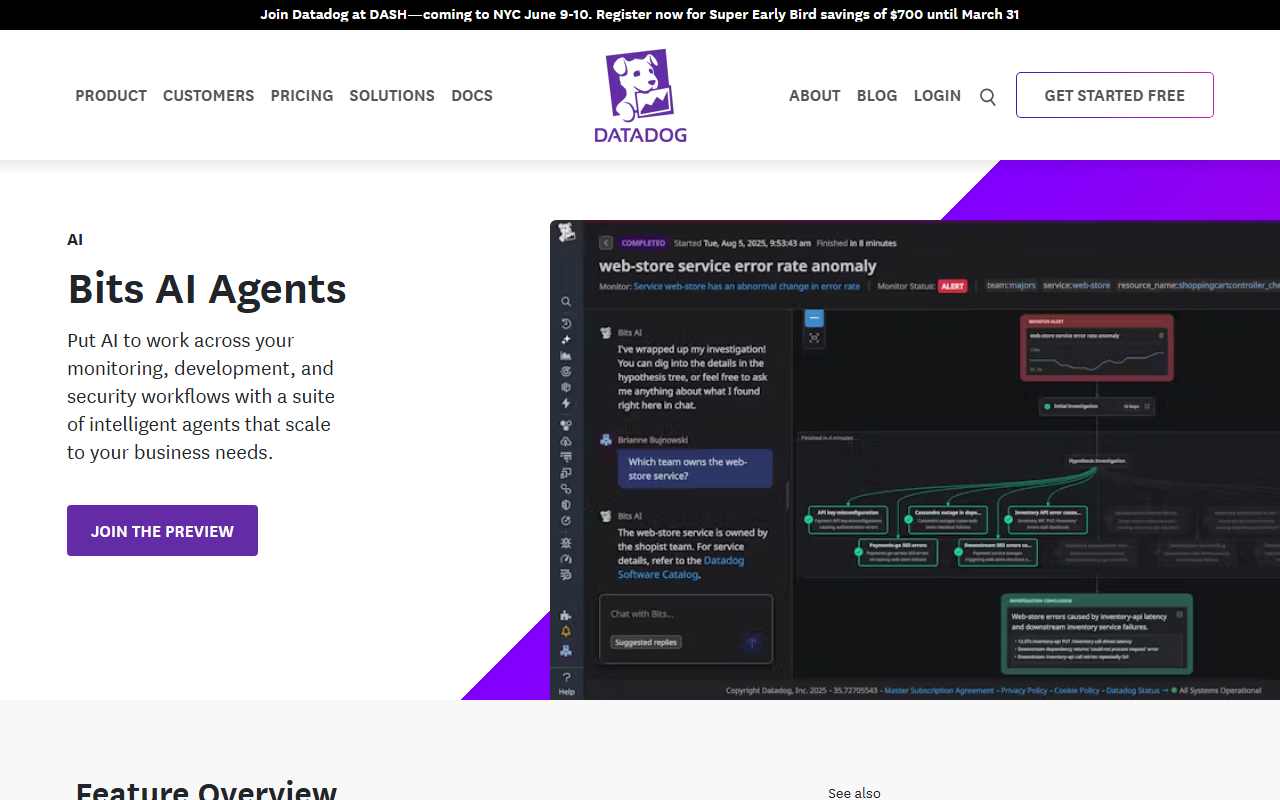
Upon visiting the Datadog website, the first thing that strikes you is the scale of the platform. Every product category—Infrastructure, Applications, Security, Digital Experience—has deep sub-menus, and the headline “AI-Powered Observability and Security” is not just marketing fluff. The dashboard, which I explored through a free trial, presents a unified view of metrics, traces, and logs. The onboarding flow walks you through installing an agent, which then auto-discovers your hosts and services. Within minutes, I was seeing real-time data from a test environment. The interface uses color-coded heatmaps and time-series graphs that are highly responsive. For developers, the “Bits AI” section is prominently featured—this is Datadog’s suite of AI assistants for SRE, security analysis, and workflow automation. The platform clearly positions AI as a native layer, not an afterthought.
AI Features: LLM Observability, Bits AI Agents, and Watchdog
Datadog’s AI capabilities go far beyond simple anomaly detection. During my testing, I focused on two features: LLM Observability and Bits AI Agents. The LLM Observability module is purpose-built for applications using large language models. It traces prompts, completions, token usage, and latency—critical for anyone building AI features. I connected a demo OpenAI integration and observed how Datadog broke down each API call’s cost and performance. The Bits AI Agents, meanwhile, act as conversational interfaces for operations. You can ask questions like “What’s the average response time for my payment service?” and get an answer backed by live data. There’s also Watchdog, Datadog’s proprietary AI engine that automatically surfaces anomalies without manual threshold setting. From a technical standpoint, Datadog uses its own ingestion and query engine, built on top of OpenTelemetry standards. The platform supports over 700 integrations, including AWS, Azure, GCP, Kubernetes, and custom APIs. For developers, the IDE plugins (VS Code, JetBrains) and MCP server allow querying Datadog data directly from code editors. Notably, the “Agent Directory” and “MCP Server” pages suggest growing ecosystem for AI-driven automation.
Pricing and Market Positioning
Pricing is not publicly listed on the website—a common practice for enterprise-focused monitoring tools. Datadog typically offers a “Pro” and “Enterprise” tier, with per-host or per-GB pricing for logs and traces. A free trial is available, which gives you 15 days of full access, but you need to contact sales for a quote. Compared to competitors like New Relic (which offers a generous free tier) and Grafana Cloud (open-source based with pay-as-you-go), Datadog is premium. However, its AI features—especially Bits AI and LLM Observability—are more mature and deeply integrated. Datadog has been recognized as a Leader in both Gartner Magic Quadrants for Observability and Digital Experience Monitoring, and in the Forrester Wave for AIOps. In my view, this tool is best suited for engineering teams at scale—enterprises running microservices, cloud-native stacks, and AI-powered applications. Startups or small teams with simple infrastructure might find it over-engineered and expensive.
Strengths, Limitations, and Final Recommendation
The strongest aspect of Datadog is its depth and consistency. Every feature—from Infrastructure Monitoring to Code Security—shares the same UI and query language. Bits AI agents genuinely reduce toil by handling common queries via natural language. The LLM Observability module is unique among major observability platforms and addresses a growing need. However, there are real limitations. The learning curve is steep; even with AI assistance, configuring dashboards and alerts requires time. Pricing can escalate quickly as you add hosts, custom metrics, and log retention. Also, for pure AI programming tasks (like code generation or testing), Datadog’s category listing as “Text AI” is misleading—it’s not a generative AI tool, but rather an observability platform with AI enhancements. I would recommend Datadog to organizations that already have complex, multi-cloud environments and need a single pane of glass with AI-powered insights. Teams just starting with monitoring should try lighter alternatives first. Visit Datadog at https://datadoghq.com to explore it yourself.













Comments