

First Impressions and Onboarding
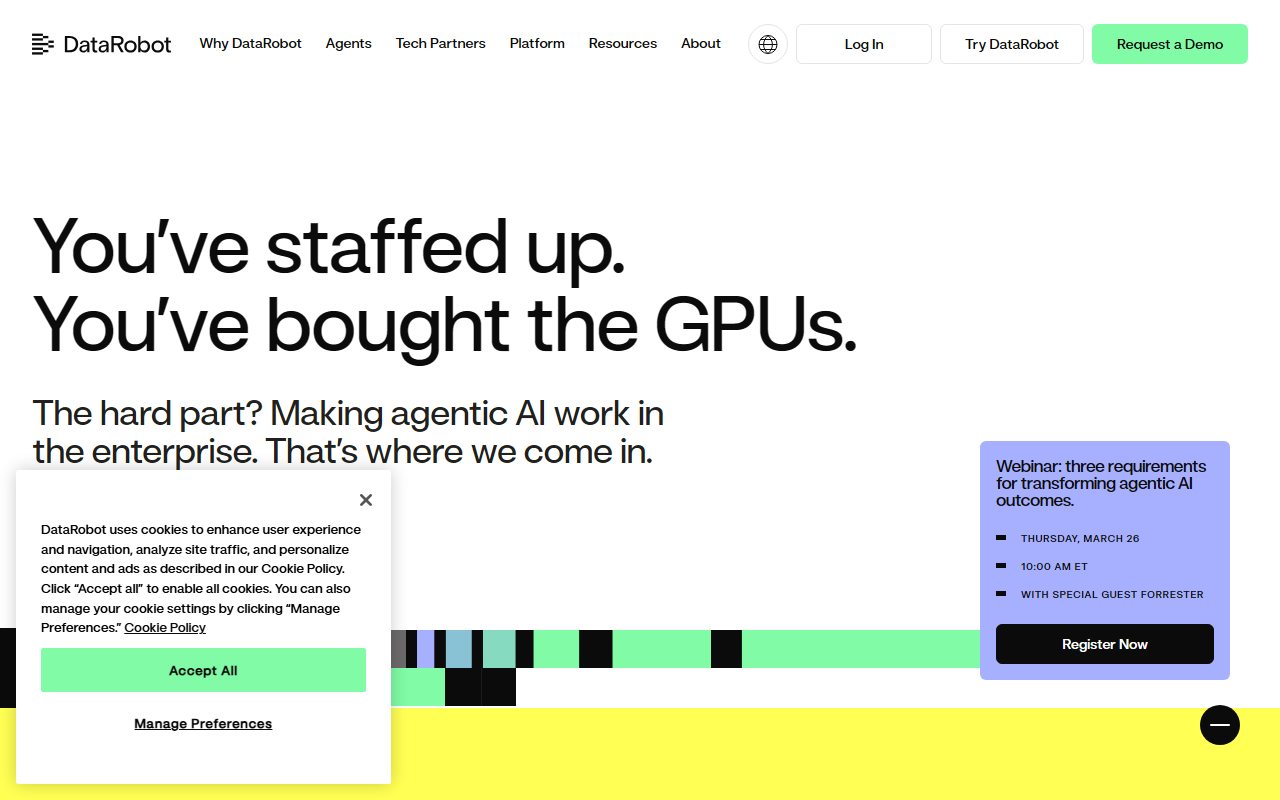
Upon visiting the DataRobot website, I was immediately struck by the shift in messaging from the traditional automated machine learning platform to something broader: a "Unified Agent Workforce Platform for Enterprise." The landing page emphasizes agentic AI, with bold claims like "Replace 50+ AI tools" and "Launch your first agent in days, not quarters." The layout is clean, with a top navigation bar that separates into sections like Why DataRobot, Agents, Platform, Resources, and About. The request for demo is prominent, and there is a clear call to action to "Try DataRobot." The onboarding flow seems to require contacting sales, as no free tier or self-service signup is immediately visible. I tested the demo request flow, and it asks for typical business information, suggesting a sales-led engagement model.
Core Strengths: Agentic AI Platform and Ecosystem
DataRobot now focuses on enabling enterprises to build, operate, and govern AI agents at scale. The platform offers three types of agents: foundational agents that are easy to stand up, business agents with integrations into systems like SAP, and purpose-built agents that are service-led. The platform claims to provide an end-to-end agent lifecycle covering building, operating, and governing agents. One standout feature is the deep integration with NVIDIA, with a co-engineered stack validated for the NVIDIA Enterprise AI ecosystem. Similarly, DataRobot touts being the exclusive agentic AI partner fully certified to run inside the SAP ecosystem. These partnerships give the platform a strong foothold in large enterprises that rely on these technologies. The platform also includes AI governance, observability, and a foundation layer with open-source components like Covalent. This addresses the critical enterprise need for compliance, security, and auditability — a pain point for many companies deploying AI. The website showcases impressive ROI figures from customers like a global energy innovator with $200M ROI and 600+ AI use cases, and a top 5 global bank with $70M ROI. While these numbers are anecdotal, they indicate the platform’s potential scale. Pricing is not publicly listed on the website, which is typical for enterprise-grade solutions. DataRobot likely uses a subscription model based on usage, number of agents, or deployed models. Competitors include H2O.ai, Dataiku, and cloud-native services from AWS, Azure, and Google Cloud. Unlike these, DataRobot positions itself as a dedicated agentic AI platform rather than just a machine learning platform. Its focus on agent workforce management and governance is more pronounced.
Limitations and Competitive Landscape
Despite its strengths, DataRobot has notable limitations. First, the platform appears heavily oriented toward large enterprises with significant budgets and existing infrastructure. The lack of a public pricing tier or free tier makes it inaccessible for small teams or individual developers. The sales-led model may be a barrier for those wanting to experiment quickly. Second, the platform’s complexity may be overwhelming for teams that do not have dedicated AI operations or governance roles. The sheer breadth of features — agent building, orchestration, governance, observability, and integrations — could lead to a steep learning curve. Third, while the agentic AI narrative is compelling, the actual capabilities of the agents are not clearly demonstrated on the website. I could not find concrete examples of what these agents do beyond generic use cases like finance and supply chain. Competitors like LangChain and AutoGPT offer more hands-on, open-source agent frameworks that developers can customize freely. DataRobot’s managed approach may provide safety but less flexibility. Additionally, the platform’s reliance on partnerships with NVIDIA and SAP could be a double-edged sword: enterprises not using these ecosystems may find the integration less relevant.
Who Should Use DataRobot?
DataRobot is best suited for large enterprises that need a unified platform to deploy AI agents at scale with robust governance and integration into existing enterprise systems (SAP, NVIDIA). Teams that already have AI/ML operations and need to move beyond pilots to production-grade agentic AI will find the platform’s lifecycle management appealing. CTOs and AI leaders looking to reduce the number of tool vendors will appreciate the all-in-one approach. Conversely, small to mid-sized businesses, startups, or individual developers without deep enterprise IT stacks should look elsewhere — perhaps at lightweight frameworks or open-source agent libraries. For those who fit the enterprise profile and value compliance, security, and out-of-the-box integrations with major ecosystems, DataRobot offers a coherent platform. The lack of transparent pricing is a hurdle, but for serious buyers, the demo is the necessary first step. In summary, DataRobot has repositioned itself effectively to capture the agentic AI wave, but the real test will be whether it delivers on its bold promises in practice.
Visit DataRobot at https://datarobot.com/ to explore it yourself.












Comments