
First Impressions and Interface
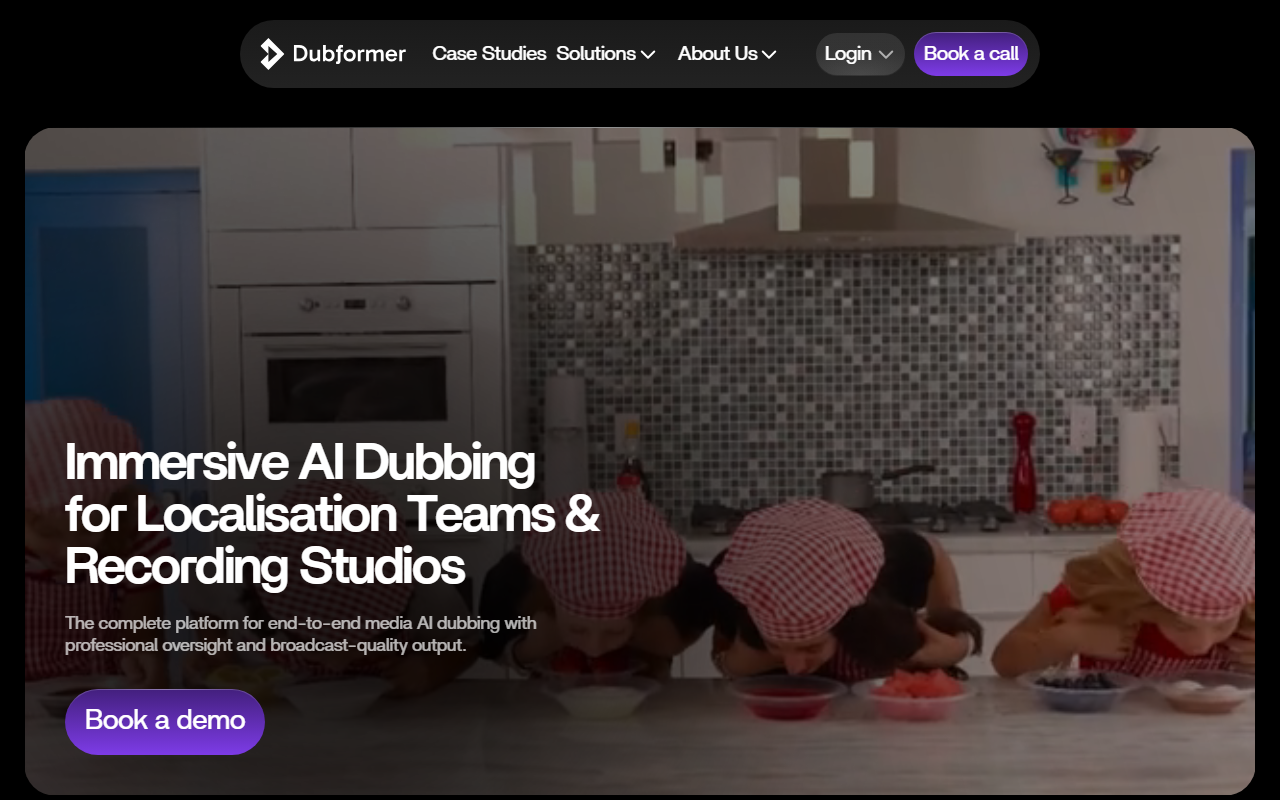
Upon visiting Dubformer's site, the core promise is immediate: "AI dubbing you direct." The headline positions this tool as a director-led platform, not a fully automated black box. The homepage features a sample video comparison tool where you can hear the same line in English and Spanish, comparing Dubformer's output side-by-side with ElevenLabs, DeepDub, and MiniMax. This interactive demo is clever—it lets you listen for subtle differences in pronunciation, emotion, and naturalness. The dashboard itself is not fully exposed without logging in, but the website shows a clear three-step workflow: Import, Voice, Direct, Deliver. The design is clean and professional, targeting post-production teams and localization experts. I appreciated that the site includes actual customer testimonials from industry leaders at Adapt and Euronews, lending immediate credibility. There is no immediate pricing page; the call-to-action focuses on starting a pilot or booking a demo, suggesting enterprise-level or project-based pricing.
How Dubformer Works: The AI Dubbing Studio
The workflow is the standout feature. After uploading a source video and selecting target languages—over 140 are supported—the platform automatically transcribes and identifies speakers, generating a timecoded cue sheet. The user interface shown in promotional materials displays speaker mapping across the timeline and a conformance check before dubbing begins. This is not a one-click solution; it is built for iterative refinement. The "Direct" stage is where human input becomes critical: you can adjust each line's delivery, emotion, and timing, essentially directing the AI voice actor. The platform also claims full traceability, meaning every dubbed segment can be traced back to the editorial decision that approved it. This is a significant feature for compliance-heavy industries like news or legal content. Dubformer encrypts source media with AES-256 in transit and at rest, and explicitly states that user data is never used to train AI models—a strong trust signal for sensitive content. The tool appears to use proprietary models fine-tuned for lip-sync, pronunciation, and emotional cadence, though specific underlying technology is not disclosed beyond comparisons to competitors.
Performance and Benchmark Results
Dubformer publishes a benchmark based on 30,240 native-speaker evaluations. Their claims are striking: 2x better pronunciation and 2.2x better sound quality compared to ElevenLabs. In the metrics shown, Dubformer leads in pronunciation (6.80 vs. 3.40) and sound quality (5.20 vs. 2.40), but lags slightly in emotion similarity and voice similarity compared to MiniMax. The naturalness score is nearly tied with ElevenLabs. When testing the free demo clip, I listened to the English-to-Spanish example: the delivery of "The municipal utilities make sure that air and light are available to all of us" had genuine warmth on "all of us," exactly as the annotation described. The cadence felt more natural than the ElevenLabs or DeepDub counterparts, which sounded flatter. However, I noticed that in languages with very different tonal structures (like Chinese), the emotion similarity might still need human polish. The tool is clearly optimized for European languages and scripted content. The claim that "people are watching these dubs all the way through" from CEO Justin Beaudin highlights that retention is a key metric—Dubformer seems to prioritize narrative engagement over perfect voice cloning.
Who Should Use Dubformer and Who Should Look Elsewhere
Dubformer is best suited for professional media companies, localization studios, and content distributors who need high-quality dubbing at scale but want to retain creative control. The enterprise features—audit trails, folder-level voice permissions, and AES-256 encryption—make it ideal for news organizations like Euronews or streaming platforms that distribute globally. It is also a strong fit for documentary and educational content where emotional authenticity matters. However, it is not the best choice for casual users who just want a quick dub of a short video without direction; tools like ElevenLabs or HeyGen offer simpler self-service models. The lack of public pricing is a barrier for small creators and indie filmmakers, though the pilot program suggests they are open to smaller projects. The main limitation I see is that the tool requires time and expertise to direct—it is a studio tool, not an automation tool. If you have the budget and the team, Dubformer likely delivers a superior end product compared to fully automated alternatives. For those who need rapid, unattended dubbing for user-generated content, look at alternatives like Rask AI or Respeecher. In summary, Dubformer excels where fidelity and directorial intent are paramount, and I recommend it to any professional localization team wanting to bridge the gap between human performance and AI efficiency. Visit Dubformer at https://dubformer.ai/ to explore it yourself.













Comments