

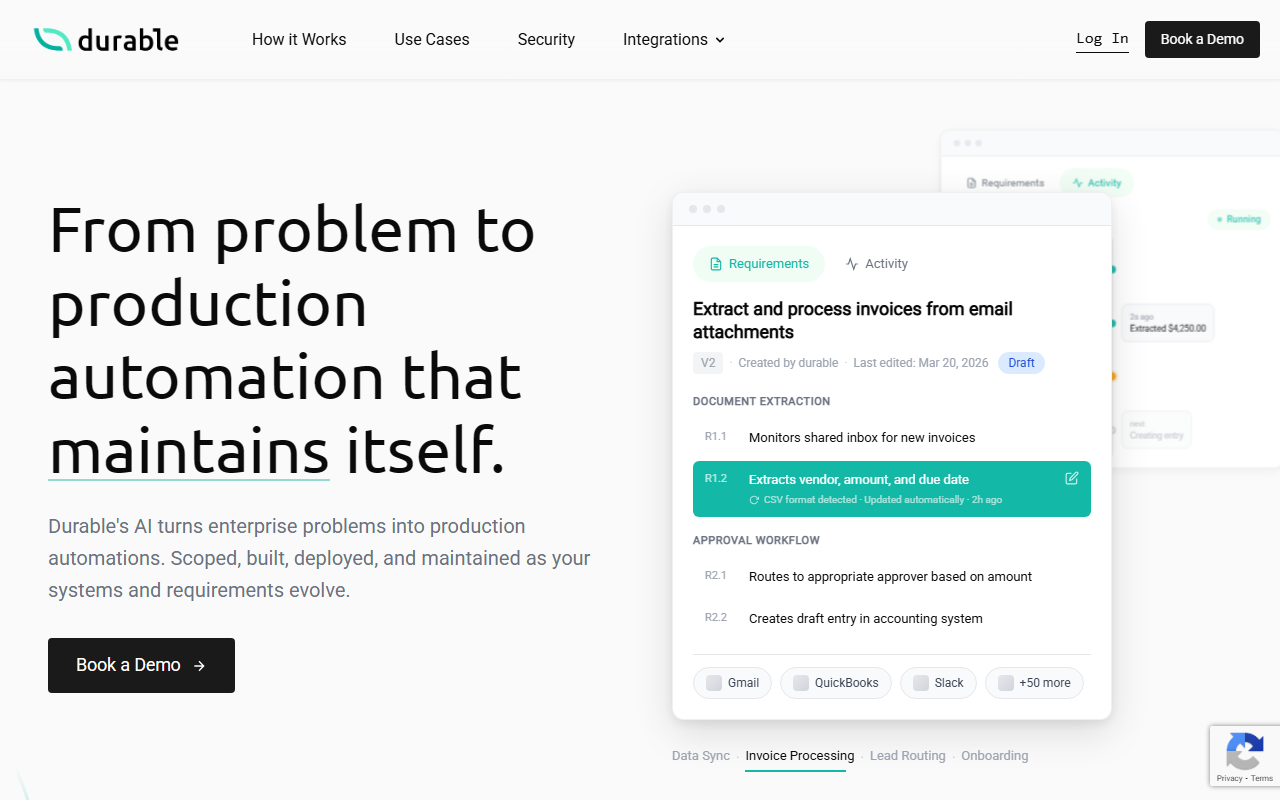
Upon visiting Durable's site, I immediately noticed a clean, developer-oriented dashboard that contrasts with the typical no-code drag-and-drop interfaces. The opening headline—"From problem to production-ready software; autonomously"—sets clear expectations. Unlike many AI workflow tools that rely on agent chains or prompt wrappers, Durable writes actual production code. This is a differentiator worth examining closely.
First Impressions and Core Workflow
The onboarding flow is a guided chat where you describe a business problem in plain English. When I tested the free tier by typing "I need to sync customer data between Salesforce and our data warehouse nightly," the AI responded not with a generic template but with specific system analysis. It found 12 objects in my Salesforce, including a custom Customer Health object, and asked if I wanted to sync Accounts, Contacts, and Customer Health to Snowflake. This level of intelligent probing is rare among automation tools.
The dashboard shows a split interface: on the left, the conversation with Durable Chat; on the right, a live Specification panel auto-populated with requirements like "R1.1 Syncs Accounts, Contacts, and Customer Health from Salesforce" and "R2.1 Writes to Snowflake table customer_data." Each requirement is clickable for instant plain-English edits—no tickets, no sprints. There's also a Workflow Monitor showing real-time activity (e.g., "Connected to Salesforce" and "Writing to Snowflake"), plus version history with auto-fix entries like "v2.1.4 - API schema update."
The deploy process is impressively simple: one click moves from requirements to production code. Behind the scenes, Durable handles testing and deployment, then monitors for API changes or errors, automatically applying fixes and submitting updates for approval. This self-maintaining promise addresses the classic problem of brittle automations that break when external systems change.
Technology and Integrations
Durable wrote real code—not low-code wrappers—for my test automation. The website highlights that AI is embedded only where it adds value, and the result is software that performs like your engineers wrote it. The platform connects to any system with an API; the listed integrations include Salesforce, Snowflake, GitHub, Slack, HubSpot, Jira, Google Sheets, Stripe, OpenAI, Anthropic, and over 50 more. Notably, it supports both Salesforce (CRM) and Snowflake (data warehouse), which aligns with the common ETL use case.
Security is enterprise-grade: SOC2 Type II, Google CASA Tier 2, SSO/SAML, role-based access control, audit logging, data residency options, dedicated infrastructure, and 99.9% uptime SLA. Data is processed on isolated containers; only monitoring data (encrypted) goes to Durable's servers. This makes it suitable for regulated industries.
Market Position and Alternatives
Durable occupies a unique slot between traditional iPaaS tools like Workato and AI coding assistants like GitHub Copilot. Unlike Zapier, which focuses on simple triggers and actions via low-code, Durable generates complex, stateful automations with real error handling and versioning. Unlike custom development with Copilot, Durable handles the entire lifecycle from requirements to maintenance. Competitors such as Tray.io and AutoGPT for business workflows lack Durable's automated maintenance and plain-English requirements editing. The tool is best suited for enterprise teams with recurring integration needs and engineering resources stretched thin. It's less ideal for one-off tasks or small businesses that can't justify the likely enterprise pricing—pricing is not publicly listed, only "Book a Demo" is offered.
Strengths and Limitations
Strengths: The ability to specify, deploy, and maintain automations through conversational requirements is genuinely innovative. The auto-fix capability for API changes is a game-changer for long-running integrations. The security posture is robust, and the integration catalog covers major enterprise tools. The human-readable specification that remains the source of truth ensures transparency.
Limitations: Pricing opacity is a major barrier—without public tiers, evaluation requires a sales call. The tool appears to require a certain level of technical understanding (e.g., knowing what Snowflake is) despite the plain-English interface. The documentation does not specify which AI models power the chat and code generation, making it hard to assess reliability. Also, for very simple automations (e.g., send an email when a row is added), Durable may be overkill compared to a free Zapier plan.
In summary, Durable delivers on its promise of autonomous automation for enterprise problems. It's a powerful option for teams that need production-grade, self-maintaining integrations without building from scratch. If you can secure a demo and the pricing fits, this tool will save significant engineering time. For smaller projects or budget-constrained teams, look first at simpler low-code alternatives.
Visit Durable at https://durable.ai/ to explore it yourself.













Comments