

First Impressions and Onboarding
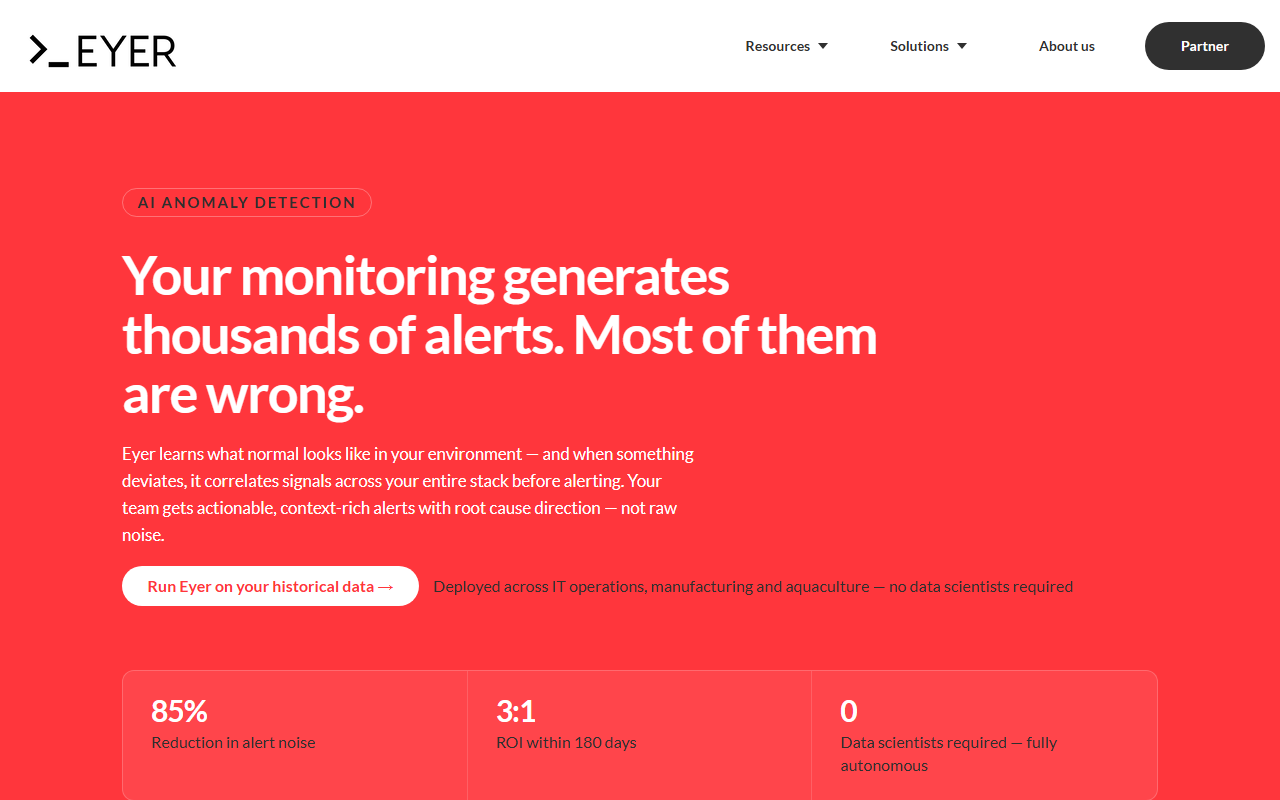
Upon visiting the Eyer website at eyer.ai, the first thing I noticed was the clear, problem-focused messaging: “Your monitoring generates thousands of alerts. Most of them are wrong.” It immediately resonated with anyone who has managed a modern observability stack. The interface presents a straightforward value proposition rather than a flashy demo, which sets the tone for a tool that prioritizes outcomes over aesthetics. The site lacks a public interactive dashboard, but it offers a step-by-step explanation of how the proof-of-value process works: users share 3–12 months of historical time series data, and Eyer runs its AI on that data to surface anomalies and correlations. The onboarding appears to be entirely guided by the Eyer team, starting with a data connection and culminating in a 30-minute findings call. This approach reduces the risk of misconfiguration but also means there is no self-service free tier to explore on your own.
How Eyer Works and Key Features
Eyer positions itself as a “headless AIOps” platform, meaning it operates autonomously in the background without requiring a separate user interface for everyday monitoring. The core technology is an anomaly detection engine that learns what “normal” looks like across your metrics—whether they come from IT infrastructure, operational technology (OT) sensors, or business KPIs. According to the site, the AI builds baselines automatically within the first week and updates them continuously as your environment changes. Crucially, no threshold configuration or rules writing is required, and no data scientists are needed to maintain the system.
When an anomaly is detected, Eyer’s correlation engine maps relationships across metrics before sending an alert. This means each alert arrives with root cause direction and a chain of affected systems, rather than being raw noise. The tool integrates with existing alerting channels like Slack, SMS, and webhooks. Specific use cases are detailed for IT Operations, Manufacturing (OT), Integration (Boomi iPaaS), and Aquaculture. The website claims an 85% reduction in alert noise and a 3:1 ROI within 180 days, citing customer testimonials from a large manufacturing conglomerate and a major US retail corporation. Recognitions include being part of ABB Synerleap, NVIDIA Inception, and Microsoft for Startups programs, which lend credibility to its enterprise readiness.
Pricing and Market Positioning
Eyer does not publicly list pricing on its website. The only way to engage is through the proof-of-value process, after which a live 30-day proof-of-value (POV) is scoped with defined success criteria. This indicates a sales-led model rather than a self-service SaaS offering. In the context of the AIOps market, competitors like Datadog Cloud SIEM, Splunk IT Service Intelligence, and PagerDuty Operations Cloud also offer anomaly detection and correlation, but they often require significant configuration and domain expertise. Eyer differentiates itself by claiming zero need for data scientists or manual tuning—a strong selling point for teams with limited resources. However, the lack of transparent pricing and the requirement to hand over historical data before even seeing a demo may deter smaller teams or those seeking a quick trial. The tool is best suited for mid-to-large enterprises in IT, manufacturing, or aquaculture that are overwhelmed by alert fatigue and have at least three months of historical metrics available. Teams that need a quick, low-commitment solution or that prefer fully self-service tools should look elsewhere.
Final Verdict and Recommendations
After reviewing Eyer’s capabilities and claims, I see genuine strengths in its autonomous learning and correlation-first alerting approach. The promise of reducing noise by 85% without manual tuning is compelling, and the customer testimonials add credibility. The focus on specific operational contexts—IT, OT, manufacturing, aquaculture—suggests deep domain knowledge rather than a generic solution. On the limitations side, the entire engagement model requires trust and time: you must share historical data and go through a sales process before even seeing results. There is no self-service sign-up, no pricing transparency, and no public API documentation. For a tool that markets itself as “headless,” the lack of an autonomous trial experience feels contradictory. If you are an operations leader drowning in alerts and have the patience to undergo a structured evaluation, Eyer is worth a look. But if you need to validate a solution within an hour, you might start with a more accessible alternative and return to Eyer only if that fails. Visit Eyer at https://eyer.ai/ to explore it yourself.













Comments