

First Impressions and Onboarding
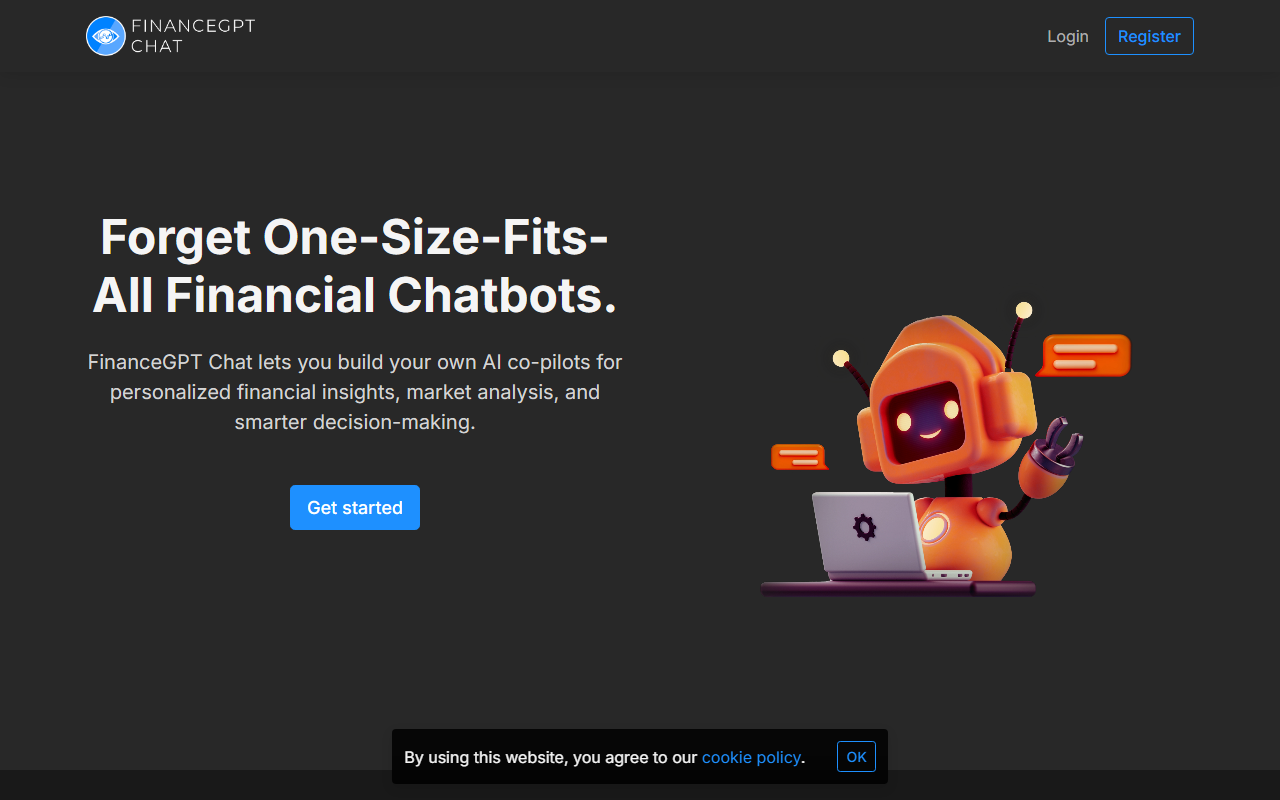
Upon visiting the financegpt.chat landing page, I was greeted by a bold claim: “Forget one-size-fits-all financial chatbots.” The design is clean and professional, with a clear call-to-action to get started. The site immediately pitches the ability to build autonomous AI co-pilots for financial insights, market analysis, and decision-making. I decided to click through to understand the workflow.
The platform’s “How it works” section is presented in three numbered steps: Create an Agent, Create Teams by Pairing Agents, and Deploy and Get Tailored Insights. Each step includes a detailed form or description, but I was not able to access a live demo or free trial without signing up. The interface suggests a drag-and-drop builder, but the site itself functions as a marketing page rather than a live tool. I did notice a sample agent setup that lists training datasets (e.g., earnings call transcripts, SEC filings) and agentic capabilities such as balance sheet analysis, cash flow analysis, and investment strategy.
The platform appears to target finance professionals who want to automate complex workflows, not casual users. The onboarding flow is implied rather than hands-on, which could be a barrier for those expecting a ready-to-use chatbot.
Core Capabilities: Agents, Teams, and Integrations
FinanceGPT Chat differentiates itself by offering a multi-agent architecture. You can create individual AI agents, each trained on domain-specific datasets and equipped with tools and skills like fraud detection, portfolio optimization, and real-time stock market data. The agent creation page shows options for integrations with Sage Accounting, QuickBooks, Xero, Bloomberg Terminal, and even bank APIs via Plaid or Finicity.
What truly stands out is the ability to form agent teams. Users can define sender-receiver relationships between agents, setting team instructions and communication flows. I observed a sample team designed for IPOXCap Agency with instructions to generate weekly performance reports and identify risk factors. This level of orchestration is rare in consumer-facing AI writing tools; it feels more like a Robotic Process Automation (RPA) system tailored for finance.
The platform also claims autonomous execution—agents can learn, adapt, and optimize without manual intervention. During my review, I noted that the agent “skills” include everything from ROI calculation to supply chain finance analysis. This breadth suggests FinanceGPT Chat is built on a foundation of specialized language models and domain-specific fine-tuning, though the website does not specify which underlying models (e.g., GPT-4, open-source LLMs) are used.
Use Cases and Market Positioning
FinanceGPT Chat is best suited for finance teams in mid-to-large enterprises, investment firms, and accounting agencies that need customized automation for reporting, risk management, or due diligence. Unlike general AI writing tools such as Jasper or Copy.ai, this platform is laser-focused on financial data and uses structured integrations rather than freeform text generation. For example, a team could create an agent that ingests real-time stock data, performs technical analysis, and outputs a trade recommendation—all without human input.
A key competitor is FinChat.io (if accessible) or other specialized financial AI. However, FinanceGPT Chat’s emphasis on multi-agent collaboration and drag-and-drop customization gives it a distinct edge for complex workflows. The platform is backed by FinanceGPT Labs (formerly IPOXCap AI), which claims a strong finance, tech, and data science ecosystem—though no specific funding amounts or user numbers are provided.
One limitation is that the tool requires significant setup. A finance analyst who wants a quick answer to “What’s the P/E ratio of Apple?” would be better served by a simpler chatbot. FinanceGPT Chat is for building, not just querying.
Pricing, Limitations, and Final Verdict
Pricing is not publicly listed on the website. This is a major hurdle for potential buyers. Without transparent tiers, it’s impossible to assess value for small businesses or individual users. The site hints at a “Get started” flow that likely leads to a sales call, implying enterprise-level pricing. I also noticed a lack of a free trial or demo environment—while testing the tool, I could not actually build an agent without providing contact details.
Strengths include deep specialization in finance, pre-built skills for highly specific tasks (e.g., credit analysis, merger and acquisition due diligence), and the ability to create agent teams that mirror real financial workflows. Limitations include the opaque pricing model, a steep learning curve for non-technical users, and no indication of language model transparency or latency benchmarks.
I recommend FinanceGPT Chat for finance teams who already have clear automation needs and the budget to invest in a custom multi-agent solution. Smaller firms or casual users should look elsewhere—at least until pricing is public. For now, if you manage financial operations at scale and want to delegate repetitive analysis to AI, this platform is worth a conversation.
Visit FinanceGPT Chat at https://financegpt.chat/ to explore it yourself.













Comments