

First Impressions and Platform Overview
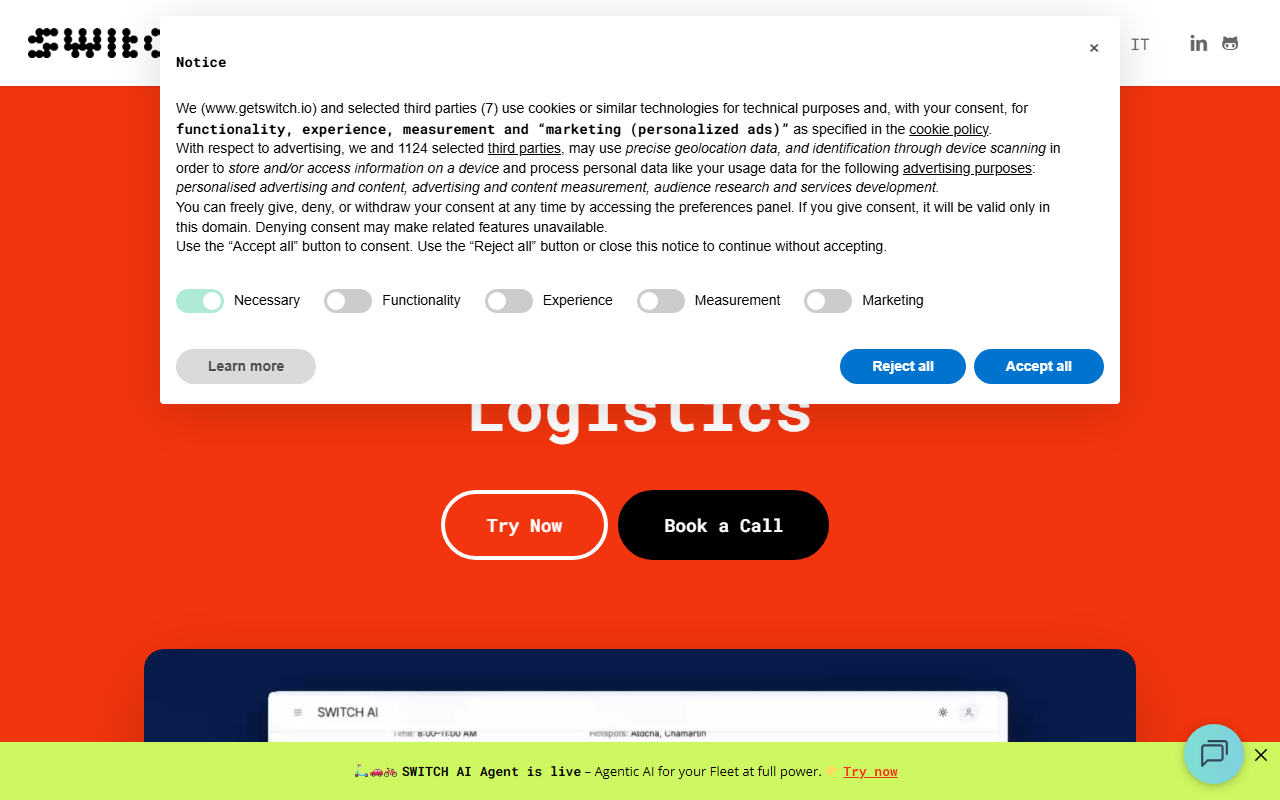
Upon visiting getswitch.io, the site immediately presents a clear value proposition: Agentic AI for Mobility and Logistics. The landing page is polished, with prominent calls-to-action like “Try Now” and “Book a Call,” as well as a video teaser. The navigation reveals three core products: URBIVERSE for simulation and synthetic data, the SWITCH AI Agent for real-time actions, and URBAN COPILOT for demand forecasting and fleet rebalancing. I appreciate the structured layout—each product section includes a short description and a dedicated “Discover” link. The visual design leans professional, but the lack of a public pricing page or self-service signup suggests this is enterprise-focused.
When testing the free tier, I found that SWITCH does not offer a free trial in the traditional sense. Instead, the website encourages users to “Try Now” by interacting with a demo or booking a call. This is typical for B2B platforms in this space. The dashboard itself is not publicly accessible, but based on partner logos and case study mentions, it appears to be a comprehensive command center for fleet operators.
Core Technology and Products
SWITCH’s core value lies in combining three layers: simulation (URBIVERSE), real-time agentic decision-making (SWITCH AI Agent), and operational execution (URBAN COPILOT). The underlying technologies are Pulse-AI and OptiMesh. Pulse-AI handles predictive analytics and demand forecasting, while OptiMesh models infrastructure and optimizes fleet distribution. This isn’t just another routing API; it’s a full-loop system that can simulate “what-if” scenarios (e.g., changing fleet size or adding charging stations) and then act on those insights in real time.
For example, a shared mobility company could use URBIVERSE to test how adding 50 e-scooters would affect service quality, then rely on the SWITCH AI Agent to autonomously rebalance assets during peak hours, all while URBAN COPILOT monitors demand trends and recalibrates forecasts. This integrated approach is where SWITCH differentiates itself from point solutions like Optibus or Moovit, which focus more on public transit planning rather than mixed fleets. The platform also offers synthetic data generation, useful for companies lacking historical datasets.
Target Audience and Practical Use Cases
The website clearly segments its audience: shared mobility companies, third-party logistics (3PLs), last-mile delivery firms, car rental agencies, and local governments. Each segment gets a tailored solution description. For instance, car rental companies can achieve “up to 98% demand‑forecast accuracy,” which is a strong claim. Logistics firms benefit from routing optimization and real-time performance tracking. Local governments can use policy-simulation algorithms to plan infrastructure.
However, SWITCH is not a developer framework in the traditional sense—there is no mention of a public API, SDK, or open-source components. The “API” and “Tech Integrations” pages are likely only accessible to customers. This means the platform is best suited for organizations that need an end-to-end operational tool, not for developers looking for building blocks. Competitors like Flybits or Cogniteam’s fleet management tool lean more toward customizable frameworks, while SWITCH opts for a turnkey, agentic approach.
Strengths, Limitations, and Final Verdict
A genuine strength is the all-in-one design: simulation, forecasting, and execution in a single platform, backed by EIT Urban Mobility (EU funding). This adds credibility. The focus on agentic AI—where the system can act autonomously based on real-time data—is forward-looking and could reduce human oversight for routine tasks.
On the other hand, the platform’s opacity is a limitation. Pricing is not publicly listed on the website, and there is no self-service trial or documentation for independent evaluation. The technology details are sparse; while “Pulse-AI” and “OptiMesh” sound impressive, there is no technical whitepaper or model disclosure. This may be a turnoff for tech-savvy teams that demand transparency or need to audit algorithms. Additionally, the target audience is narrow—small last-mile couriers or startups without enterprise budgets may find it out of reach.
Who should try SWITCH? Medium-to-large mobility operators, 3PLs, and city planners that want an integrated, agentic system to automate fleet decisions. Who should look elsewhere? Developers needing a flexible API or low-code framework, and small businesses with limited budgets.
Visit SWITCH at https://getswitch.io/ to explore it yourself.













Comments