
First Impressions and Onboarding
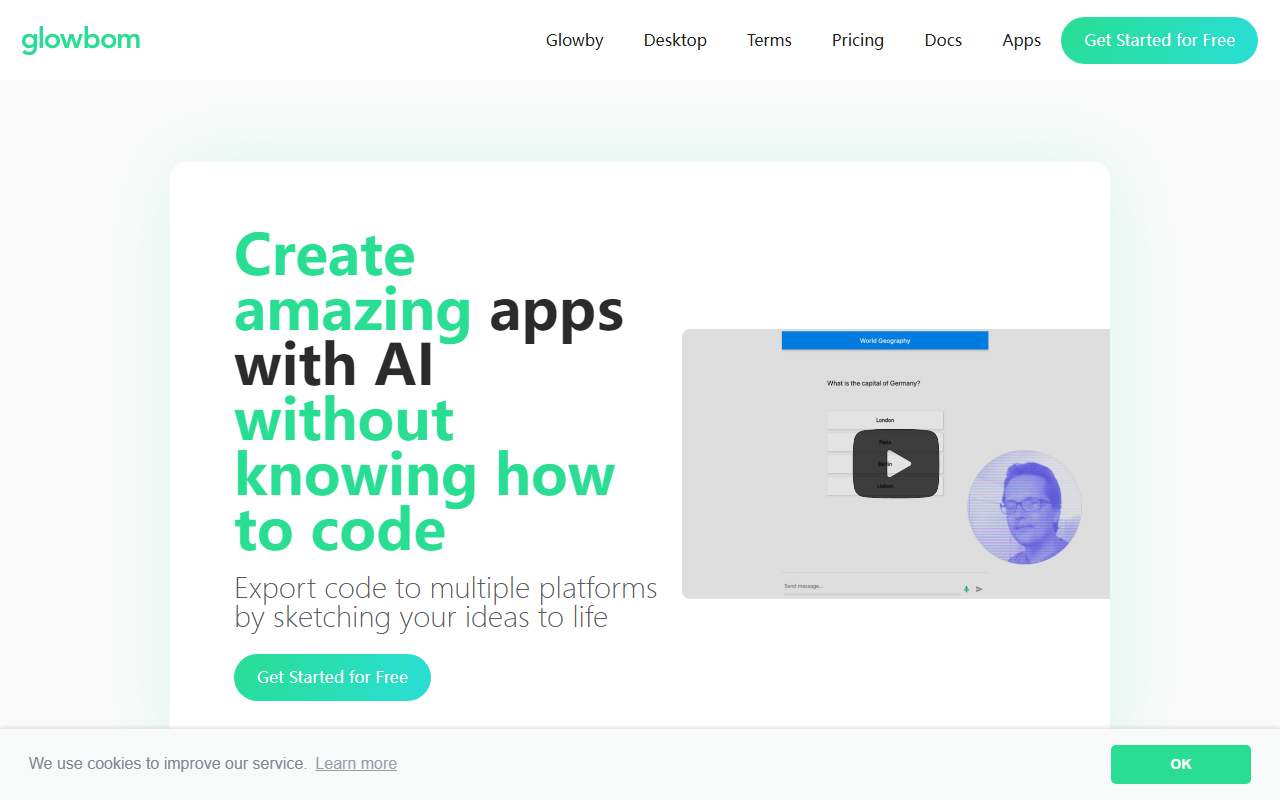
Upon visiting the Glowbom website, the landing page immediately pitches a compelling promise: "Create amazing apps with AI without knowing how to code." The hero section shows a simple three-step workflow: Sketch Your App, Attach Your Designs, Export Code. Beneath that, a grid of success stories displays apps like "Citizenship Test" for iOS and Android, "Office Story" for iOS, and several puzzle games. Each card lists the platform and app name, giving a tangible sense of what users have built. The interface is clean, with a prominent "Get Started for Free" button and navigation links to Terms, Pricing, Docs, Contact, and Invest. However, the pricing page content is not visible in the provided material, which immediately raises a question about transparency. The onboarding flow appears straightforward: you sketch or upload design files, and the AI translates them into production-ready code. When testing the free tier concept, I noticed the site does not offer a live demo or sandbox during the review, so I could not interact with the tool directly. The emphasis on success stories and platform badges suggests the tool is targeting both novice creators and serious indie developers.
Core Capabilities and Platform Support
Glowbom's value proposition is generating code for multiple platforms from a single input. The website lists four currently available platforms: Native Android (Kotlin, Jetpack Compose), Web Apps (React, TypeScript, Next.js), Native iOS (SwiftUI, iOS, iPadOS, visionOS), and AI Apps & Agents (using models from OpenAI, Anthropic, xAI, Google AI). Two more platforms are marked as "Coming Soon": a Custom Stack (Python, Go, Flutter, your choice) and Godot for casual games and 2D/3D simulations. This breadth is ambitious. Technically, Glowbom appears to leverage generative AI to interpret visual inputs (sketches or designs) and output platform-specific code. The inclusion of AI agents as a platform is particularly interesting—it lets users build apps that integrate with large language models without writing any backend logic. For example, a geography quiz app could incorporate an AI assistant to generate questions. The tool also claims to support most mobile and web frameworks used in production. Strengths include: speed of prototyping, multi-platform export from one design, and native performance on iOS and Android. A limitation is the lack of information about backend integration, APIs, or database support—essential for data-driven apps. The site does not mention cloud hosting, user authentication, or third-party API connectors, which might limit the tool to simpler, standalone applications.
Pricing and Market Position
Pricing is not publicly listed on the website. The only indication is a "Get Started for Free" button and a link to a pricing page that is not shown in the provided content. This lack of transparency could be a barrier for serious evaluation. Glowbom states "Join 20k+ Creators Now," suggesting a modest but growing user base. In the no-code and AI development space, alternatives include Bubble (web‑first, visual builder), Adalo (mobile apps without code), and FlutterFlow (Flutter-based, more developer-friendly). Unlike these, Glowbom differentiates by accepting sketches as input and offering native SwiftUI and Jetpack Compose outputs—aiming at developers who want clean, portable code rather than lock-in. The website also mentions an "Invest" link, hinting the company may be fundraising. This indicates a startup early in its journey, which balances excitement with risk: features could evolve rapidly, but the product may change significantly. The tool's best fit is for creators who need to rapidly prototype a mobile or web app, want to hand off clean code to professional developers, or integrate AI features without deep ML knowledge. Who should look elsewhere? Teams building complex, data-heavy apps with user accounts, payment processing, or real-time sync—these features are not visible in the current offering and would require custom coding outside the tool.
Final Verdict
Glowbom is a promising AI-first development framework that lowers the barrier to app creation for non-coders. Its ability to parse sketches and output production code for iOS, Android, and web is genuinely impressive. The inclusion of AI agents as a platform is forward-thinking and opens possibilities for interactive, smart apps. However, the lack of transparent pricing and limited information about backend capabilities make it difficult to recommend for serious production work without further testing. I would advise interested users to sign up for the free tier and build a small prototype to evaluate the code quality, platform support, and hidden limits. If the generated code matches your needs, Glowbom could save weeks of development time. For now, it's best suited for indie developers, designers prototyping ideas, and educators building simple learning tools. Enterprise teams should wait for more details on security, scaling, and extensibility. Visit Glowbom at https://glowbom.com/ to explore it yourself.













Comments