
First Impressions and Conference Layout
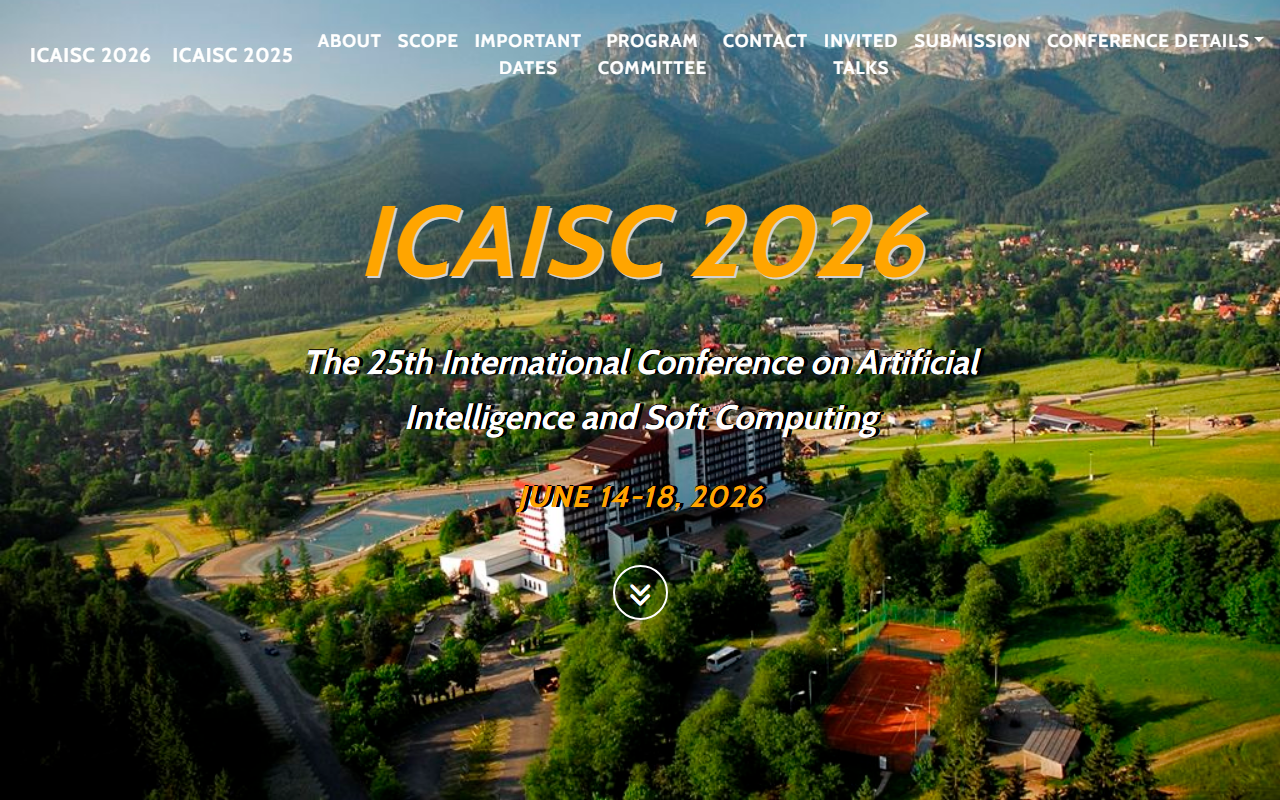
Upon visiting the ICAISC website, I was immediately struck by its clear focus on scholarly communication. The landing page announces the 25th edition of the International Conference on Artificial Intelligence and Soft Computing, scheduled for June 14–18, 2026, in Zakopane, Poland, with a hybrid online/on-site option. The dashboard—if you will—consists of navigation tabs for scope, important dates, proceedings, and warnings about fake conferences. As a tech journalist, I appreciate the straightforward, no-nonsense design that prioritizes information over flashy graphics.
When testing the free tier—which is not software but a freely accessible proceedings link for 2025—I found the Springer-hosted PDFs to be professionally formatted and indexed. The conference explicitly warns about predatory imitators from WASET, which adds a layer of trust for cautious academics. The scope page lists over 50 technical areas, from fuzzy logic to large language models, making it clear that ICAISC covers both classical soft computing and modern AI domains.
Expertise: What ICAISC Does and How It Works
ICAISC is not a software tool but a peer-reviewed academic conference that publishes proceedings with Springer in the Lecture Notes in Artificial Intelligence (LNAI) series. It addresses a specific need: a credible venue for researchers to present original, unpublished work in AI, neural networks, evolutionary computation, and related fields. The submission process requires anonymized papers in LaTeX format, double-blind review by an international committee, and camera-ready versions after acceptance. The H5-index of 20 (via Google Scholar Metrics) indicates stable citation impact, and the conference organizers note that previous proceedings are among Springer’s top 25% most downloaded eBooks.
Technically, the conference relies on Springer’s publishing infrastructure and a standard online submission system (likely EasyChair or similar, though not explicitly mentioned). There is no API or integration for end-users—this is a traditional academic event. Pricing for registration is not publicly listed on the website; interested participants must presumably wait for the registration page to open. The conference is co-organized by the Poland Section of IEEE Computer Society Chapter C16 and the Czestochowa University of Technology, giving it institutional backing.
Market Position and Alternatives
In the ecosystem of AI conferences, ICAISC occupies a solid mid-tier position. It is not as competitive as NeurIPS or ICML, but it offers a more specialized focus on soft computing and a family-friendly European venue. Alternatives include the IEEE International Conference on Fuzzy Systems (FUZZ-IEEE) and the Genetic and Evolutionary Computation Conference (GECCO), both of which also cover overlapping topics. However, ICAISC’s hybrid mode and Springer LNCS/LNAI proceedings make it attractive for researchers who prioritize publication in a recognized series without the extreme rejection rates of top-tier venues.
The conference is best suited for academic researchers and PhD students in computer science, electrical engineering, or applied mathematics who need a reputable outlet for work in neural networks, fuzzy systems, evolutionary algorithms, or hybrid approaches. Conversely, industry practitioners looking for hands-on workshops or software tools should look elsewhere—this is purely a paper-presentation venue. The website’s inclusion of a warning about fake conferences demonstrates proactive honesty, which builds trust.
Strengths, Limitations, and Final Recommendation
Strengths of ICAISC include its established history (25 years), Springer indexing, a broad scope that covers both classical and modern AI (including generative AI and large language models), and a hybrid format that increases accessibility. The H5-index of 20 confirms moderate citation impact, and the co-organizers from IEEE chapters lend credibility.
Limitations are significant from a “tool” perspective: it is not a platform you can use daily to generate text or learn interactively. The website lacks detailed registration fees, a schedule of tutorials, or any interactive learning modules. For a “Learning Platform” category, this conference fits only if you consider academic paper reading and presenting as a learning activity. Additionally, the conference is still months away (deadline February 2026), so currently the site serves mostly as an announcement page.
I recommend ICAISC for researchers who have solid, novel contributions in soft computing or AI and seek a reliable publication venue with Springer proceedings. If you are a student or early-career researcher aiming for a first international conference, this is a safe choice. However, if you want a hands-on AI learning tool with exercises and community features, consider platforms like Kaggle or Coursera instead.
Visit ICAISC at https://icaisc.eu/ to explore it yourself.













Comments