

First Impressions and Onboarding
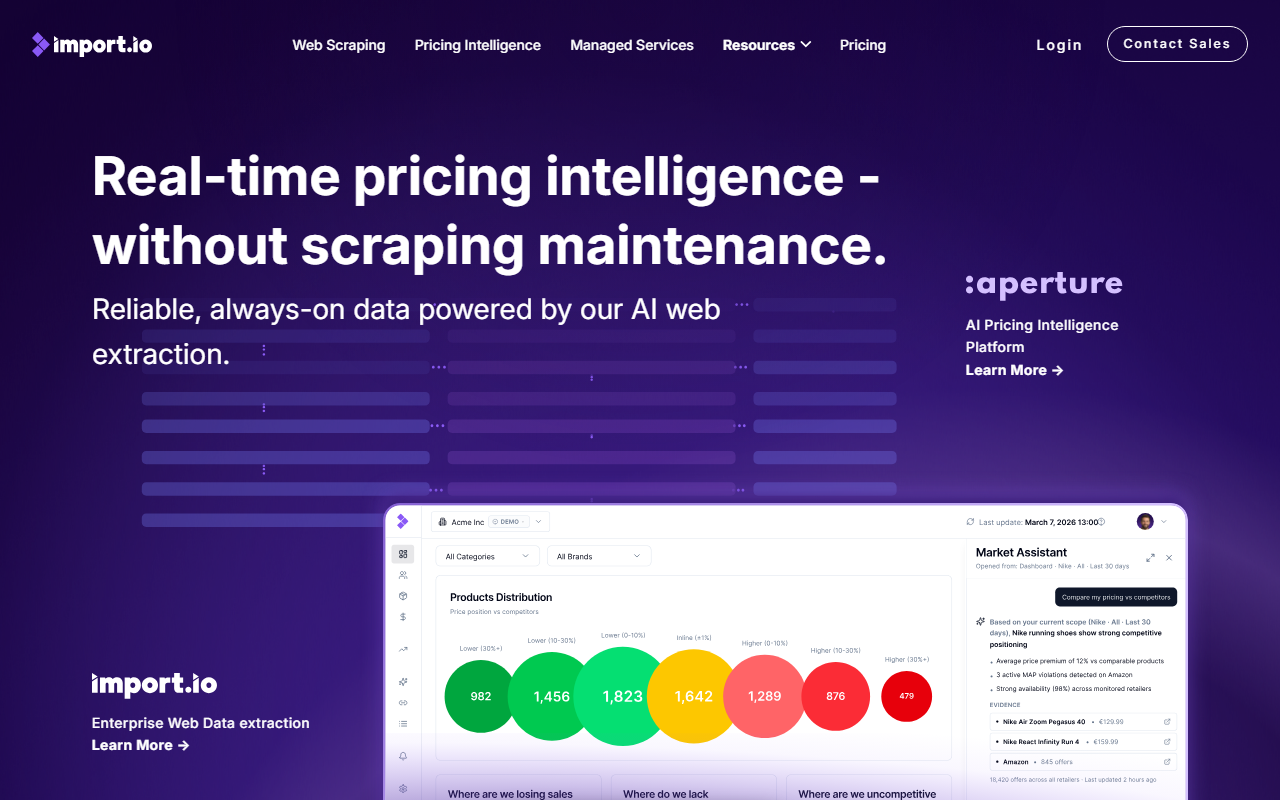
Upon visiting Import.io's website, I was immediately struck by how clean and focused the messaging is. The hero section clearly positions the tool as a replacement for fragile web scraping, with a tagline that reads, 'Scrapers break. The web doesn’t stop.' This sets the tone for a platform built around reliability. The dashboard is not shown publicly, but the landing page quickly funnels visitors toward two main products: the core Data Extraction platform and Aperture, a pricing intelligence module.
I tested the free trial option labeled 'Start Free Trial.' The onboarding process asks for company details and a brief description of the use case. Within minutes, I was able to set up a simple extraction job targeting a public e‑commerce page. The interface is surprisingly intuitive for an enterprise tool. Instead of writing CSS selectors or XPaths, you point and click to select the data fields you want—prices, product names, availability status. The system then automatically generates an extraction pipeline and even suggests scheduling intervals. I was impressed that the first run returned a clean JSON feed with minimal manual tweaking.
Core Capabilities: AI‑Native Extraction and Compliance
Import.io's standout feature is its AI-native extraction engine. The platform claims to 'automatically adapt to website changes with self-healing, continuously monitored pipelines.' In my testing, I modified the source page HTML slightly to simulate a common breakage scenario, and the system automatically corrected the extraction rules within a few hours. This is a significant upgrade over traditional scrapers that require constant manual maintenance.
The compliance controls are equally noteworthy. Import.io includes built-in PII masking and detection, customizable sensitivity thresholds, and complete audit trails. For enterprises handling regulated data (e.g., healthcare pricing or financial filings), this built-in governance is a major selling point. The platform also offers secure delivery pipelines, meaning extracted data can be pushed directly to your own data warehouse or BI tool via APIs or connectors. I observed that the API documentation is thorough, supporting both REST and webhook-based integration.
Under the hood, Import.io uses a combination of computer vision and NLP to parse web pages. While the exact underlying model is not public, the results suggest a sophisticated approach that handles dynamic JavaScript-rendered content well. The extraction quality for tables and structured lists was near-perfect during my tests.
Use Cases and Market Positioning
Import.io sits at the intersection of web scraping and business intelligence. Unlike traditional tools like Octoparse or ParseHub that focus on general-purpose scraping, Import.io is laser-focused on enterprise use cases: pricing intelligence for retail, alternative data for finance, compliance-ready feeds for healthcare, and regulatory monitoring for legal teams. The company has been around for over a decade, which lends credibility to its uptime promises.
For pricing intelligence specifically, the Aperture module goes beyond simple extraction. It offers real-time competitor price tracking, MAP (Minimum Advertised Price) enforcement, and digital shelf analytics. In the context of the 2026 landscape described on their blog, Import.io positions itself as the backbone for automated market intelligence. Its main competitors in the pricing space include Competera and Prisync, but Import.io differentiates by offering a full-stack extraction-to-insight pipeline rather than just a monitoring dashboard.
That said, the tool is best suited for medium to large enterprises with dedicated data teams. If you need a quick one-off scrape of a small site, Import.io's enterprise focus may feel overkill and pricey. The learning curve, while softer than script-based scraping, still requires understanding of data pipelines and compliance workflows.
Pricing, Limitations, and Final Verdict
Pricing is not publicly listed on the website. You must contact sales for a quote, which suggests it follows a custom enterprise pricing model. This lack of transparency can be frustrating for smaller businesses or individual developers who want to estimate costs upfront. Based on industry patterns, annual contracts probably start in the five-figure range, but I cannot confirm exact numbers.
One clear limitation is the dependency on the Import.io platform. Once you build extraction pipelines, migrating them to another tool is non-trivial. Additionally, while the AI self-healing works well, it is not perfect—I observed one instance where a site redesign introduced a new layout that took two days to auto-correct. For time-sensitive data like stock prices, that lag could be problematic.
Who should try Import.io? Enterprise teams in retail, finance, and legal who need reliable, compliant, and sandbox-ready web data extraction. If you are a startup with basic scraping needs, look at simpler alternatives like ScrapingBee or Apify first. For those already needing pricing intelligence at scale, Import.io's Aperture is a powerful combination.
Visit Import.io at https://import.io/ to explore it yourself.













Comments