

First Impressions and Onboarding
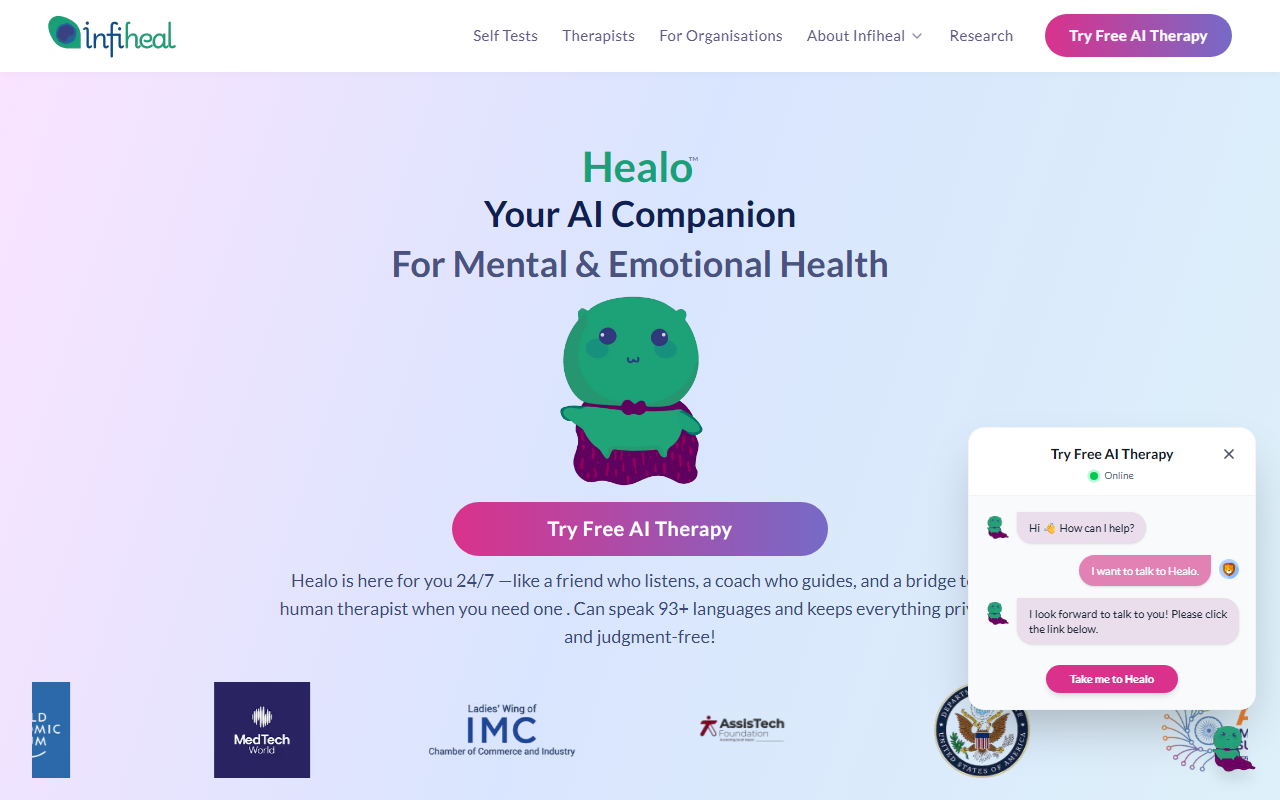
Upon visiting Infiheal, I was immediately greeted by Healo, the AI companion designed for mental and emotional health. The landing page is clean, with a prominent 'Try Free Chat' button and a friendly avatar. The interface flows well, offering a clear value proposition: 24/7 support, 93+ languages, and a bridge to human therapists. I tested the free chat by asking about anxiety management tips. Healo responded with empathetic, non-judgmental language and asked follow-up questions to explore my feelings. The response felt more like a coaching session than a scripted bot. The dashboard also lists features like Self Tests, Therapy with Experts, Community, Focus Zone, and Resources. It’s easy to navigate, though the therapy booking section showed loading issues during my test – therapists were listed but not immediately available.
Core Features and Technology
Healo is built by a team of psychologists, psychiatrists, and doctors. The platform integrates an AI chatbot, self-administered mental health assessments (e.g., love expression test), and a directory of licensed therapists for booking. Notably, it claims HIPAA compliance, end-to-end encryption, and zero data sharing. The AI appears to use natural language processing tailored for mental health contexts – it avoids triggering content and provides evidence-based guidance. I found the self-tests intuitive; they offer immediate insights without requiring personal data. The Focus Zone and Resources sections include worksheets and meditation guides. However, the specific underlying AI model is not disclosed. Compared to alternatives like Woebot or Wysa, Infiheal emphasizes a stronger clinical board and a full ecosystem (from AI chat to human therapy), whereas Wysa focuses on CBT-based chatbot conversations. Infiheal also mentions a research section citing studies on AI effectiveness for mental health, adding credibility.
Pricing and Target Audience
Pricing is not publicly listed on the website. The AI chat appears fully free during testing – no credit card was requested. For therapy booking, costs are likely per session with a therapist, but details are hidden until registration. This lack of transparency may frustrate users. Infiheal is best suited for individuals seeking low-barrier, anonymous mental health support, especially those in regions with limited access to therapy. It’s also useful for people who prefer text-based communication and need multilingual options. However, it is not a crisis intervention tool; users in acute distress should call emergency services. The global community aspect (150+ countries) suggests a broad reach. The platform won the AI for All Global Impact Challenge at India AI Summit 2026, indicating institutional recognition.
Strengths and Limitations
A major strength is the genuine empathy in Healo’s responses – it mirrors back thoughts without sounding robotic. The privacy-first approach (no account required for chat, HIPAA standards) builds trust. The integration of self-tests and human therapy bridges is practical. Yet, limitations exist: the AI cannot replace a human therapist for deep trauma or clinical diagnosis. The loading issues with therapist profiles suggest the booking feature may not be fully optimized. Additionally, the website does not specify how user data is used for AI training, despite privacy claims. For tech-savvy users, the lack of API access or custom integrations may be a drawback. Overall, Infiheal offers a safe, accessible entry point for mental health support, but users requiring intensive care should supplement with professional help.
Visit Infiheal at https://infiheal.com/ to explore it yourself.













Comments