

First Impressions and Overview
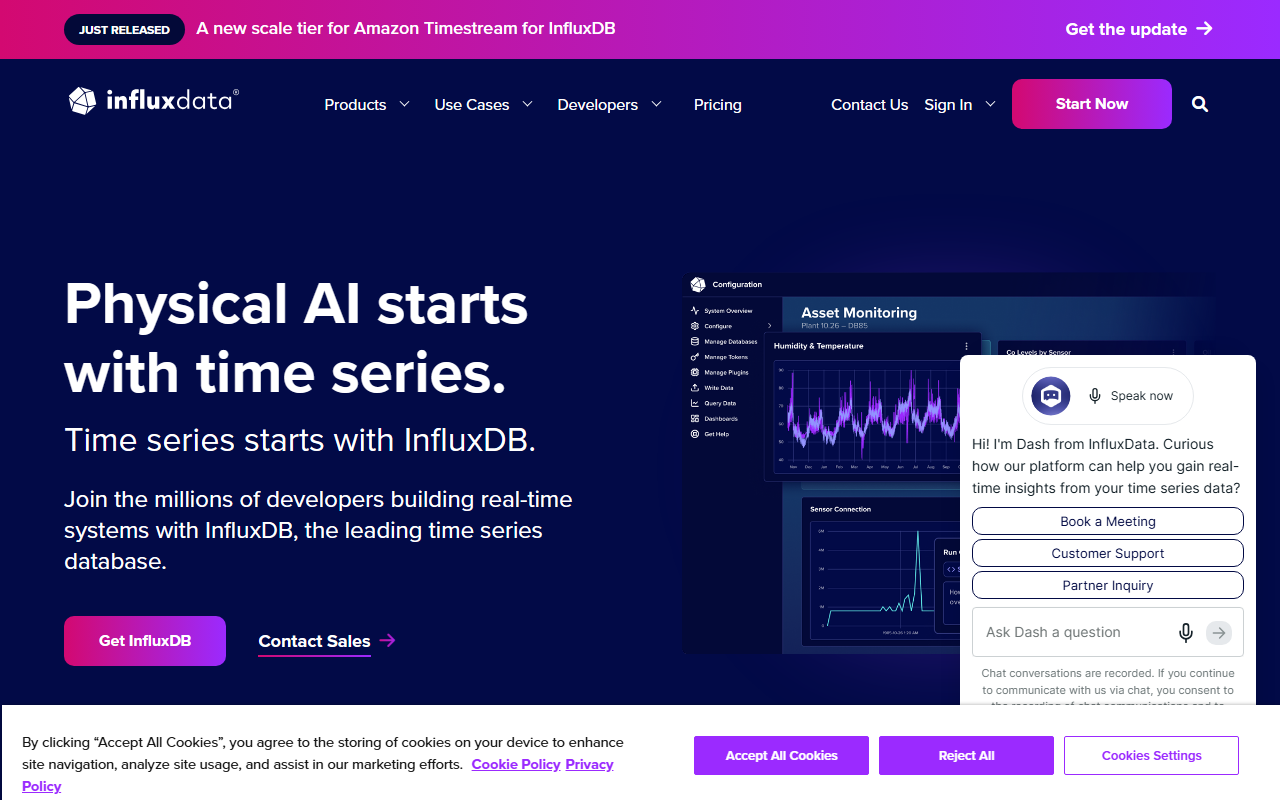
Upon visiting influxdata.com, the landing page immediately signals that this is a database engineered for speed and scale. The hero message—"Time series starts with InfluxDB"—paired with bold statistics (1B+ downloads, 1M+ live open source instances) establishes instant credibility. As a developer, I appreciate that the site jumps straight into code examples in Python, JavaScript, Go, and C#. The dashboard for the hosted cloud version (InfluxDB Cloud) is clean and focused on query building and monitoring. Testing the free tier, I was able to spin up a bucket within minutes and start ingesting simulated sensor data using the provided client libraries. The onboarding flow guided me through writing line protocol and running SQL-like queries via the UI—no manual configuration required for basic use.
Core Features and Architecture
InfluxDB is a purpose-built time-series database designed for continuous, high-resolution data from telemetry, edge devices, and physical AI systems. Under the hood, it uses a columnar storage format (Parquet) with best-in-class compression and automatic downsampling. The architecture supports high-speed ingest at millions of data points per second without performance degradation, and real-time analytics via SQL or InfluxQL. One standout feature is edge-to-cloud continuity: you can capture data on an edge device and later analyze it in the cloud without redesigning your pipeline. The platform also includes automatic eviction of cold data to lakehouses and AI/ML pipelines. For developers, the client libraries (Python, JavaScript, Go, C#, Java) are well-documented and follow idiomatic patterns, as shown in the code snippets on the site. The open-source core (InfluxDB OSS) is free, while InfluxDB Cloud offers managed tiers with scaling.
Pricing, Integrations, and Market Position
Pricing is not publicly listed on the website—InfluxDB Cloud uses a consumption-based model (data ingested, queries, storage), and enterprise plans require contacting sales. This lack of transparency can be a hurdle for small teams or indie developers who need to budget upfront. InfluxDB competes with TimescaleDB (PostgreSQL-based time-series) and Prometheus (monitoring-focused). Unlike Prometheus, which is pull-based and limited to metrics, InfluxDB is push-based, handles arbitrary events, and integrates natively with Grafana, Telegraf, and major cloud providers. Its strength is in IoT, industrial automation, and real-time analytics where low latency and high cardinality are critical. The website lists use cases in aerospace, energy, and manufacturing, highlighting its industrial-grade reliability. Open-source contributors (2,800+) and top ranking on DB-Engines for time-series databases add authority.
Final Verdict and Recommendations
InfluxDB excels where other databases struggle: ingesting and querying massive volumes of time-stamped data with minimal latency. Its edge-to-cloud continuity and compression are genuine strengths. However, the learning curve is steep for teams unfamiliar with time-series modeling, and the lack of upfront pricing may frustrate smaller projects. I recommend InfluxDB for developers building real-time monitoring, IoT platforms, or AI-driven operational systems—especially if you need to handle millions of data points per second. For simpler logging or occasional time-series queries, alternatives like TimescaleDB or SQLite might be more accessible. Overall, InfluxDB is the definitive choice for high-performance time-series workloads. Visit InfluxData at https://influxdata.com/ to explore it yourself.













Comments