

First Impressions and the Platform’s Focus
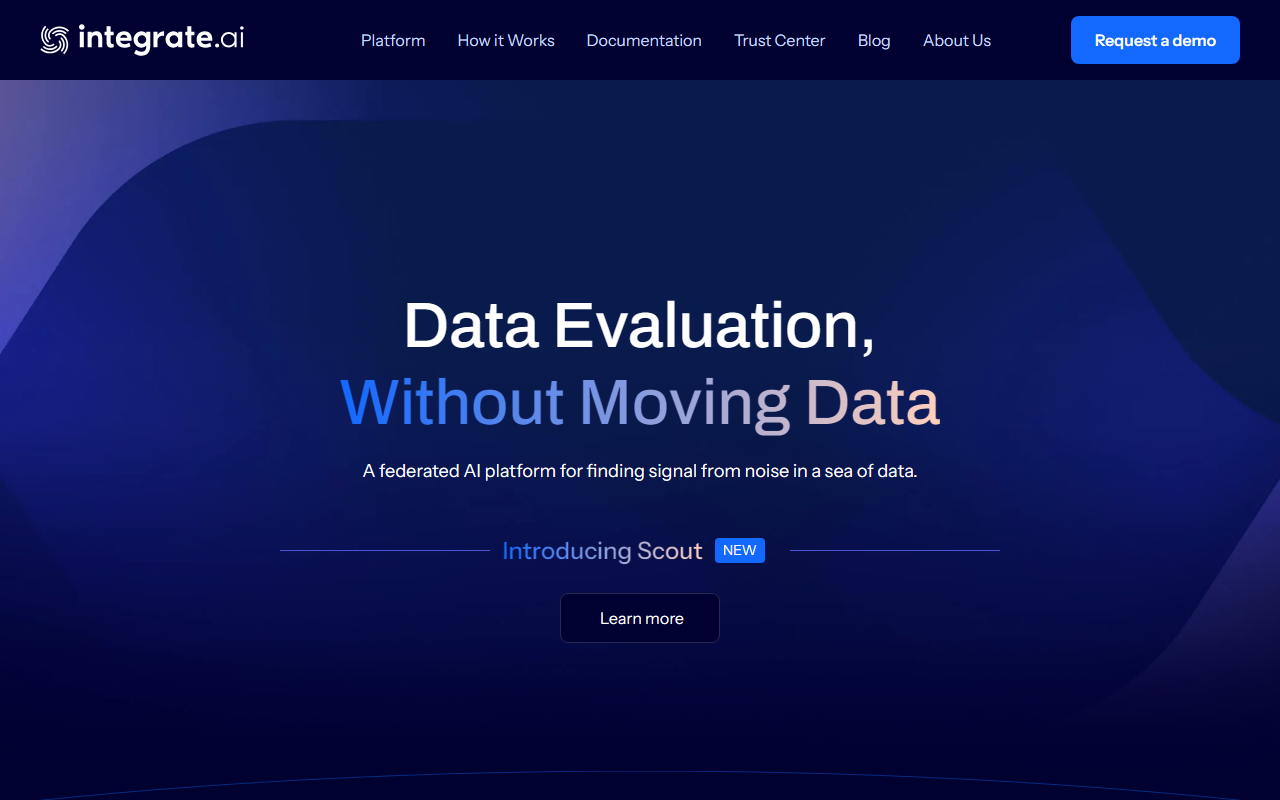
Upon visiting integrate.ai, the landing page immediately signals a niche focus: insurance carriers and data providers. The design is clean but generic—a cookie preference manager pops up, and a tagline “Data Evaluation, Without Moving Data” sets the stage. The hero section introduces a new product called Scout, but the main pitch is a federated AI platform designed to solve a specific pain point: testing external data with models without ever exposing raw data. As someone who has reviewed many data collaboration tools, I appreciate that integrate.ai doesn’t try to be everything to everyone. It drills down into a single, high-stakes industry (insurance) where legal, infosec, and compliance teams create bottlenecks when evaluating third-party data. The website emphasizes rapid experimentation in a sandbox that enforces privacy “by design” with mathematically guaranteed protection. While the site lacks a public demo or interactive walkthrough, the “Book a Demo” button suggests a sales-led onboarding—typical for enterprise B2B offerings in this space.
How It Works and What’s Under the Hood
integrate.ai’s core proposition is federated data science: both parties register their data via a “Task Runner” client, and no record-level data ever moves between participants. The workspace acts as a control centre for managing secure, federated connections. The platform supports summary statistics, match rate analysis, and even model training without exposing sensitive data—all while integrating with familiar data science tools (the site doesn’t specify which, but “favorite tools” like Jupyter notebooks are implied). Technically, this is a variant of a data clean room, but with a stronger emphasis on client-side execution and privacy guarantees. The technology likely leverages differential privacy or secure multi-party computation, though the site doesn’t detail specific implementations. Importantly, pricing is not publicly listed on the website. This is common for enterprise platforms that require custom quotes based on usage volume and deployment complexity. Competitors include Snowflake’s Data Clean Room and AWS Clean Rooms, but integrate.ai differentiates by focusing on the pre-contract evaluation phase—letting carriers test external data without lengthy legal approvals. Another alternative is OpenMined’s PySyft, but that is more developer-oriented and open-source.
Strengths, Limitations, and Verdict
Strengths: The platform directly addresses a real, painful bottleneck in AI adoption for regulated industries. By eliminating the need to move data, it drastically speeds up proof-of-concept cycles. The “mathematically-guaranteed privacy” angle is a strong trust signal, and the ability to evaluate full datasets (not just samples) improves accuracy. The blog posts show thought leadership on federated learning and data governance, adding credibility. Limitations: The narrow focus on insurance may alienate other verticals with similar needs, such as healthcare or finance. The lack of a free tier or self-service trial means potential users cannot test the tool without a sales conversation. The website is also thin on technical documentation—developers will likely need to request detailed specs. Additionally, the “Scout” product is only mentioned as “NEW” with no explanation, which feels incomplete. Who should use it? Insurance carriers and data providers who need to evaluate external datasets (e.g., credit scores, claims histories) without risking compliance violations. Teams that have struggled with multi-month vendor evaluations will find the promise of rapid, secure testing appealing. Who should look elsewhere? Smaller startups without strict privacy requirements may find simpler data-sharing tools more cost-effective. Developers seeking open-source or API-first solutions might prefer platforms like PySyft or discrete data clean rooms.
In summary, integrate.ai solves a well-defined problem with a sophisticated federated approach. It is not a general-purpose tool but a purpose-built solution for a specific compliance-heavy workflow. If you are in insurance and sick of moving data through legal black holes, it is worth scheduling a demo. Otherwise, the lack of pricing and limited public info makes it hard to evaluate without vendor engagement. Visit integrate.ai at https://integrate.ai/ to explore it yourself.













Comments