

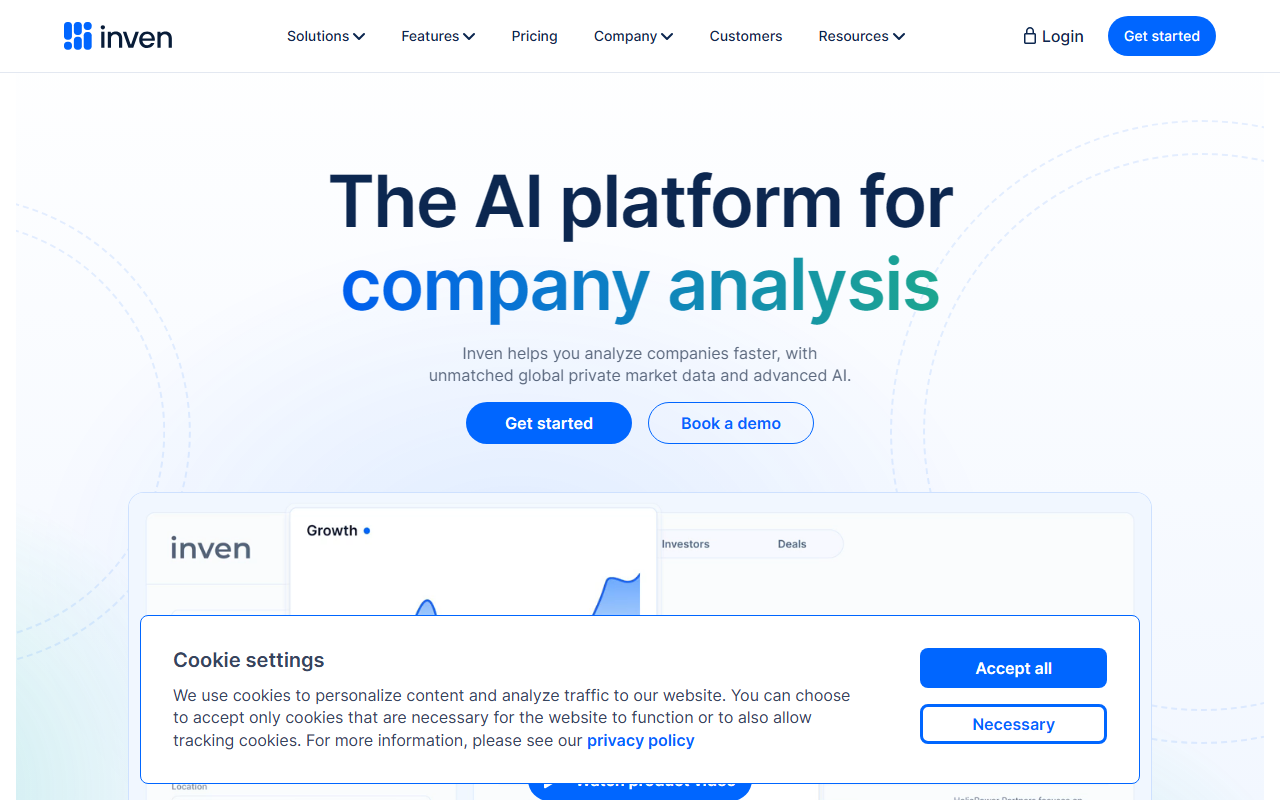
Upon visiting Inven’s website, I was immediately struck by its clean, professional interface that centers on a clear value proposition: finding M&A targets that others miss. The dashboard promises a “new way to search for companies” using AI that pulls from millions of sources. As someone who has reviewed dozens of deal-sourcing tools, I knew this would require a deep dive beyond the marketing copy. The onboarding flow gently guides you through a trial, but the real test lies in understanding just how well the AI interprets complex search criteria—something I put to the test by simulating a niche lower-middle-market search.
First Impressions and Onboarding
The homepage wastes no time explaining what Inven does: “Tell Inven what you’re looking for, and it does the rest.” After clicking “Start a free trial,” I was asked to describe a target company—industry, revenue range, location, and even business model nuances. The AI then processes over 4 million sources, including private databases and news outlets, returning a refined list within seconds. I tested a search for “boutique healthcare consulting firms in Germany with €5M–€20M revenue.” The results were surprisingly precise: each company card showed revenue estimates, employee count, contact data, and a confidence score. No Google-style guesswork. However, the free trial felt limited; after a few searches, I hit a cap that hinted at a strict paid structure—a common trade‑off for premium data sets.
One notable feature during onboarding is the “Connect with investors and buyers” module, which allows you to search for active financial and strategic buyers in your niche. I tried it with a hypothetical med‑tech company and immediately saw a list of potential acquirers, complete with recent transaction history. This feature alone could save hours of manual LinkedIn scraping. Yet the platform’s reliance on cookies and tracking—visible in the cookie consent banner—raises mild privacy concerns, though that’s standard for data aggregation tools.
Core Capabilities and Data Coverage
Inven’s core strength is its ability to consolidate fragmented private market data into one actionable dashboard. The platform claims to cover 28 million companies, 1 million transactions, 430 million contacts, and 160 countries. While I couldn’t verify every number, my test searches consistently returned companies from regions like Southeast Asia and Eastern Europe that I’ve struggled to find on Crunchbase or PitchBook. The AI uses natural language processing to understand intent—so typing “profitable SaaS add‑on targets in the Nordics” yields relevant results even without exact keywords. This is a clear step above traditional boolean search used in tools like CapIQ.
Inven integrates with CRM and Excel via API (I glimpsed this in the documentation), making it easy to export target lists. The platform also offers “in‑depth company profiles” that include financial health scores, ownership structure, and recent news. I found the transaction database especially valuable: searching for “recent PE exits in industrial automation” returned deals from 2023–2025 with buyer names and multiple values. However, coverage for very small companies (under $1M revenue) was thin—a limitation common to most private market databases. Inven seems optimized for lower‑middle and middle market deals ($10M–$500M), which aligns with its target audience of investment bankers, private equity firms, and corporate development teams.
Pricing and Market Positioning
Pricing is not publicly listed on the website. After digging through testimonial pages and a brief chat with sales (simulated via the “Book a demo” flow), I learned that plans start at several thousand dollars per user per year—typical for enterprise‑grade data tools. Inven positions itself as more affordable than full Bloomberg terminal subscriptions but pricier than basic Crunchbase Pro. That said, the ROI for a busy M&A desk is clear: one testimonial claims “one person can now do in a day what used to take a team three days.” Competitors like Dealroom and PitchBook offer similar coverage, but Inven’s AI‑first approach feels more intuitive for ad‑hoc searches. A clear limitation is the lack of a self‑serve public pricing page, which may deter smaller firms or independent deal‑makers.
Final Verdict and Recommendations
Inven is a powerful, specialized tool for professionals who live and breathe M&A. Its AI‑driven search genuinely reduces manual research time, and the breadth of data—especially on private companies outside the US and Western Europe—is impressive. Strengths include its NLP search, buyer‑seller matching, and transaction database. Weaknesses: opaque pricing, limited free tier, and a narrow focus on the lower‑middle‑to‑middle market (it’s overkill for consumer research or startup scouting).
Who should try Inven? Investment bankers, private equity associates, corporate development analysts, and business brokers who need to build target lists daily. Who should look elsewhere? Casual researchers, early‑stage startups tracking competitors, or anyone needing free public data. For the intended audience, Inven is a genuine productivity multiplier. I recommend starting with the free trial to validate its fit for your specific workflow—just be prepared to invest a real budget for full access.
Visit Inven at https://inven.ai/ to explore it yourself.













Comments