
First Impressions and Site Overview
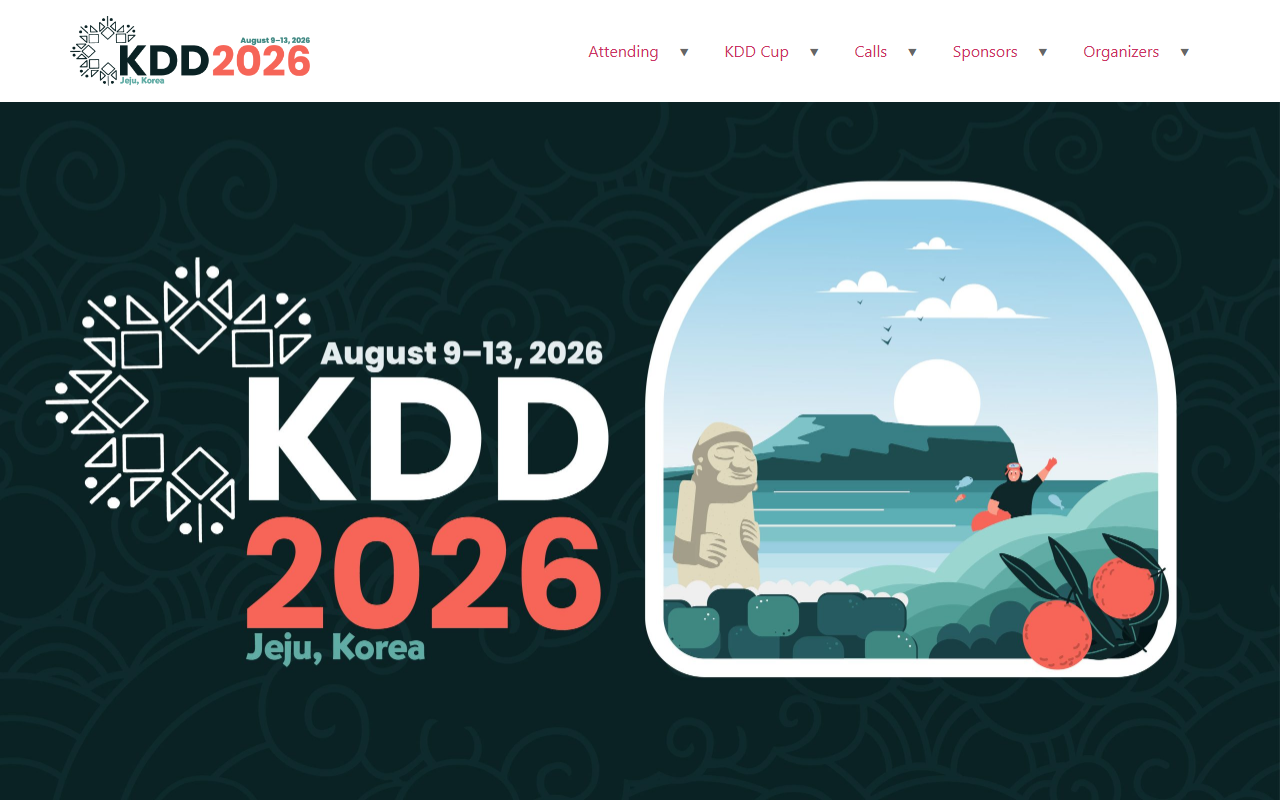
Upon visiting the KDD 2026 website, I was greeted by a clean, minimalistic layout that immediately focuses on the core event details. The homepage displays the conference location—International Convention Center Jeju (ICC Jeju) in Jeju, Korea—and dates: August 9-13, 2026. A prominent navigation bar directs visitors to each call for papers: Research Track, Applied Data Science (ADS) Track, Datasets and Benchmarks Track, and AI for Sciences Track. There's also a curious note about an OpenReview Data Leak, which suggests the team is transparent about past issues. The design is straightforward, lacking flashy animations but providing clear, actionable information for prospective authors and attendees. I found the onboarding experience intuitive: within seconds, I knew exactly what tracks were open and where to submit.
What KDD 2026 Offers as a Learning Platform
KDD is the flagship conference of the ACM Special Interest Group on Knowledge Discovery and Data Mining (SIGKDD). As a learning platform, it delivers immense value to anyone working in Text AI, natural language processing, and broader data science. The conference features multiple tracks that cover the entire lifecycle of AI research. The Research Track is where you'll find state-of-the-art methodologies, including transformer architectures, graph neural networks, and unsupervised learning techniques. The Applied Data Science (ADS) Track bridges theory and practice, showcasing deployed systems and real-world case studies. For those building datasets, the Datasets and Benchmarks Track is invaluable—it presents new, rigorously curated collections that can accelerate your own experiments. The AI for Sciences Track highlights cross-disciplinary work, from drug discovery to climate modeling. Each track publishes peer-reviewed papers, and the proceedings are archived in the ACM Digital Library, providing a permanent reference library for learners.
The conference also includes workshops, tutorials, and keynotes from industry leaders. While the 2026 site doesn't list specific sessions yet, past KDD events have covered topics like large language model evaluation, responsible AI, and scalable graph analytics. This makes KDD 2026 a living textbook for text AI: you can attend paper presentations to learn techniques and then discuss them directly with authors. The networking opportunities—poster sessions, social events—are part of the learning experience, allowing you to ask questions and clarify doubts in real time.
Technical and Competitive Context
KDD is one of the top conferences in data mining, competing with NeurIPS, ICML, and AAAI. Unlike NeurIPS, which often skews toward deep learning theory, KDD emphasizes robust, reproducible, and deployable systems. Its Applied Data Science track is a standout feature, often missing from more theory-focused conferences. If you're a practitioner looking to learn how commercial AI systems are built, KDD provides more actionable insights than, say, ICML. However, the conference's focus is broad—it doesn't specialize solely in text AI. For dedicated NLP researchers, ACL or EMNLP may be more focused. But for anyone wanting a holistic view of AI's role in data-driven decision making, KDD is unmatched.
On the technology side, KDD uses OpenReview for paper submissions, allowing transparent peer review with public discussions. The website itself is static HTML—no API, no interactive learning dashboard. That's expected for a conference site; the learning happens offline through presentations and proceedings. There are no pricing tiers listed because attending a conference is not a SaaS subscription. Registration fees are typically announced later, but expect early-bird rates around $600-900 for ACM members, with student discounts.
Strengths and Limitations
A genuine strength of KDD 2026 as a learning platform is its breadth. You can absorb cutting-edge research from five distinct tracks, all curated by leading experts. The Jeju location and the conference's reputation ensure high-quality attendance. Another plus is the emphasis on reproducibility and datasets, which is critical for advancing text AI responsibly. However, a real limitation is time and cost. Attending in person requires travel, accommodation, and registration fees, pricing out many individuals and small teams. Additionally, the website lacks any digital learning materials—no pre-recorded talks, no interactive code notebooks. If you cannot attend, you miss the full experience. The conference also doesn't offer certifications or structured learning paths; it's a passive consumption event unless you actively participate.
KDD 2026 is best suited for researchers, data scientists, and machine learning engineers who want to stay at the frontier of applied AI. It is less ideal for beginners seeking guided tutorials or those on a strict budget. For self-paced learners, alternative platforms like Coursera or Udacity offer structured courses, but they lack the immediacy of peer-reviewed research. If you can afford the travel and time, KDD 2026 is an unparalleled deep dive into text AI and data science. Visit KDD 2026 at https://kdd2026.kdd.org/ to explore it yourself.













Comments