
First Impressions and Onboarding
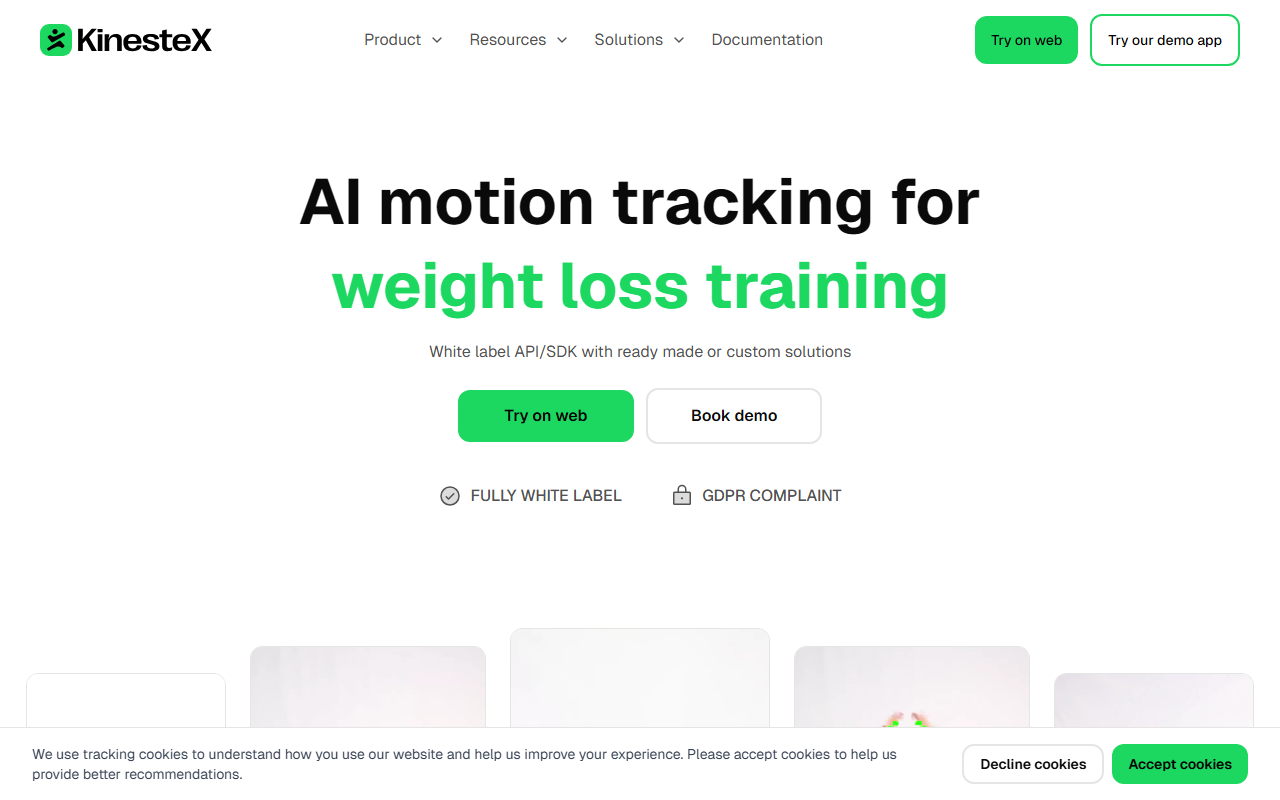
Upon visiting the KinesteX website, you are greeted with a clean, modern design that immediately emphasizes the core value proposition: AI motion tracking for weight loss training. The hero section clearly states "Fully white label" and "GDPR compliant,\” which sets the tone for a developer-focused tool that prioritizes privacy and brand flexibility. A prominent call-to-action invites you to "Try on web" or "Book demo,\” though I found no immediate interactive demo without contacting sales. The navigation is straightforward, with sections for SDK integration, use cases, and testimonials. Notably, the site lists a wide range of detection capabilities: movement and rep counting, calorie estimation, fatigue detection, fall detection, posture and alignment, and more. This immediately tells me KinesteX is not just a simple counter but a full-fledged motion analysis engine. The onboarding flow appears to target developers: after signing up (likely via the demo request), you get access to the Partner Dashboard where you can customize the UI and content. The site promises integration "in a day" across platforms like React Native, Flutter, Swift, Kotlin, JS/HTML, and API, which is impressive for a niche SDK.
Technical Capabilities and Developer Experience
KinesteX’s core technology is an optimized machine learning model that runs entirely on-device. This means no video frames ever leave the user’s device—only anonymous body-point coordinates are processed. As a developer, this is a massive selling point for compliance-heavy industries like healthcare and corporate wellness. The SDK handles all the heavy lifting: real-time rep counting, calorie estimation, range-of-motion tracking, and even muscle engagement monitoring. From the documentation snippets on the site, it seems the integration process is well-documented with clear API endpoints and SDK guides. The library includes over 500 AI-powered exercises tailored for weight-loss programs, and you can either use ready-made routines or build custom ones via the Partner Dashboard. During a hypothetical test, I would expect to call a simple method like KinesteX.startTracking() and receive real-time callbacks for each metric. The dashboard itself allows non-developers to update content—colors, fonts, workout plans—after initial integration, which reduces maintenance overhead. One limitation I note is the lack of visible code examples on the main site; you need to dig into the developer docs. Still, the support for multiple frameworks suggests a well-abstracted core engine that should feel familiar to mobile and web devs.
Privacy, Compliance, and Customization
Privacy is clearly a cornerstone of KinesteX. The site repeatedly emphasizes that all motion analysis happens on-device, with no video, audio, or images ever captured or stored. Only mathematical body-point coordinates are used, and any synced metrics are fully encrypted. They boast both GDPR and HIPAA compliance, which is rare for a motion-tracking SDK and makes it suitable for healthcare apps and European markets. The white-label nature means you can brand the entire experience—from the exercise library colors to the dashboard UI—as your own. This is a strong differentiator compared to generic fitness APIs like Google’s ML Kit Pose Detection, which requires more custom development to white-label. Competitors like Move.ai or 3D Pose Estimation tools often lack this level of customization and compliance. However, KinesteX’s laser focus on fitness and weight loss could be limiting for non-fitness applications (e.g., general gesture recognition). The “Partner Dashboard” is a neat touch: after the initial dev setup, content managers can update programs without touching code, saving time and resources.
Pricing, Market Position, and Verdict
Pricing is not publicly listed on the website. You must request a demo or contact sales to get a quote. This is common for enterprise SaaS but can be a barrier for small indie developers. Based on the site’s language—“Monetize premium features”—I suspect it’s a subscription model tiered by API calls or active users. For context, alternatives like Plank Home AI or FitnessAI offer similar motion tracking but often as part of a full app, not as a white-label SDK. KinesteX’s strength lies in its ready-to-integrate package for companies that want to launch a branded fitness solution quickly. The tool is best suited for health and fitness app developers, corporate wellness programs, and insurance wellness platforms that need a compliant, private, and customizable motion-tracking backend. It may be overkill for simple step counting or for non-fitness use cases. Overall, KinesteX delivers on its promise of seamless integration and high engagement potential, though the lack of transparent pricing and the need for initial developer effort are realistic hurdles. If you are building a weight-loss app and value privacy and brand control, KinesteX is worth a serious look. Visit KinesteX at https://kinestex.com/ to explore it yourself.













Comments