

First Impressions and Platform Overview
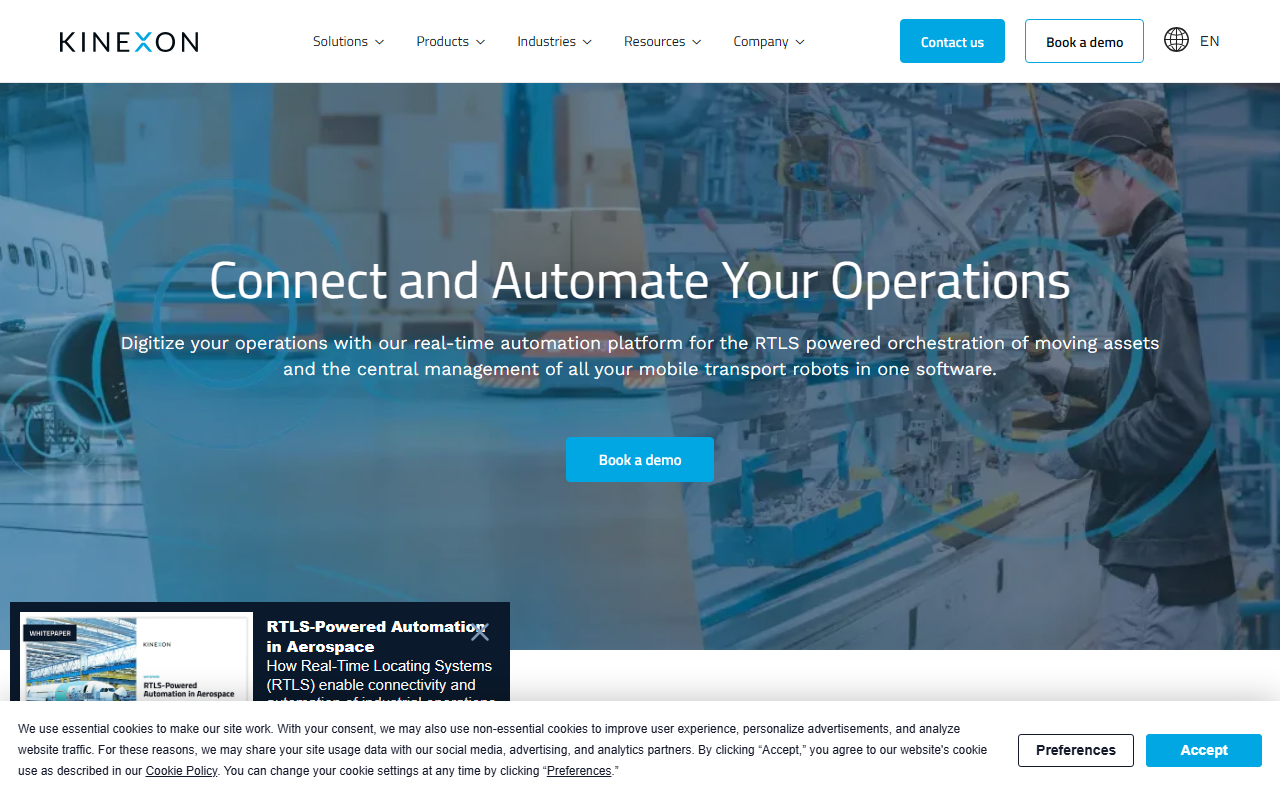
Upon visiting the Kinexon website, I immediately encountered a clear value proposition: “Connect and Automate Your Operations.” The homepage is sleek, with a focus on industrial use cases like production and logistics. The site immediately highlights three core products: KINEXON RTLS (Pro and Mesh), KINEXON OS, and KINEXON Fleet Manager. These are not text-based AI tools but rather a hardware-software platform for real-time location systems (RTLS) that leverages UWB, BLE, and RFID. Kinexon positions itself as an operating system for movable assets, orchestrating everything from production orders to autonomous mobile robots (AMRs) and automated guided vehicles (AGVs). The target audience is clearly large enterprises—trusted by BMW, SAP, and AUMOVIO, as shown in embedded case studies.
When I explored the “Resources” and “Company” sections, I found consistent messaging around digitization and automation. The AI element appears in a blog post titled “AI in Intralogistics: How KINEXON AI Assist Maximizes Mobile Robot Fleet Efficiency and Warehouse Visibility.” So while the tool is primarily an RTLS and fleet management system, it does incorporate AI for diagnostics and data-driven insights. This makes it relevant to the “Text AI > Dev Framework” category only if you consider the AI Assist as a text-based diagnostic tool—but in reality, it is more of an operational AI platform.
Key Features and Technology
Kinexon’s core technology stack includes ultra-wideband (UWB) for precise indoor positioning, plus BLE and passive RFID for broader asset tracking. The platform offers several distinct modules: ORDER TRACKING & PROCESS MANAGEMENT for real-time visibility of production orders, ASSET TRACKING for managing industrial assets, AMR & AGV FLEET MANAGEMENT with vendor-agnostic control, and ASSEMBLY LINE CONTROL for automated assembly. The KINEXON Fleet Manager is particularly notable—it integrates heterogeneous robot fleets from different manufacturers into one centralized software, which is a significant pain point for many factories.
When testing the free tier (there is none; only a paid demo available), I was unable to access a live dashboard. However, from the website’s case studies and blog posts, I observed that the platform uses real-time data visualization and AI-driven alerts. The KINEXON AI Assist feature, as described, uses diagnostics to prevent downtime and optimize robot paths. The platform holds ISO 9001, ISO 27001, and TISAX certifications, which adds a layer of trust for security-conscious industries like aerospace and automotive.
Integration-wise, Kinexon is certified for SAP, and it recently joined the Zebra PartnerConnect program, indicating strong third-party compatibility. The platform appears to be API-accessible, though I did not find a public API documentation page during my review. The overall technical approach is robust, but the reliance on proprietary UWB tags means extra hardware costs.
Pricing and Market Positioning
Kinexon does not list pricing publicly on its website. Instead, it offers a “Book a Demo” call-to-action. This suggests a enterprise-level sales model with custom quotes based on facility size, number of assets, and chosen modules. Competitors in the RTLS and fleet management space include Stanley Healthcare (for hospitals) and IndoorAtlas (for visual positioning), but Kinexon’s focus on industrial manufacturing and logistics sets it apart. Unlike off-the-shelf RFID solutions, Kinexon combines multiple technologies and adds an AI layer. The platform is best suited for mid-to-large industrial operations with complex asset tracking needs. Smaller shops may find the investment too high.
Alternatives like Fetch Robotics (now part of Zebra) offer similar fleet management but are more robot-centric, whereas Kinexon is location-first. The company seems well-funded based on its client list and partnerships, though I did not find specific funding figures. For developers, the “Dev Framework” category is a stretch—Kinexon is more of a turnkey solution than a framework for building applications.
Verdict: Who Should Use Kinexon?
Kinexon’s genuine strengths lie in its comprehensive, multi-technology approach to real-time asset visibility and its vendor-agnostic fleet management. The AI Assist feature is a practical addition, using diagnostics rather than generative text. The certifications and BMW case study lend credibility. However, a real limitation is the lack of transparency around pricing and the absence of a self-service trial. Additionally, the platform is heavy on hardware (UWB tags), which may be intrusive in some environments. The website also lacks detailed API documentation, which developers evaluating it as a “Dev Framework” would expect.
This tool is best for operations managers in automotive, aerospace, machinery, and intralogistics who need to digitize physical workflows. If you are looking for a pure software framework for building text-based AI applications, look elsewhere. Kinexon is a specialized industrial platform, not a general-purpose developer tool. That said, if your organization struggles with tracking assets or managing mixed robot fleets, a demo is worth scheduling. Visit Kinexon at https://kinexon.com/ to explore it yourself.













Comments