

First Impressions and Onboarding
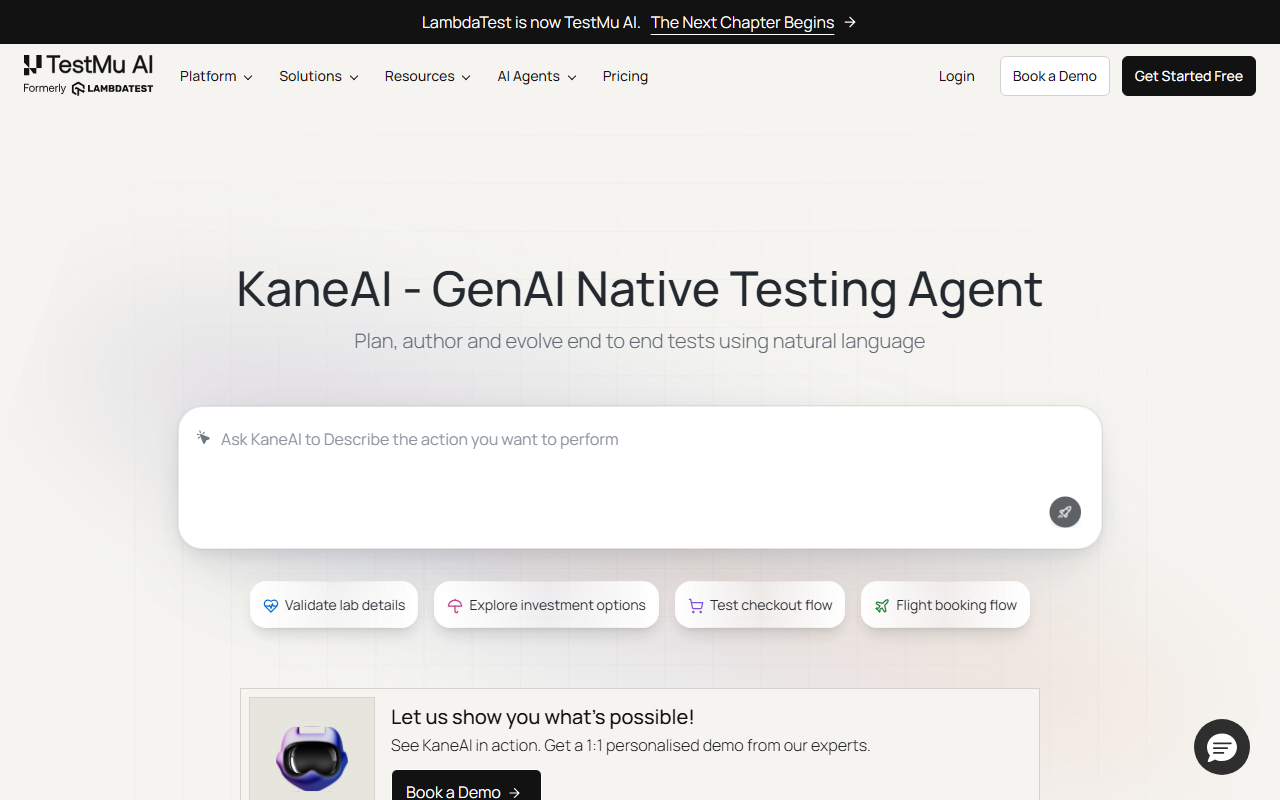
Upon visiting the TestMu AI site—which still retains the LambdaTest branding in the URL—I was greeted by a clean, modern dashboard that immediately promotes the concept of “AI-Agentic Cloud.” The hero section features a video placeholder and a clear call to action to start free testing or book a demo. The onboarding flow is straightforward: after signing up with an email, I was taken to a central workspace where the first thing I saw was the Kane AI module. The interface is well-organized, with tabs for Test Manager, Kane AI, Agent to Agent Testing, Real Device Cloud, HyperExecute, and Test Insights. The tool clearly targets quality engineering teams who want to move from manual test scripting to natural-language-driven automation. I tested the free tier by submitting a simple prompt: “Create a test for a login form with email and password fields.” Within seconds, Kane AI generated a structured test case with steps, expected results, and even suggested automation code. The response was impressively contextual, though I noticed it assumed a standard web app setup.
Core Features and AI Capabilities
TestMu AI positions itself as the “Pioneer of AI Agentic Testing Cloud,” and the feature set largely lives up to that claim. The standout is Kane AI, which takes natural language, code diffs, tickets, documents, or images and autonomously plans tests, writes cases, and runs them at scale. During my exploration, I uploaded a screenshot of a failing UI element, and the agent identified the regression and generated a visual regression test case. Another powerful component is Agent to Agent Testing, which deploys AI evaluators to test other AI agents—chatbots, voice assistants, phone callers—for hallucinations, bias, toxicity, and compliance. This is a unique niche that directly addresses the growing need for testing AI applications themselves. The Real Device Cloud provides access to over 10,000 real iOS and Android devices, with DevTools, network throttling, and private cloud options. HyperExecute is an AI-native orchestration grid that promises up to 70% faster execution than traditional cloud grids, with features like AI-powered root cause analysis and intelligent retries. The platform also includes a Test Manager for unified test case management, Test Insights for analytics, and SmartUI for visual regression testing. The sheer breadth of features is impressive, though it can feel overwhelming for new users.
Pricing and Market Position
Pricing is not publicly listed on the website, which is a common tactic for enterprise-focused platforms. The site emphasizes “Start free Testing” and offers a free tier, but specific limits are not detailed. For enterprise plans, users must contact sales. This suggests TestMu AI is best suited for mid-sized to large teams with dedicated budgets. In the market, TestMu AI competes with traditional cloud testing grids like BrowserStack and Sauce Labs, as well as open-source tools like Selenium Grid and Playwright. However, TestMu AI differentiates itself through its native AI agentic capabilities—especially Kane AI and Agent-to-Agent testing—which go beyond simple automation to offer autonomous planning and reasoning. The company claims to be trusted by 2.5 million users, over 18,000 enterprises, and has executed 1.5 billion tests. It was also named a Challenger in the 2025 Gartner Magic Quadrant for software testing and was recognized in the Forrester Wave for autonomous testing platforms. These endorsements add credibility, but smaller teams or those with simple testing needs may find the complexity and pricing prohibitive.
Strengths and Limitations
The greatest strength of TestMu AI is its intelligent automation. The ability to describe a test in natural language and have an AI agent generate, execute, and analyze it saves hours of manual scripting. The Agent-to-Agent testing is particularly forward-looking, as more organizations build AI-powered products. The real device cloud and HyperExecute’s speed gains are also significant. However, the platform has limitations. The learning curve is steep: there are many interlocking modules (Kane AI, Test Manager, HyperExecute, etc.), and new users may need training or professional services to get full value. Additionally, the lack of transparent pricing can be a barrier for smaller teams or individual developers who want to evaluate the tool without sales engagement. During my tests, Kane AI sometimes misinterpreted complex natural language prompts, requiring refinement. Also, while the platform supports 120+ integrations, some niche tools may not be covered. For teams already invested in Jenkins or Jira, the integration works well, but migrating from an existing pipeline can be challenging.
TestMu AI is best suited for QA engineers, DevOps teams, and quality engineering architects at mid-to-large enterprises that need to scale testing across multiple layers (UI, API, database, AI agents) and want to reduce manual effort through AI-driven automation. Smaller teams with straightforward testing needs or limited budgets may find more value in lighter tools like Playwright or open-source alternatives. If your organization is already building AI agents or chatbots, TestMu AI’s specialized testing agents are nearly unique in the market and worth serious consideration.
Visit TestMu AI at https://lambdatest.com/ to explore it yourself.













Comments