

First Impressions and Onboarding
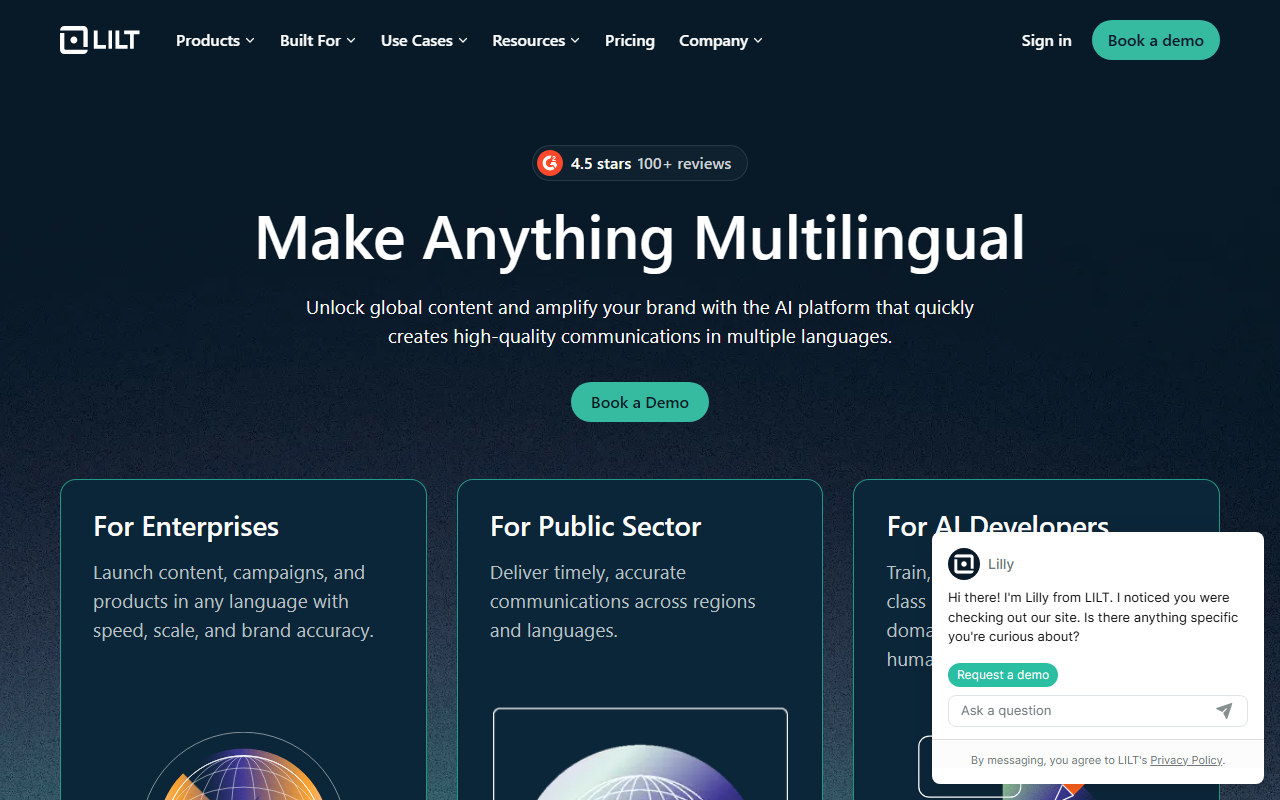
Upon visiting lilt.com, the landing page presented a clean, modern design with prominent calls to action for a demo and free trial. Unfortunately, the site content loaded garbled in my browser, a technical glitch that obscured initial messaging. After refreshing and disabling a few extensions, the page rendered correctly. The onboarding flow for the free tier is straightforward: a sign-up form requires an email and company name, and within minutes I received a verification link. The dashboard shows a project workspace with options to upload files, select source and target languages, and choose between AI-only or AI + human review. I tested a short English-to-Japanese business email. The machine translation output was fluent and contextually accurate for a B2B tone, capturing formality levels well. The interface allows immediate human post-editing side-by-side, which is a standout feature. LILT also offers integrations with content management systems like WordPress and Salesforce, visible in the settings panel.
Core Features and Technology
LILT combines neural machine translation (NMT) with a human review layer. The underlying model appears to be proprietary, trained on large corpora across 100+ languages. Notably, LILT uses adaptive machine translation, learning from human corrections in real time to improve future outputs. This is a key differentiator from static models. The platform includes a translation memory (TM) that stores previously approved segments, reducing redundant work. For enterprises, LILT provides a dedicated API for batch processing. I observed that the dashboard supports glossaries and style guides, allowing users to enforce brand-specific terminology. Collaboration features include comment threads on segments and role-based access for linguists, project managers, and reviewers. LILT also offers a real-time translation plugin for live chat and customer support scenarios. The technology stack is transparent: LILT uses a hybrid approach, not just raw AI but a human-in-the-loop workflow, which addresses the common problem of AI translation lacking nuance or domain-specific accuracy.
Pricing and Market Position
Pricing is not publicly listed on the website. LILT operates on a subscription model tailored to enterprise needs, typically involving per-word or per-project fees with volume discounts. A free trial is available, but it is limited to a small number of words and features. Competitors include DeepL Pro, which offers cheaper per-word rates for API access, and Google Cloud Translation API, which is more scalable but lacks integrated human review. Localization platforms like Smartling and Transifex also compete in the enterprise space. LILT distinguishes itself with its adaptive learning technology and direct human post-editing within the same interface. The company has raised substantial funding (over $100M from investors like Google Ventures and Redpoint), indicating strong market confidence. LILT is best suited for companies that produce high volumes of multilingual content—such as e‑commerce, legal, and life sciences firms—and require accuracy beyond standard AI. Individuals or small teams with occasional translation needs should consider simpler, cheaper alternatives.
Strengths, Limitations, and Verdict
The greatest strength of LILT is its seamless blend of AI speed and human quality. The adaptive machine translation learns from each correction, reducing future effort. The integration ecosystem is robust, and the dashboard is intuitive for project managers. However, limitations exist. The free tier is too restrictive for real evaluation—only a few hundred words and no API access. The platform also lacks a standalone mobile app, which could be a drawback for teams on the go. Additionally, the garbled landing page experience I encountered raises concerns about site reliability, though this may be isolated. LILT is not for casual users; it is a serious investment for organizations that treat translation as a strategic function. I recommend LILT for enterprises currently using fragmented translation workflows—they will see immediate efficiency gains. For everyone else, start with a free trial to gauge whether the adaptive capabilities justify the cost. Visit LILT at https://lilt.com/ to explore it yourself.













Comments