

First Impressions and Onboarding
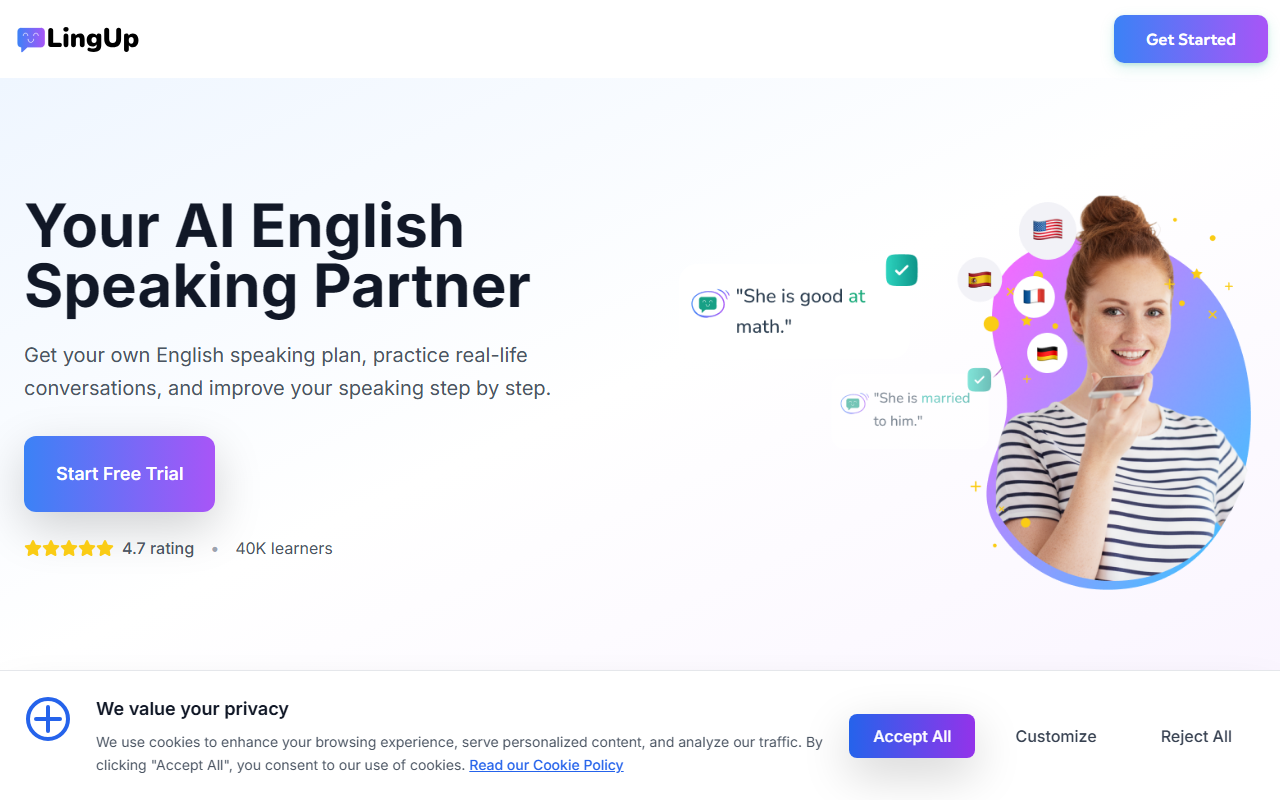
Upon visiting the LingUp website, the first thing that strikes me is the clear focus on a specific pain point: “19 out of 20 students spend years learning English, but still can't speak fluently.” The copy immediately frames the tool as a solution for learners who feel stuck—those who know grammar but freeze in real conversations. The landing page uses simple language, a clean layout, and short testimonials from both Google Play and the App Store to build credibility. I noticed the site offers a demo scheduling option for content creators and influencers, but the main flow is directed at individual learners. There is no web-based app visible; the call-to-action buttons lead to mobile store downloads. The onboarding appears straightforward: you start with a “Start Free Trial” button, which likely prompts you to create a personalized plan based on your level, goals, and interests. The website lists an average of 38 minutes of speaking and 22 minutes of listening per day, indicating the tool strongly emphasizes active practice.
Core Features and How They Work
LingUp builds a personalized learning plan after you specify your current ability and objectives. The core experience revolves around realistic conversations—not drills or multiple-choice exercises. The AI listens to your spoken responses, provides instant feedback on pronunciation, vocabulary, and grammar, and adapts subsequent sessions accordingly. The site claims learners speak over 1,500 words aloud in their first week. Unlike many language apps that focus heavily on reading and writing, LingUp positions itself as a speaking partner that mimics human interaction. A comparison chart on the page highlights advantages over human partners: personalization to your level, a non-judgmental environment, cultural context and idioms, progress tracking, and the ability to practice anytime. The tool is supported by an undisclosed AI model, but the feedback mechanism suggests speech recognition and natural language processing are central. Integrations are limited to mobile platforms (iOS and Android), and there is no mention of an API or desktop version.
User Feedback and Community Indicators
The website displays a 4.7 rating from 40,000+ learners across app stores. Multiple testimonials repeat similar sentiments—learners appreciate having “someone to talk to” and receiving corrections in real time. One user explicitly says, “the best and only way to learn English is by speaking it,” which aligns with LingUp’s core philosophy. However, the repetition of the same two or three quotes (with slightly varied wording) raises a minor trust flag; I would prefer to see a wider range of authentic reviews. The presence of both Google Play and App Store listings, combined with a 40K user base, suggests the tool is established but not yet a mainstream giant. For context, competitors like ELSA Speak also focus on speaking and pronunciation with AI feedback, while Duolingo gamifies vocabulary and grammar drills. LingUp differentiates itself by being purely conversation-driven and by providing a personalized, adaptive path rather than a fixed curriculum.
Strengths, Limitations, and Final Verdict
The genuine strength of LingUp is its targeted approach to speaking fluency. It directly addresses the “translate in your head” and “forget words when needed” problems by forcing active production in realistic scenarios. The personalized plan adapts over time, which keeps practice relevant. The non-judgmental environment is a major plus for shy learners. On the limitation side, the lack of publicly listed pricing is frustrating—you cannot evaluate cost before signing up. There is no web version, so learners without a smartphone are excluded. Additionally, the “Schedule Your Demo” section seems aimed at content creators who want to use LingUp for their audience, not at individual learners, which creates a confusing dual-purpose message. I suspect the tool uses a subscription model (likely monthly or annual), but without transparency, it’s hard to recommend blindly. This tool is best suited for intermediate English learners who have a solid foundation but lack speaking confidence. Beginners might struggle without written support or explicit grammar explanations. If you are tired of passive learning apps and want a focused speaking coach in your pocket, LingUp is worth a free trial—but be prepared to commit to mobile-only practice. For a more transparent pricing alternative, check out ELSA Speak or Cambly.
Visit LingUp at https://lingup.ai/ to explore it yourself.











Comments