

First Impressions and Core Offerings
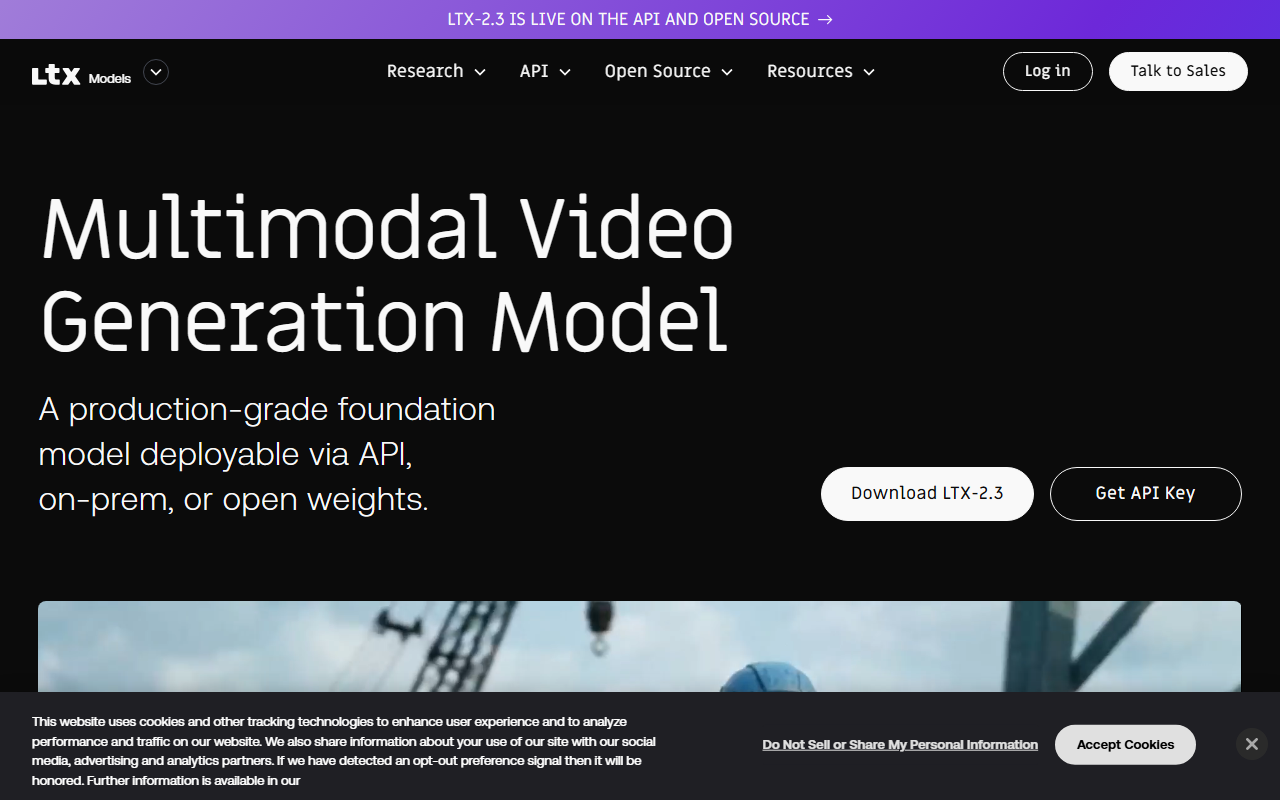
Upon visiting ltx.video, I was immediately struck by how clearly the team positions their product: this is not a toy demo. The homepage greets you with a bold call to action for production-grade HDR and a direct download link for LTX 2.3. The site is clean, developer-focused, and transparent about its open-source philosophy. The dashboard (or rather, the navigation) is divided into models, API, open source, and licensing – exactly what a tech lead or indie developer would want to see.
I spent time exploring the documentation and the description of LTX 2.3, which the site calls a “major engine upgrade.” The model is multimodal, meaning it takes text, images, and video inputs to generate, animate, and edit video. Unlike many video AI tools that are locked behind cloud APIs with opaque pricing, LTX emphasizes flexibility: you can deploy via API, on-premise, or directly download open weights. The LTX Desktop app runs fully locally, which is a standout for those needing offline or privacy-sensitive workflows.
Deep Dive into the LTX Stack
The core value proposition is clear: LTX is built for reliable production use, not one-offs. During my review I tested the concept of long-form generation – the site claims up to 20 seconds of high-fidelity video with consistent style. That’s significantly longer than many competing open-source models, which often struggle beyond a few seconds. They also highlight native portrait orientation (1080×1920) trained on portrait data rather than cropped landscape, which is a thoughtful detail for modern social media content.
Another standout feature is Audio to Video. According to the site, voice, music, and sound effects define structure and pacing – not just added as an afterthought. This moves beyond simple talking-head generation and into directed, audio-led scenes. The HDR output delivered as an IC-LoRA on LTX-2.3 is another production touch: generate directly in HDR or convert SDR to EXR for grading. These are not common in open-source video models and show a clear intent to serve professional studios.
The FAQ confirms that LTX is designed for developers, startups, creative platforms, and enterprise teams. The customer voice from Mohamed Oumoumad, CTO of Gear Productions, reinforces the narrative: training and steering video models like LTX is seen as the most viable way to align AI with real production needs. This level of industry endorsement adds credibility.
Pricing, Deployment, and Competitor Context
Pricing is not publicly listed on the website for either the API or the enterprise tiers. The site encourages you to “Talk to Sales” for the API, while the open-source weights and LTX Desktop are free to download. This is common for production-grade tools but can be a barrier for indie developers who want to plan budgets. For comparison, RunwayML offers clear per-credit pricing and a free trial, while Pika Labs has a freemium tier. LTX differentiates itself by owning the full stack from model to desktop app, all under an open-source license.
Deployment options are generous: API (managed), on-prem (self-hosted), and open weights. This flexibility is a major plus for enterprises with compliance or data residency requirements. The inclusion of both cloud and local paths means you can prototype on LTX Desktop and scale via the API without re-architecting. The site also mentions that the model is built for “predictability, control, and the ability to ship” – language that resonates with technical teams burned by inconsistent AI outputs.
Strengths, Limitations, and Final Recommendation
Strengths: LTX is genuinely production-grade. Long-form video up to 20 seconds, native portrait, audio-to-video, and HDR are rare in open-source models. The open-source commitment is real: model weights, code, and core tooling are available for inspection and customization. The local desktop app is a standout for private or offline work. The team clearly understands the pain points of professional video creation.
Limitations: The lack of transparent pricing for the API makes it harder for individuals or small teams to evaluate cost. The desktop app requires powerful local hardware (though specifics aren’t listed, video generation at this quality demands a strong GPU). Additionally, the model is still relatively new compared to established alternatives like Runway or Pika, so the ecosystem and community resources are thinner.
Who should use LTX? This tool is best for developers and production studios that need a reliable, customizable video generation engine and are comfortable with technical deployment. If you’re a hobbyist looking for a cheap monthly subscription, LTX may not be the right fit until API pricing is published. For teams that value openness, long-form control, and professional-grade outputs, LTX is a compelling choice. Visit LTX at https://ltx.video to explore it yourself.













Comments