

First Impressions and Onboarding
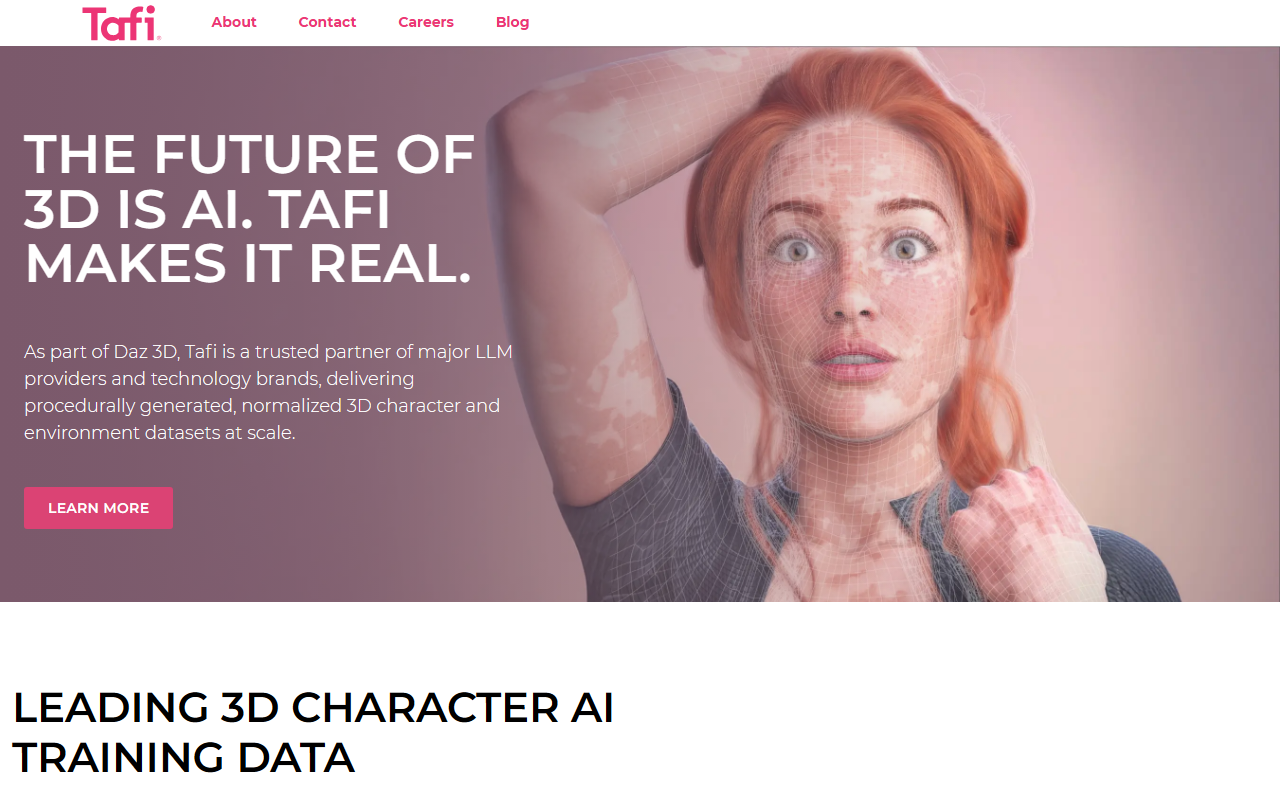
Upon visiting maketafi.com, I encountered an immediate roadblock: a prominent message demanding JavaScript enabled. After refreshing, the dashboard revealed a dense, professional portal heavily branded as Daz 3D. The navigation prioritizes 3D software, models, and memberships, with AI solutions relegated to a sub-section. The site feels less like a neat AI tool and more like an enterprise data marketplace. Without signing up, I could browse high-level use cases—gaming, robotics, healthcare—and request a sample dataset. The free tier isn’t publicly listed; instead, you submit a contact form for access. This starkly contrasts with consumer AI tools that offer instant trials.
Core Capabilities and Technology
This platform solves a specific problem: generating infinite, perfectly labeled training data without real-world collection. Daz 3D’s two-decade-old library of millions of structured 3D assets—rigged characters, clothing, environments—forms the foundation. The technology stands out for its clean topology, morph systems, and machine-readable scene structure. During my review, I noted emphasis on “perfect ground truth”: automatic generation of segmentation maps, depth maps, and pose labels. This eliminates the tedious annotation process. The datasets are built for computer vision, robotics, and simulation pipelines. I tested the “request sample” flow, which led to a sales-oriented contact form. No interactive demo exists, but the documentation underscores scalable dataset generation. The system integrates with standard ML pipelines, though no API documentation is immediately visible.
Market Position and Pricing
Tafi positions itself as an enterprise-grade synthetic data provider, competing with NVIDIA Omniverse Replicator and Microsoft AirSim. Unlike those, it leverages Daz’s pre-existing asset library, reducing the need to build scenes from scratch. Pricing is not publicly listed on the website—likely because enterprise contracts are negotiated per project. The site mentions “Daz Premier”, “Daz Plus”, and “Daz Base” memberships for 3D model purchases, but the AI dataset service appears separate. This lack of transparency may frustrate smaller teams or independent developers. The platform is best suited for large enterprises needing commercially safe data with clear IP rights. For individual AI enthusiasts or small startups, the barrier to entry is high, and competitors like Unity’s Perception tools offer more accessible alternatives.
Verdict
Strengths include massive scale (millions of production-grade assets), full commercial licensing, and structured data designed for AI. The ability to control variables like lighting, pose, and camera angle in synthetic scenes is a genuine advantage. However, the product has real limitations: no self-service tier, no public pricing, and a website that feels dated and Javascript-dependent. The tool is not for casual image generation—it’s a specialized data engine. I recommend it to enterprise AI teams working on computer vision, robotics, or autonomous systems who already have a budget for data procurement. Others should explore open-source alternatives or free dataset generators first. Visit Tafi at https://maketafi.com/ to explore it yourself.













Comments