

First Impressions and Onboarding
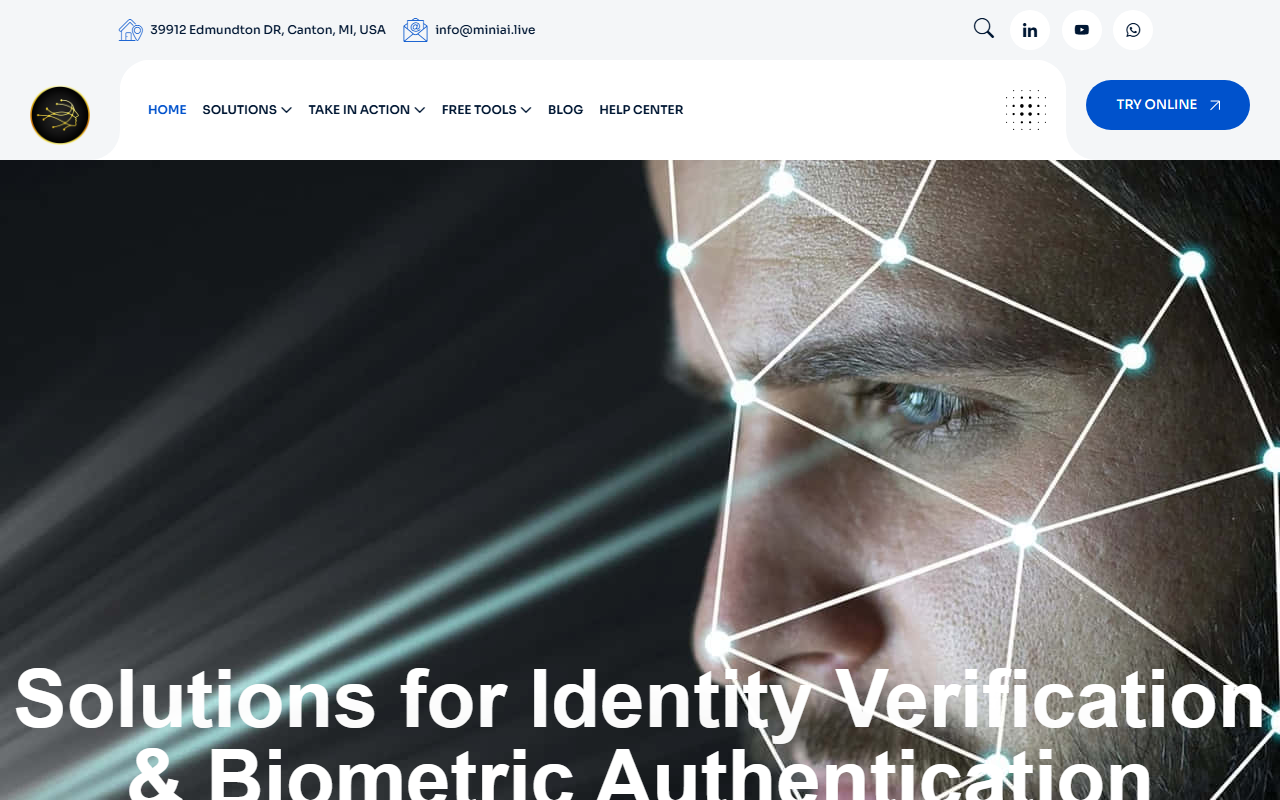
Upon visiting the MiniAiLive website, the dashboard immediately highlights six SDKs: Face Recognition, Face Liveness Detection, ID Document Recognition, ID Document Liveness Detection, Deepfake Detection, and License Plate Recognition. The landing page is clean and product-focused, with prominent "Try Online" buttons for each SDK. I clicked through to the deepfake detection demo and was able to upload an image to test against models like Stable Diffusion and DALL-E. The interface returns a JSON result with confidence scores. The onboarding flow is straightforward: you can either try the live demos, explore the GitHub repositories (26 available), or access HuggingFace demos directly. This low-friction approach makes it easy to evaluate the technology without signing up first.
Core Capabilities and Technology
MiniAiLive specializes in identity verification and biometric authentication SDKs that run fully offline on-premises or on mobile devices. The face liveness detection uses 3D depth analysis and passive checks to detect spoofing attacks like printed photos and replay videos—boasting iBeta Level 1 and 2 certification from a NIST NVLAP lab. The deepfake detection SDK claims to identify images generated by MidJourney, DALL-E, Flux, StyleGAN, and more. During my test, the tool accurately flagged a synthetic face from a public dataset. ID document liveness detection goes further, detecting screen replays and printed copies. All SDKs support mobile (iOS/Android/Flutter) and server (Kubernetes/Linux/Windows) deployment, with detailed documentation available. The technology relies on proprietary AI and machine learning models, and the company emphasizes data security through on-prem processing.
Pricing and Market Position
Pricing is not publicly listed on the website. MiniAiLive offers free trials through the "Try Online" portal, but for production licensing, you must contact their sales team. This lack of transparency is a common trait for enterprise-grade SDK vendors. In the biometric verification market, competitors include AWS Rekognition, Microsoft Azure Face API, and Onfido. Unlike those cloud-first solutions, MiniAiLive differentiates itself by providing fully offline SDKs with source code available via GitHub. This suits organizations with strict data residency requirements or those needing low-latency, air-gapped deployments. The company is based in Michigan, USA, and lists clients of all sizes, but specific user counts or funding details are absent. The technology appears mature and certification-backed, positioning it well for KYC, access control, and fraud prevention use cases.
Strengths, Limitations, and Final Verdict
MiniAiLive's strengths lie in its comprehensive portfolio—covering face, ID, liveness, and deepfake detection in one SDK suite—and its offline capability with iBeta certification. The low latency (













Comments