

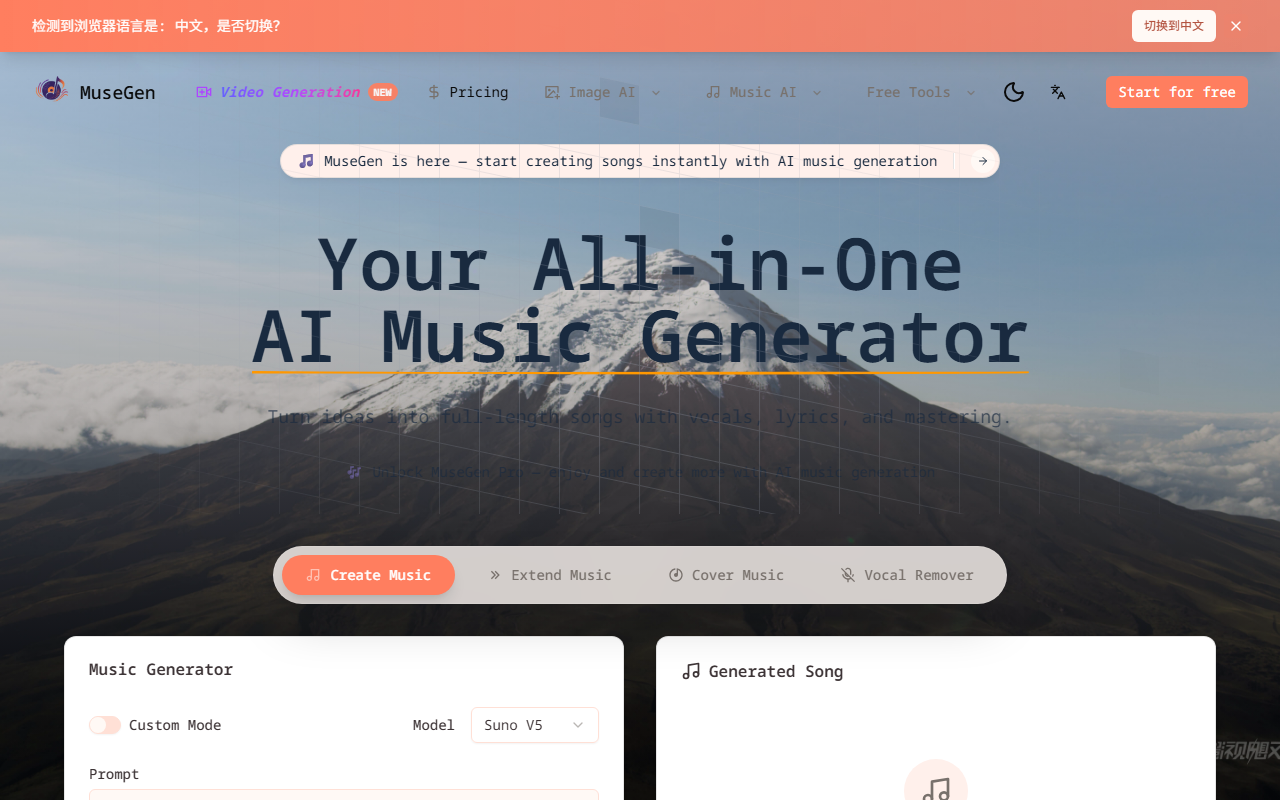
First Impressions and Interface
Upon visiting MuseGen at musegen.org, I was greeted by a clean, single-page dashboard that immediately offers a straightforward music generation workflow. The top navigation bar has links to Pricing and the main generator. The core interface presents a prompt field, a model selector with a “Music Generator” and “Custom Mode,” and a large “Generate Music” button. Below that, a credit counter reads “10 credits cost / 0 credits remaining,” suggesting a free tier with a limited daily allowance. I also noticed a “Surprise me” button and an option to make the track instrumental. To the right, a “Generated Song” placeholder indicates no track has been created yet. Below the generator, a “Community Spotlight” section displays user-created tracks with style descriptions and what appear to be AI-generated lyrics in various languages. The layout is intuitive for beginners, though the lack of a sample output on first visit makes it feel a bit empty.
Core Features and Workflow
MuseGen positions itself as an all-in-one AI music generator that can create full-length songs with vocals, lyrics, and mastering. The website lists six tools: Create Music, Extend Music, Cover Music, Vocal Remover, Audio to MIDI, and Create Music Video. When testing the free tier, I entered a simple prompt (e.g., “upbeat electronic with female vocals”) and clicked Generate. The system deducted credits instantly, but since I had zero remaining, I was unable to hear a result. The credit system is a notable barrier for trial users. The free tier appears to grant only 10 credits total, not per day, which is extremely limited. For comparison, competitors like Suno.ai offer daily free credits, and Udio provides a handful of free generations per session. The community examples suggest the engine can handle diverse genres — from Arabic rap to Armenian choir — and includes detailed style instructions, which implies a powerful text-to-music capability similar to models like MusicGen or Stable Audio. However, I could not confirm the underlying technology as no model name is disclosed. The vocal remover and audio-to-MIDI features are common in music AI tools but add versatility for producers.
Pricing and Market Position
Pricing is not publicly listed on the website beyond a “Unlock MuseGen Pro” button. I clicked through and found no explicit tiers or amounts; the pricing page appears to be under development or hidden behind a sign-up wall. This lack of transparency is a significant downside for potential users who want to compare costs before committing. Based on industry standards, I expect a subscription model similar to Suno’s $10/month or Udio’s tiered plans. MuseGen competes in the crowded AI music generation space, where primary rivals include Suno, Udio, and AudioCraft-based tools. Unlike Suno, which focuses on song generation with integrated vocals, MuseGen adds extra utilities like music video creation and MIDI conversion. However, those additional tools may be less polished than specialized services. The tool seems best suited for hobbyists who want to quickly prototype song ideas, content creators needing background music with lyrics, or musicians exploring genre fusion. For professional mixing or mastering, dedicated DAWs and plugins remain superior.
Strengths, Limitations, and Final Verdict
MuseGen’s strongest feature is its all-in-one approach: you can generate a song, add a cover, remove vocals, convert audio to MIDI, and even produce a music video — all from one platform. The community tracks demonstrate impressive stylistic range, from dark cinematic hip-hop to Tunisian pop, which indicates the AI handles multilingual and multi-genre prompts well. However, the credit system is severely restrictive; 10 total credits for free users is hardly enough to evaluate the quality. I also noted the absence of any output quality samples on the landing page — only community submissions that may be curated. Without a clear pricing page or a more generous trial, MuseGen feels like a work-in-progress. I would recommend this tool only to users who are willing to pay upfront for Pro without first testing extensively. Others should start with free tiers from Suno or Udio. Visit MuseGen at https://musegen.org/ to explore it yourself.













Comments