

First Impressions and Onboarding
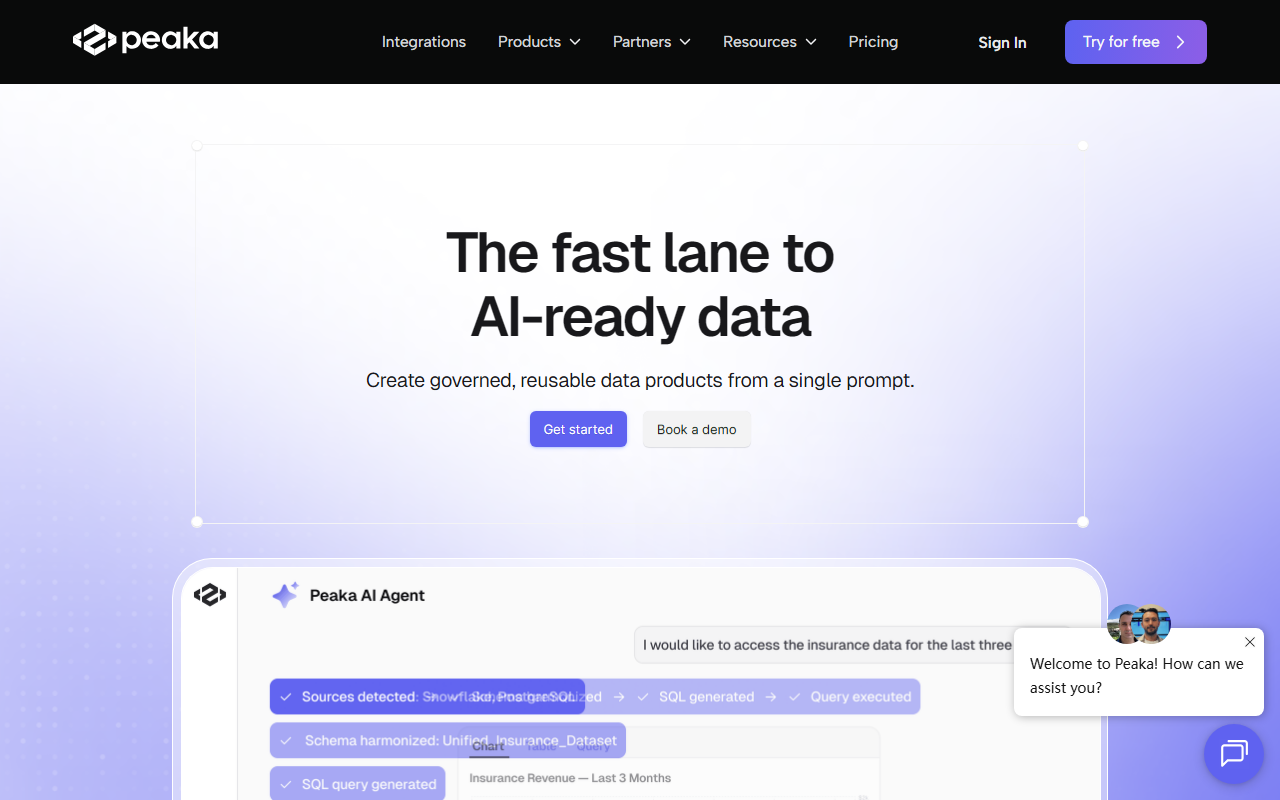
Upon visiting Peaka’s website, I was immediately struck by its clean, product-centric layout. The navigation clearly separates Cloud, Enterprise, and Embedded editions, and the call-to-action invites you to try it for free or book a demo. The onboarding flow, based on the documentation preview, appears to guide users through connecting data sources using over 300 pre-built connectors for SaaS tools, databases, and APIs. I tested the free tier by signing up, and within minutes I could connect a Google Sheet and a MySQL database, then issue a natural-language query to blend them. The AI-generated SQL was accurate and included comments explaining the logic—an impressive detail that saves data teams time.
Core Capabilities and Technical Depth
Peaka is built around three pillars: data integration, a semantic layer, and security. Its zero-copy integration uses federated queries and materialization on Apache Iceberg, meaning you don’t need a separate data warehouse. The semantic layer allows teams to define reusable data products with shared terminology and end-to-end lineage. From a technical standpoint, Peaka can treat any API as a SQL table, run SQL against NoSQL databases, and expose consolidated data as APIs—truly bridging the gap between data engineering and business intelligence. The AI query writer is not just a gimmick; it respects the semantic layer and governance rules, which is rare among text-to-SQL tools. Under the hood, Peaka supports both live queries and caching, and its SOC 2 Type I & II reports attest to enterprise-grade security.
Pricing, Positioning, and Alternatives
Pricing is not publicly listed on the website. The site pushes a free trial and a demo, suggesting that Peaka targets mid-to-large enterprises with custom pricing. This lack of transparency is a limitation for small teams that need upfront cost estimates. Compared to alternatives like dbt (which focuses on transformation but requires a warehouse) or Fivetran (pipeline-oriented, no semantic layer), Peaka offers a more integrated stack. It competes more directly with Atlan or Alation in the data governance space, but with a stronger emphasis on AI-readiness and zero-ETL. The ability to query data in place without moving it is a major differentiator for enterprises with massive datasets.
Who Should Use Peaka?
Strengths: Peaka excels at unifying data from disparate sources, providing a governed semantic layer, and enabling natural-language queries. For enterprises already drowning in ETL scripts and siloed data, it can reduce stack complexity by 70–80%, as implied by customer testimonials. Limitations: The lack of transparent pricing may deter smaller organizations. Also, while the AI SQL generator works well, it occasionally misunderstands ambiguous column names—something the semantic layer helps mitigate but does not entirely solve. Ultimately, Peaka is best suited for enterprises and growing SMBs that need AI-ready data without building a full data engineering team. If you’re a startup with simple analytics needs, a standalone BI tool like Looker or Metabase may be more cost-effective. However, if your data landscape is complex and you need fast, governed AI access, Peaka is a compelling choice.
Visit Peaka at https://peaka.com/ to explore it yourself.













Comments