

First Impressions and Core Capabilities
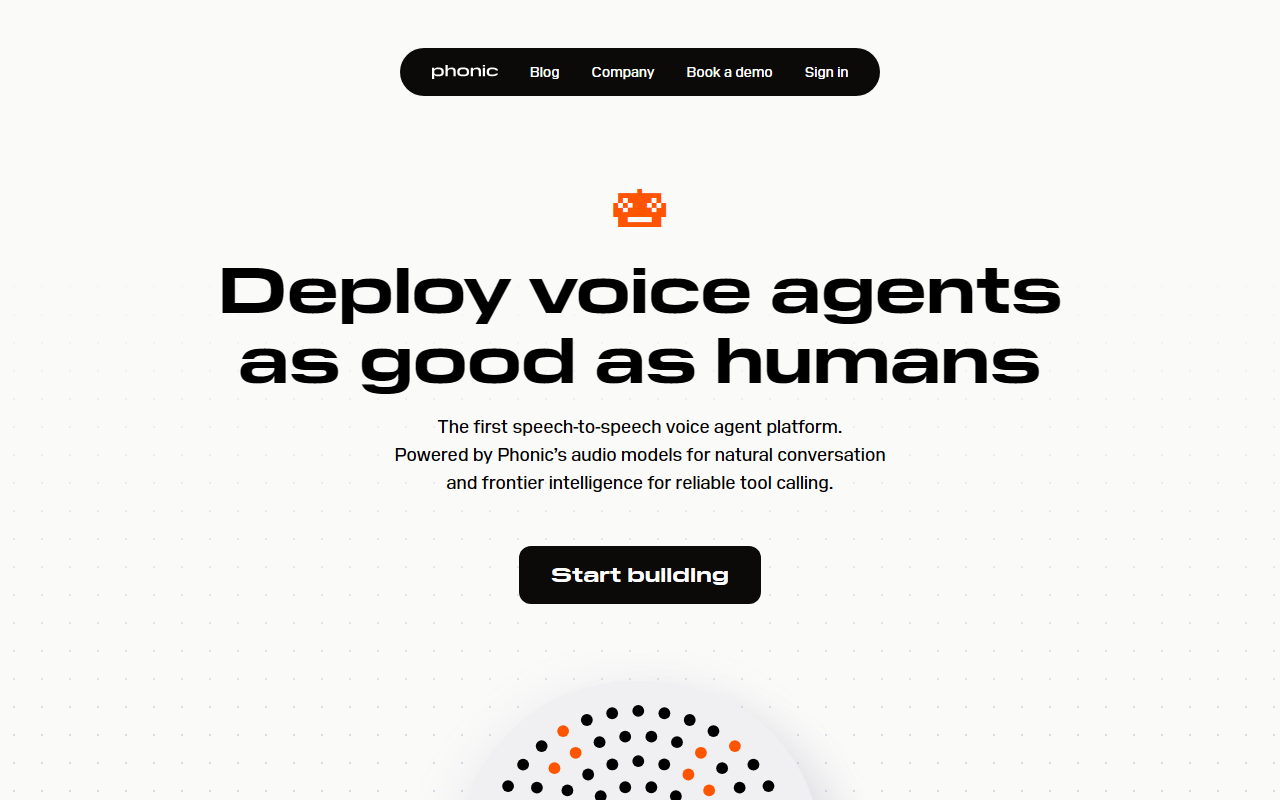
Upon visiting Phonic's site, the first thing that strikes you is the clarity of their value proposition: deploy voice agents as good as humans. The landing page immediately contrasts their speech-to-speech approach with the failings of legacy cascaded systems—those multi-step pipelines that introduce awkward pauses and robotic misunderstandings. Phonic’s own audio foundation models drive the entire stack, from input to output, without stitching together separate ASR, NLP, and TTS components.
The platform is squarely aimed at developers and enterprises. A quote from Sami Shalabi of Maven AGI underscores the real-world benefit: speed and natural flow for high-stakes calls. Another from Flexbone’s founder notes how Phonic removed significant codebase complexity. These aren’t vague testimonials; they speak to concrete gains in reliability and development speed.
Technical Deep Dive and Performance
Phonic claims end-to-end latency of under 300 milliseconds—speech in to speech out. That’s competitive with the best real-time voice AI systems and critical for maintaining conversational flow. The architecture relies on proprietary audio models rather than off-the-shelf components, which likely explains the natural realism they advertise. While I couldn’t test the free tier (none appears to be offered), the site emphasizes “frontier intelligence for reliable tool calling,” suggesting deep integration with external APIs and data sources.
For enterprise deployment, Phonic offers fully containerized environments that run in your own infrastructure. This is a significant differentiator: data never leaves your control. They also provide searchable call records (system of record), real-time observability dashboards across millions of agents, and evaluation tools to pinpoint common failure modes. These features signal a platform built for production scale, not just demos.
Pricing, Integration, and Market Position
Pricing is not publicly listed on the website. You must book a demo or sign in to learn costs, which is common for enterprise-focused tools. Pricing likely scales with usage and deployment size. Compared to alternatives like ElevenLabs or Play.ai, Phonic differentiates by offering a full speech-to-speech framework rather than just a TTS or voice cloning API. It also carries notable backing: investors include Lux Capital, and advisors include the CEOs of Hugging Face, Replit, and Applied Intuition. This pedigree suggests strong research chops and deep industry connections.
Integration appears to be through a developer framework, though specific SDKs or programming languages aren’t detailed on the site. The mention of “tool calling” indicates compatibility with function-calling paradigms popularized by LLM frameworks like OpenAI’s. Phonic likely works best for teams building custom voice agents for customer support, healthcare, or finance, where reliability and data privacy are paramount.
Strengths, Limitations, and Recommendation
Phonic’s real strengths are its low latency, natural speech quality, and enterprise-grade security. The containerized deployment and observability tools are exactly what large organizations need to trust voice AI at scale. The endorsement from Flexbone’s founder—who removed significant codebase complexity—hints at a clean developer experience.
However, the platform has limitations. There is no free tier or public pricing, which makes it hard for small teams or indie developers to experiment without a sales conversation. The website lacks technical documentation or API examples, so I couldn’t verify the ease of integration. Additionally, Phonic seems relatively new; the team is hiring, which may mean the product is still maturing in terms of ecosystem support and community.
I recommend Phonic primarily for enterprise engineering teams already committed to voice AI and needing a reliable, low-latency, speech-to-speech platform with strict data security requirements. If you’re prototyping on a budget or need a simple TTS API, look at ElevenLabs or Play.ai instead. For serious production voice agents, Phonic is worth a demo call.
Visit Phonic at https://phonic.ai/ to explore it yourself.












Comments