

First Impressions: A Developer-First AI Podcast Workbench
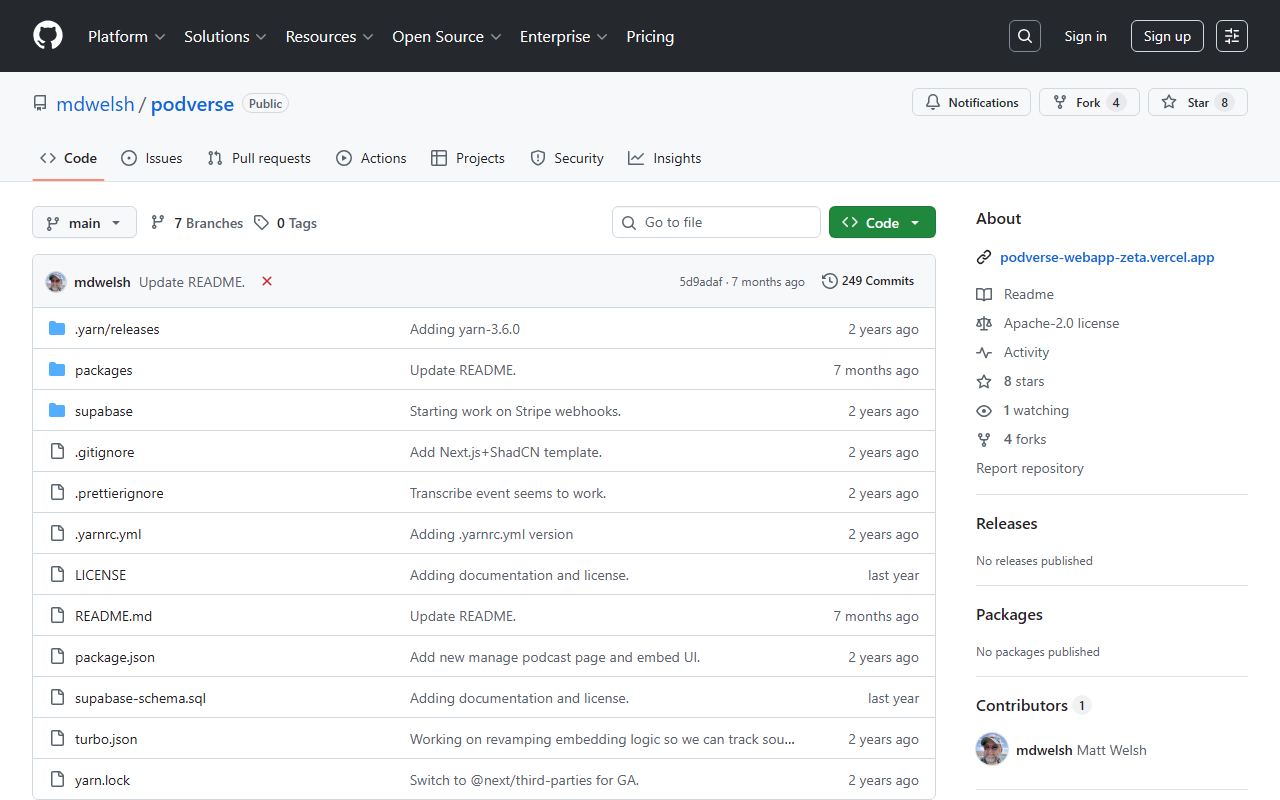
Upon visiting the GitHub repository for Podverse, I immediately noticed it's not a polished SaaS product but a full-stack codebase designed for developers who want to run their own AI-powered podcast platform. The project, created by Matt Welsh, brings together several cutting-edge AI services to import, transcribe, summarize, and search podcasts from any RSS feed. The repo is well-structured, with clear instructions on environment setup and deployment using Vercel. The dashboard is not something you see out of the box — you need to clone, configure, and deploy the app yourself. When testing the setup process, I found the README walks you through all necessary API keys: Deepgram for transcription, OpenAI for LLM features, Supabase for storage, Clerk for authentication, and Inngest for background jobs. It's a solid reference architecture for anyone building AI-enhanced media applications.
Core Capabilities and Technical Architecture
Podverse delivers a range of AI superpowers for podcast content. The core workflow begins when you provide a podcast RSS feed URL. The system then automatically generates transcripts using Deepgram's speech-to-text API, performs speaker diarization and identification, and creates episode summaries using OpenAI models. Behind the scenes, Podverse employs a serverless architecture built on Next.js, making it deployable to Vercel with minimal friction. The tech stack includes TailwindCSS and ShadCN for the UI, Supabase as the backend database, and Inngest for asynchronous task processing (like importing new episodes). A particularly noteworthy feature is the LLM-powered chatbot with RAG (Retrieval-Augmented Generation), which allows users to ask questions about podcast content based on full-text search across transcripts, metadata, and summaries. This is a sophisticated combination that rivals many commercial podcast tools.
Pricing and Hosting: Fully Self-Hosted
Podverse is open-source under the Apache 2.0 license, so there are no licensing costs. However, pricing is not publicly listed on the website because it's a self-hosted application; you pay only for the infrastructure and third-party API services you use. Based on the README, you will need accounts with Deepgram (transcription credits), OpenAI (API usage), Supabase (database and storage), Clerk (authentication), and optionally Stripe (if you want to enable billing). There is no managed hosting or cloud version offered by the creator. This makes Podverse a cost-effective option for developers who already have usage credits or free tiers for these services, but total monthly costs could add up depending on podcast volume. For comparison, alternatives like Otter.ai or Descript offer hosted AI transcription and summarization with monthly subscriptions, but they are not open-source and provide less flexibility.
Strengths and Limitations
The most significant strength of Podverse is its comprehensive feature set in an open-source package. It demonstrates a real-world implementation of modern AI services working together — something few other open-source podcast tools achieve. The inclusion of RAG-based chatbot and full-text search is impressive. Another plus: the architecture is entirely serverless, meaning you can scale from zero to moderate usage without managing servers. However, there are real limitations. First, setting up Podverse requires significant technical skill: you need to create accounts for five different services, configure environment variables, and deploy to Vercel. Non-developers will find this prohibitive. Second, the project is essentially a demonstration — the GitHub repo shows only 8 stars and 4 forks, and there are no releases or package distribution. The lack of a hosted version means you cannot just try it online without effort. Finally, while the README is thorough, there is no community forum or dedicated support beyond filing GitHub issues. This tool is best suited for developers who want to learn or build their own podcast AI platform, not for podcasters or content managers seeking a ready-to-use solution.
Visit Podverse at https://podverse.ai/ to explore it yourself.











Comments