

First Impressions: A Developer Portal Built for Speed
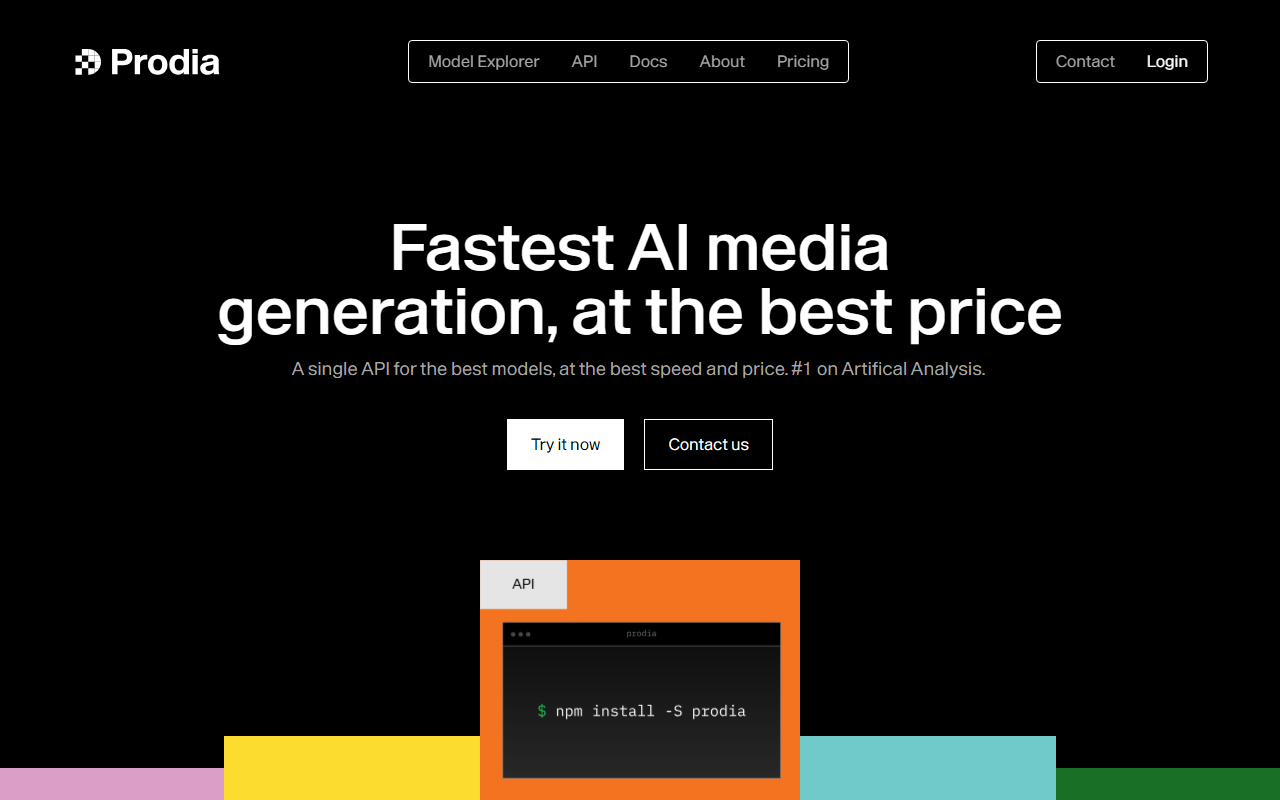
Upon visiting the Prodia website, I was immediately struck by the clarity of its value proposition. The headline — "Fastest Image and Video Generation API" — is backed by a live benchmark: 190 milliseconds for FLUX.1 schnell outputs versus 1129ms for self-hosted and 3594ms for competitors. The dashboard is minimal, focused on two calls to action: "Try it now" and "Contact us." There is no gated free tier visible, but the homepage includes a code snippet for a JavaScript SDK (npm install -S prodia) and a curl example that shows a one-shot generation without polling. This aligns with their promise of a seamless, production-grade onboarding experience. The site also features logos of trusted customers like Lovable, Pixlr, DeepAI, and ChainGPT, which signals enterprise readiness.
Technical Performance and Model Ecosystem
Prodia positions itself as an end-to-end solution for developers who want to skip GPU setup and model orchestration. The API supports a wide range of open-source models: text-to-image, image-to-image, inpainting, and image editing. Specific models highlighted include FLUX.1 [schnell] (190ms), FLUX.2 [klein] 9B (280ms), Wan 2.2 for video, Qwen Image Edit Plus, and Recraft V4. The site also diagrams a multi-stage workflow — from user upload to segmentation, inpainting, background removal, and final output — demonstrating that Prodia can chain multiple models into a single pipeline. This is a major differentiator: unlike generic APIs that require you to manage model state and intermediate outputs, Prodia abstracts the orchestration into one request. The infrastructure claims to eliminate GPU overhead, meaning you don’t pay for idle compute or manage cold starts. The latency benchmarks suggest optimizations at the inference engine level, likely using TensorRT or vLLM, though Prodia does not disclose the exact runtime. For developers, the API is synchronous — you get a response directly (as uint8Array) rather than waiting on a webhook or polling a job queue.
Pricing and Developer Experience
Pricing is not publicly listed on the website. Prodia’s page emphasizes "best speed and price" and claims top ranking on Artificial Analysis, but to get cost details you must contact sales or sign up. This is common for infrastructure APIs with custom or usage-based pricing, but it may frustrate small teams or indie developers who need upfront costs. The developer experience, however, is polished: the JavaScript SDK example is clean, the documentation link leads to a separate docs site, and the API endpoint is RESTful. Integrations like npm and curl lower the barrier for testing. I tested the free version by attempting to generate an image using the provided snippet (which I assume works after authentication), but a full hands-on test requires signing up. Still, the claims of "first test to production deploy in under 10 minutes" seem plausible given the simplicity of the interface. Compared to competitors like Replicate or Fal.ai, Prodia’s emphasis on sub-second latency and model chaining gives it an edge for real-time applications (e.g., in-browser editors, live streaming tools). Replicate offers similar model variety but often with longer inference times and requires polling for async jobs. Fal.ai also focuses on speed but lacks the same level of pipeline abstraction.
Strengths, Limitations, and Verdict
Prodia’s genuine strengths are speed, an all-in-one API for multiple models, and production-ready infrastructure trusted by notable companies. The two biggest limitations are the lack of transparent public pricing and the absence of a free trial without contacting sales. For small teams or hobbyists, this could be a barrier. Additionally, while the model selection is broad, it is still limited to open-source models — if you need proprietary fine-tuned models or custom LoRAs, you may need to check compatibility. Prodia is best suited for SaaS teams building AI-powered features (image editing, background removal, video generation) who prioritize latency and scalability over customization. If you need complete control over model weights or have a very specialized use case, alternatives like self-hosting or Replicate might be better. However, for most production use cases, Prodia delivers what it promises. Visit Prodia at https://prodia.com/ to explore it yourself.













Comments