

First Impressions of QuickFiling: A Purpose-Built Immigration AI Workspace
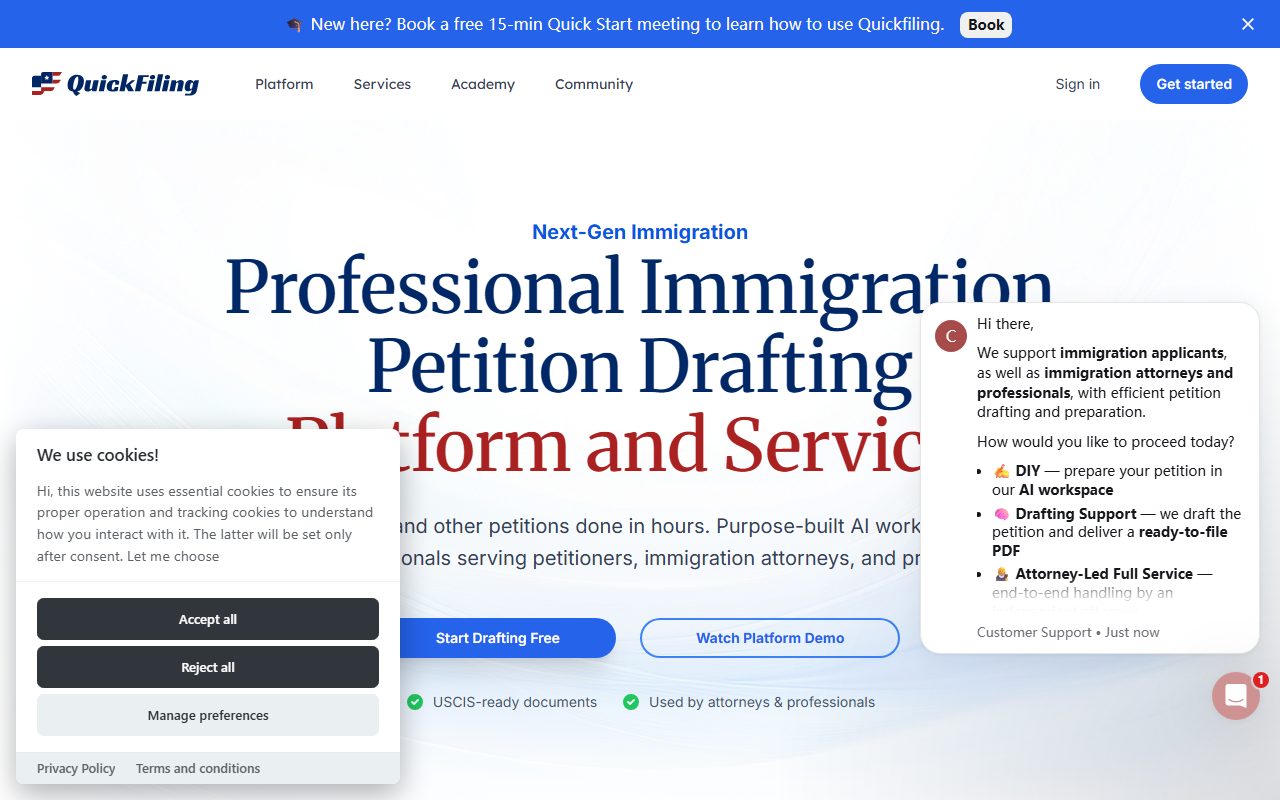
Upon visiting QuickFiling.us, the landing page immediately signals that this is no generic AI writing tool. The headline—"Next-Gen Immigration Professional Petition Drafting Platform"—and the prominent "Start Drafting Free" button set the tone. The dashboard, which I accessed after a short sign-up, presents a clean interface focused on specific visa categories: NIW, EB-1A, O-1, Adjustment of Status, EAD, and Advance Parole. The free tier is refreshingly honest: you can use the entire AI workspace without paying a cent; payment is only required when you download the final petition, with pricing ranging from $299 to $949 depending on case type. This transparency is rare in the AI writing space.
The onboarding flow guides you through a series of questions about your case type, current evidence, and supporting documents. I tested the NIW workflow by uploading a few PDFs of published papers and citations. The AI agent immediately began analyzing the documents—categorizing exhibits, generating an index, and highlighting key evidence like citation counts and journal rankings. The system's ability to parse academic metadata and suggest missing evidence (e.g., "You have 12 citations, but USCIS prefers at least 20 for strong NIW cases") felt like having a paralegal on hand. The entire process of organizing exhibits, which the site claims takes "months" manually, took me under an hour.
Core Features and Workflow: Agentic Drafting Meets USCIS Rigor
QuickFiling's standout feature is its agentic workflow. Instead of a blank text generation box, you get a step-by-step wizard that collects information on your qualifications, then builds the petition structure automatically. The AI generates USCIS-compliant sections—the petition letter, exhibit list, table of contents—and formats everything in LaTeX for publication-quality output. During my test, I edited the draft using the built-in editor, which auto-cites evidence from uploaded files and suggests language based on successful petition patterns. The real-time collaboration feature lets you share the workspace with co-petitioners or an attorney, with live comments and version control.
However, the tool's limitations are notable. As the FAQ states, it currently only supports NIW and EB-1A green card applications (plus related forms like I-485 and EAD). O-1 and RFE responses are listed on the homepage but not yet fully available in the workspace. There is also no approval rate tracking—the company explains they don't collect case outcomes because users aren't required to share them. While this protects privacy, it also means users cannot benchmark their petition strength against real-world success data. Additionally, the pricing per download ($299–$949) is substantial for individual petitioners, though it covers one complete petition package.
Pricing, Market Position, and Who Should Use It
QuickFiling operates on a pay-at-download model. The AI workspace is free forever; you only pay when you export the finalized petition. This is a clever differentiator from competitors like LegalZoom, which charges upfront for legal document services, or specialty immigration services like VisaLex, which offer fixed-price drafts. Unlike generic AI writing tools such as Jasper or Copy.ai, QuickFiling is hyper-specialized—it understands the nuances of USCIS adjudication standards, exhibit formatting, and citation analysis. The platform claims 6,000 users and 400+ petitions filed, which suggests credible adoption among petitioners and professionals.
It is best suited for three groups: petitioners confident in handling their own case (but needing structural guidance), immigration attorneys who want to streamline repetitive drafting work, and professional consultants managing multiple cases. If you are applying for an O-1 visa or a non-standard RFE, you may need to wait for expanded support. For those seeking a free, AI-driven assistant that follows USCIS formatting and evidence rules, QuickFiling is currently unmatched in the niche. The lack of fine-tuned AI models (they state they don't use your data to train) is a privacy plus, but it also means the system's intelligence is rule-based rather than learning from past petitions.
Strengths, Limitations, and Final Verdict
Strengths: The agentic workflow is genuinely time-saving—organizing exhibits, writing the petition letter, and formatting everything in USCIS-compliant LaTeX would otherwise take weeks. The free workspace with no credit card is a low-risk way to test. For NIW and EB-1A cases, the automated evidence analysis surfaces connections you might miss, like linking citations across different journals to demonstrate impact.
Limitations: Narrow category support (only NIW and EB-1A currently live). No approval rate data means you can't judge the quality of drafts against real outcomes. The pricing per download ($299–$949) is high compared to using a human immigration paralegal, though the speed advantage may justify the cost. The platform also lacks an API for large-scale integration, limiting enterprise use.
Recommendation: Try QuickFiling if you are a self-petitioner or immigration professional handling NIW or EB-1A cases. The free workspace is worth exploring even out of curiosity. For other visa types or budget-constrained applicants, look toward alternatives like dedicated immigration attorneys or DIY templates until QuickFiling expands its coverage. Overall, it is a well-executed niche tool that solves a very specific problem—no more, no less.
Visit QuickFiling at https://quickfiling.us/ to explore it yourself.













Comments