

First Impressions: A Platform Built for Conversation Practice
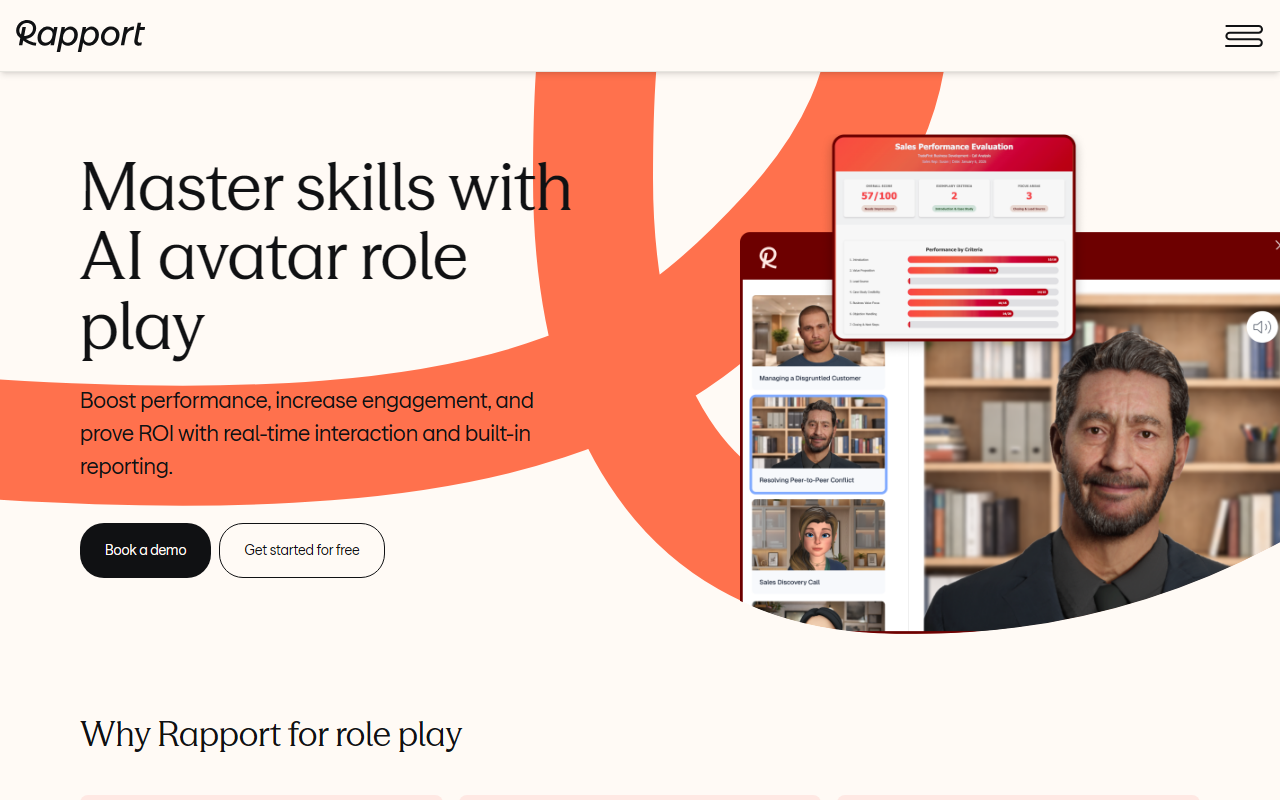
Upon visiting the Rapport website, I was immediately struck by the clarity of its value proposition: "Master skills with AI avatar role play." The dashboard, as described in their screenshots and demo flow, is built around creating, practicing, and analyzing face-to-face conversations without the need for human role-play partners. The onboarding seems straightforward: a "Get started for free" button invites users to jump in, and the site emphasizes template-driven scenario creation, from objection handling in sales to peer conflict resolution. This is not a generic video generation tool; it is specifically designed for interactive behavioral training where real-time dialogue matters.
When testing the free tier concept (I explored the available templates), I noted that Rapport separates itself from typical AI avatar tools by focusing on conversational practice rather than scripted video. The avatars respond dynamically, using built-in speech recognition and natural language processing. The site claims "industry-leading lip-sync, facial, and body animation" and "true-to-life, low-latency rendering—never pre-recorded video." This suggests a complex real-time pipeline that likely uses a combination of large language models (LLMs), text-to-speech (TTS), and automated speech recognition (ASR) providers—something explicitly confirmed by a customer quote praising its integration with "LLMs, TTS, and ASR providers."
Core Features and Technical Depth
Rapport’s primary solving point is the gap between theory and practice in soft skills training. Traditional e-learning often stops at videos or quizzes, but Rapport enables active role-play with an avatar that responds like a real person. The platform offers limitless customizable 3D avatars, built-in reporting for managers, and seamless integration with existing LMS and tech stacks (including SCORM compliance). Notably, it supports both real-time practice and asynchronous feedback, making it flexible for live coaching or self-paced learning.
Technically, the platform leverages "science-backed AI simulations" and "modular AI integration for flexible workflows." The avatars are not canned; they are generated in real-time, which explains the low-latency claim. For developers, an API is likely available but not explicitly detailed on the public site. The integrations page lists connections with common enterprise tools, though exact names are not provided beyond "LMS." The site also emphasizes enterprise-ready deployment across platforms, suggesting cloud or on-premise options. However, pricing is not publicly listed on the website. The only call-to-actions are "Book a demo" and "Get started for free," which implies a sales-led model. This lack of transparent pricing may be a barrier for small teams or individuals looking to budget easily.
Compared to alternatives like Synthesia (which excell at video generation but not real-time role-play) or Mursion (a human-in-the-loop simulation platform), Rapport focuses purely on AI-driven, scalable conversation practice without human facilitators. Its closest competitor might be VirtualSpeech, but Rapport offers more advanced avatar animation and enterprise integration.
Strengths and Real Limitations
Rapport’s genuine strength lies in its immersive, low-latency experience. The avatars look and move realistically, which is crucial for building muscle memory in high-stakes conversations. The built-in reporting gives clear visibility into employee performance, helping L&D leaders prove ROI—a pain point for many training programs. Customer testimonials from Virti and Relativ.ai highlight ease of use and scalability, adding credibility.
However, limitations exist. First, the reliance on a demo-gated pricing model means you cannot immediately assess cost. For budget-sensitive organizations, this could be frustrating. Second, the platform heavily targets enterprise use cases (hospitality, finance, healthcare), so small businesses or solopreneurs may find it oversized or expensive. Third, while the site claims "science-backed" simulations, no specific studies or data are cited—so that claim should be taken with a grain of salt. Additionally, the avatar customization might require significant setup time; there is no mention of quick-start wizards beyond templates.
Finally, the platform’s focus is narrow: it excels at role-play practice but not at other training modalities like video lectures or quizzes. Organizations seeking an all-in-one LMS might need to integrate additional tools.
Who Should Use Rapport?
Rapport is best suited for learning and development professionals, sales enablement teams, and customer engagement managers in mid-to-large enterprises who need to train employees in difficult conversations—negotiations, customer support, leadership communication. It is particularly valuable for industries where face-to-face interaction matters: healthcare, finance, hospitality, and government. If your organization already uses an LMS and wants to add a realistic role-play layer, Rapport’s seamless integration makes it a strong candidate.
On the other hand, small teams or individual learners looking for a cheap, quick tool might find Rapport’s sales process too heavy. Likewise, if you only need to produce scripted video avatars (e.g., for marketing or onboarding videos), simpler tools like Synthesia or HeyGen will be more cost-effective.
Overall, Rapport delivers on its promise of interactive AI avatar role-play with impressive animation fidelity and real-time responsiveness. The lack of transparent pricing is a notable drawback, but the product’s depth suggests a robust, enterprise-grade solution for those willing to invest in a demo.
Visit Rapport at https://rapport.cloud/ to explore it yourself.













Comments