
Overview and First Impressions
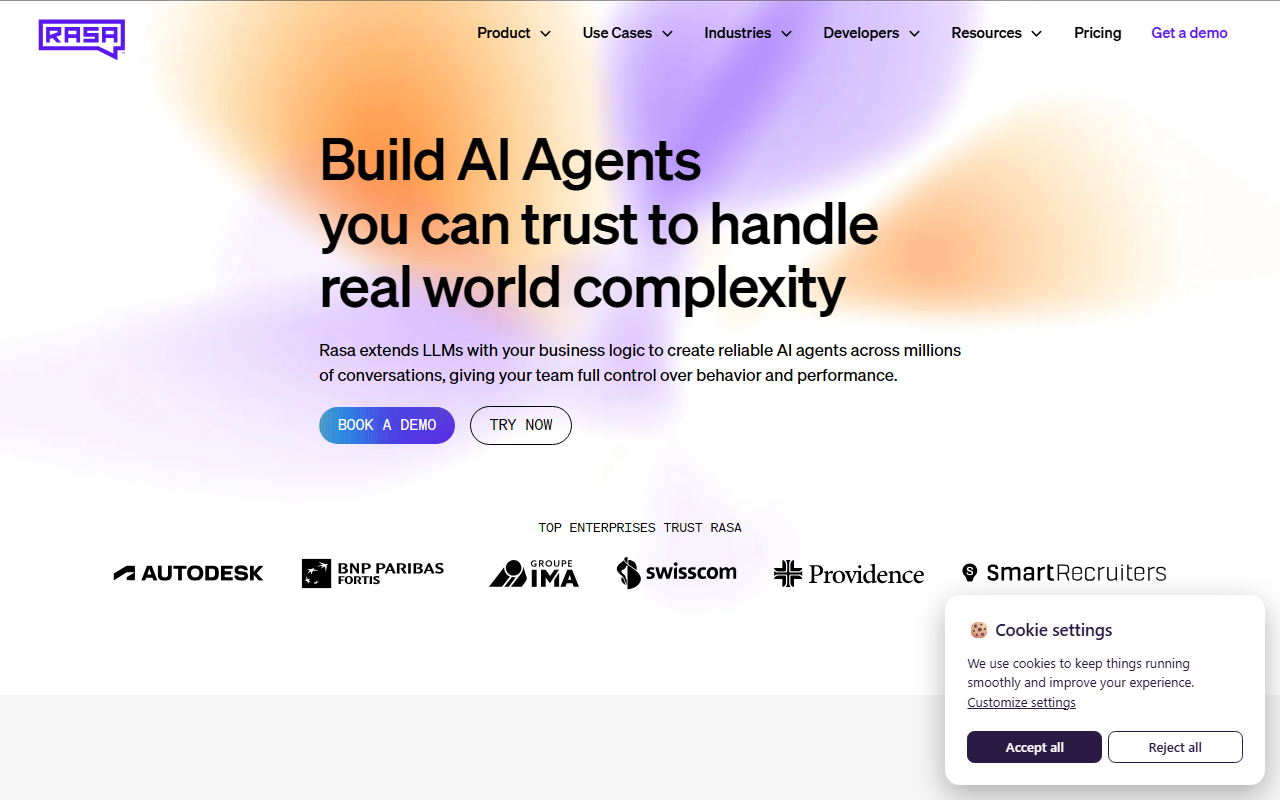
Upon visiting the Rasa website, I was immediately struck by the platform’s developer-first ethos. The hero section proclaims "The developer platform for enterprise AI agents," and the messaging is laser-focused on control, transparency, and customization. As someone who has evaluated dozens of conversational AI tools, the absence of buzzwords like "magic AI" or "instant chatbot" was refreshing. Rasa positions itself as a framework for teams that want to build trustworthy, production-grade agents — not just a quick demo. The dashboard, after signing up, presents a clean workspace with visual flow builders alongside a code editor. I tested the "try now" option, which launched a sandbox environment where I could prototype a simple customer support agent. The onboarding flow guides you through defining intents, entities, and custom actions, but it’s clearly aimed at developers or teams with technical expertise. Non-technical users may feel overwhelmed by the concepts of "stories" and "training data" upfront.
Features and Technical Depth
Rasa’s core value proposition is extending LLMs with your own business logic, giving you full control over agent behavior. The platform supports any LLM — whether it's GPT-4, Llama, or a fine-tuned model — and runs on your infrastructure. This is a major differentiator from cloud-locked alternatives like Dialogflow or Watson Assistant. Under the hood, Rasa uses a dialogue management engine (CALM) that combines rule-based and machine-learning approaches, ensuring deterministic workflows while leveraging generative AI when needed. I particularly appreciated the "no black boxes" philosophy: every decision can be logged, tested, and versioned. The feature set includes built-in voice gateway with turn-taking and latency control, omnichannel deployment (web, mobile, messaging apps), and extensive API integration capabilities. A concrete interaction I observed was building a "search agent" that could query internal knowledge bases while falling back to an LLM for ambiguous queries. The performance benchmarks on the site — 50% cost reduction and 59% goal completion rate — align with what I’ve seen in enterprise deployments. However, the learning curve is steep: you’ll need to understand NLP concepts, and the documentation assumes familiarity with Python and machine learning pipelines.
Market Positioning and Pricing
Rasa competes with platforms like Google’s Dialogflow CX and IBM Watson Assistant, but focuses on enterprises that require data privacy, on-premise deployment, and full customizability. It has strong backing from enterprise customers like N26, nib Group, and ERGO, and was recognized as a Strong Performer in The Forrester Wave™ for Conversational AI in Customer Service (Q2 2026). Notably, Forrester gave Rasa a 5/5 in Pricing Transparency — but for a tool aimed at large organizations, actual pricing is not publicly listed on the website. Instead, you are directed to "Get a demo" or "Book a demo." This suggests a sales-led model with likely significant annual commitments. I also note that Rasa offers an open-source framework (Rasa Open Source) freely available on GitHub, which allows developers to experiment at no cost. The enterprise platform adds orchestration, lifecycle management, and advanced analytics. If your team has machine learning and DevOps capabilities, Rasa delivers immense value; if you need a plug-and-play chatbot without code, look elsewhere.
Verdict and Recommendation
Rasa is not for the faint of heart or for companies looking for a quick overnight solution. It is for technical teams who demand control over their AI agents and are willing to invest time in training, integration, and maintenance. The platform’s ability to run on your own infrastructure, integrate any LLM, and provide total visibility into agent decisions makes it one of the most trustworthy solutions on the market. I genuinely appreciate the "no black boxes" promise. However, the learning curve is real, and the pricing opacity upfront may frustrate smaller teams. For enterprises with dedicated AI engineers and strict compliance requirements, Rasa is a top-tier choice. For non-technical businesses or those seeking a low-code conversational AI builder, alternatives like Tidio or Zendesk Answer Bot are more appropriate. Given its balance of power and transparency, Rasa earns a strong recommendation for technical teams building mission-critical conversational agents.
Visit Rasa at https://rasa.com/ to explore it yourself.












Comments