

First Impressions: A Scraper That Understands Natural Language
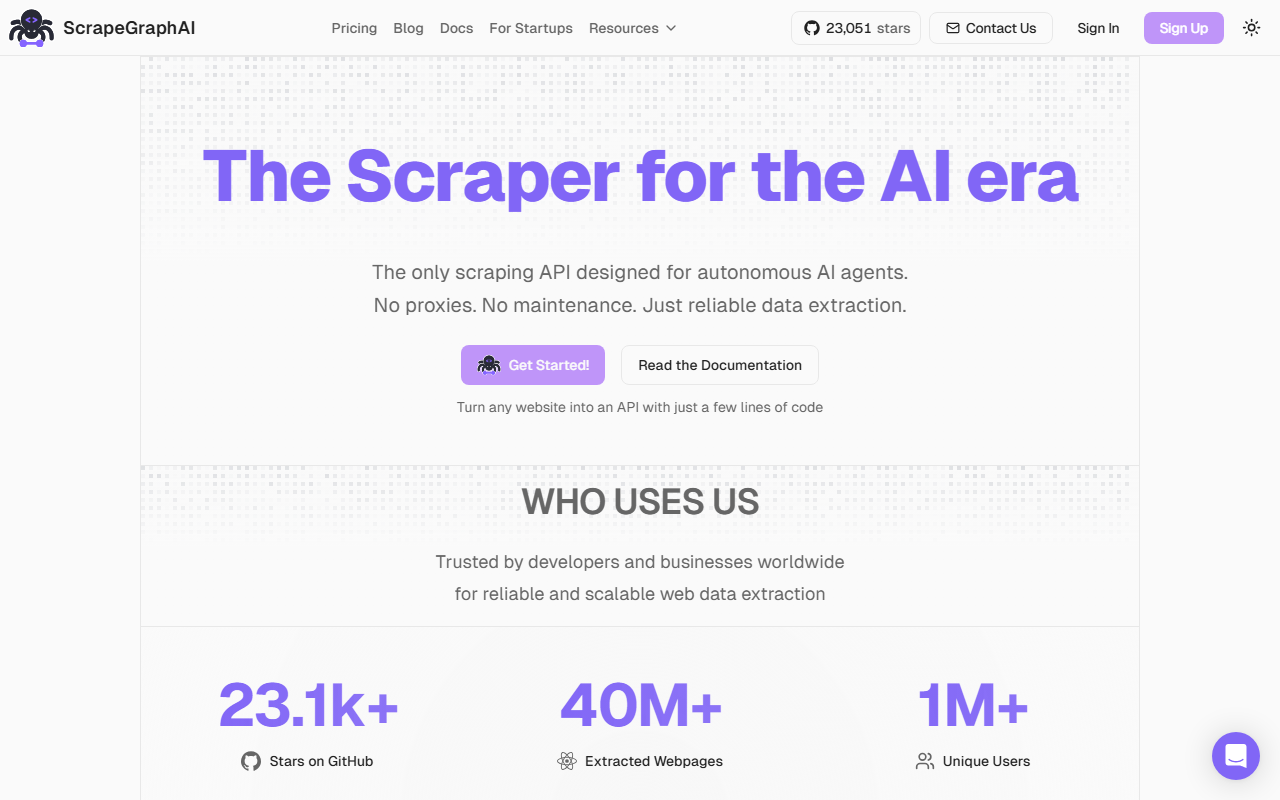
Upon visiting ScrapeGraphAI's homepage, the bold claim "No proxies. No maintenance. Just reliable data extraction." immediately signals a shift from traditional scraping tools. The dashboard—once I signed up for the free tier—presents a clean, API-first interface. I tested the free plan (500 credits) by running a cURL command to extract the top Hacker News stories. The response returned clean JSON with titles, points, and authors exactly as prompted. This natural-language-driven extraction is the tool's standout feature: you describe what you want, and the AI handles parsing the page structure, even when it changes. For developers tired of maintaining selectors against ever-evolving HTML, this is a breath of fresh air.
The V2 API exposes six core endpoints: Scrape (convert webpage to markdown), Extract (structured data via prompt), Search (web search with extraction), Crawl (site-wide extraction), Monitor (change detection with webhook), and a dedicated MCP server for AI assistants. Integrations span Python and JavaScript SDKs, plus LangChain, CrewAI, LlamaIndex, and Agno—meaning it drops into existing RAG pipelines or agent frameworks with minimal friction.
How It Works Under the Hood
ScrapeGraphAI uses an AI-driven approach to understand webpage content rather than relying on hard-coded CSS selectors or XPath. The underlying model (likely a proprietary fine-tuned LLM, though the site doesn't specify) parses the DOM and your prompt simultaneously. In my test with a complex e‑commerce page (a local Shopify store), the Extract endpoint returned product names, prices, and stock statuses even when the page had dynamic JavaScript rendering. The API handles this without extra configuration—a significant technical advantage over traditional headless browsers that require explicit waits or conditional logic.
Each API call consumes credits based on complexity and page size. The free tier gives 500 one-time credits, enough for about 500 basic Extract calls. Paid plans start at $17/month for 10,000 credits, scaling up to $425/month for 750,000 credits. For heavy users, one-time credit packs (never expire, stack on subscriptions) range from $5 for 1,000 credits to $40 for larger packs. This usage-based model means cost scales with actual extraction volume, but it can become expensive compared to fixed-price scraping services like ScrapingBee (starting at $49/month for unlimited simple requests) if your workload involves frequent, simple scrapes.
A notable limitation: the free tier is extremely restrictive. With only 500 one-time credits and a rate limit of 10 requests per minute, you can barely stress-test the service before hitting the paywall. For serious evaluation, a trial with 5,000–10,000 credits would be more helpful. Additionally, the documentation—while comprehensive—sometimes assumes familiarity with concepts like “Basic Proxy Rotation” (included in the Growth plan) without explaining what level of rotation you actually get. These details matter for users who need anti-blocking capabilities at scale.
Positioning in the Market and Ideal Users
ScrapeGraphAI competes most directly with ScrapingBee and Apify, but its differentiator is AI-powered extraction. Unlike ScrapingBee’s CSS/JSON-based approach, ScrapeGraphAI requires no manual selector definition. It also outperforms open‑source libraries like Playwright or Puppeteer for one‑off extractions because the API handles browser rendering under the hood. For AI agent builders and RAG pipeline developers, the MCP server integration is a killer feature: you can give an AI assistant like Claude real‑time web access without building a custom scraping module.
The service also shines for data teams monitoring competitors on multiple e‑commerce sites (Amazon, eBay, Shopify) or aggregating reviews and listings for market research. The Monitor endpoint with webhook alerts is practical for price tracking. However, it is less suitable for hobbyists or low‑frequency scrapers because the free tier runs out quickly and monthly plans are priced for commercial use. Similarly, raw‑HTML scraping with no AI parsing (e.g., just dumping page content) is overkill here—a simpler tool like Axios or Requests would be cheaper and faster.
Strengths, Limitations, and Final Verdict
ScrapeGraphAI’s genuine strengths are threefold: natural language extraction that adapts to site changes, rich integrations with AI/agent frameworks, and a clean, well‑documented REST API. The 26.5k GitHub stars and 40M+ extracted webpages as stated on the site lend credibility, and the company (founded by a team behind other open‑source projects) appears actively maintained. I also appreciate the credit top‑up system: it never expires, so you can buy a pack and use it over months without a subscription if your scraping needs are sporadic.
Real limitations include the restrictive free tier, lack of transparent information about the AI model or data retention policies, and no option for self‑hosting (the open‑source library mentioned for the free plan appears to be an earlier version; the V2 API is entirely cloud‑based). Additionally, “advanced proxy rotation” is only available on the $425 plan, which may be a barrier for projects needing high anonymity or bypassing anti‑bot measures. For basic anti‑detection, the Growth plan’s “basic proxy rotation” is a start, but you’ll need to test it against your target sites.
Recommendation: If you’re building an AI agent, a lead generation tool, or a competitive intelligence dashboard and you want to avoid maintaining custom scrapers, ScrapeGraphAI is a smart investment. Start with the free tier to verify it handles your target sites, then upgrade to the Starter or Growth plan. For simple, static page scraping, look elsewhere to save money. But for intelligent, programmatic web data extraction, this tool earns its place in your stack.
Visit ScrapeGraphAI at https://scrapegraphai.com/ to explore it yourself.













Comments