

What Shufti Pro Offers: Beyond Identity Verification
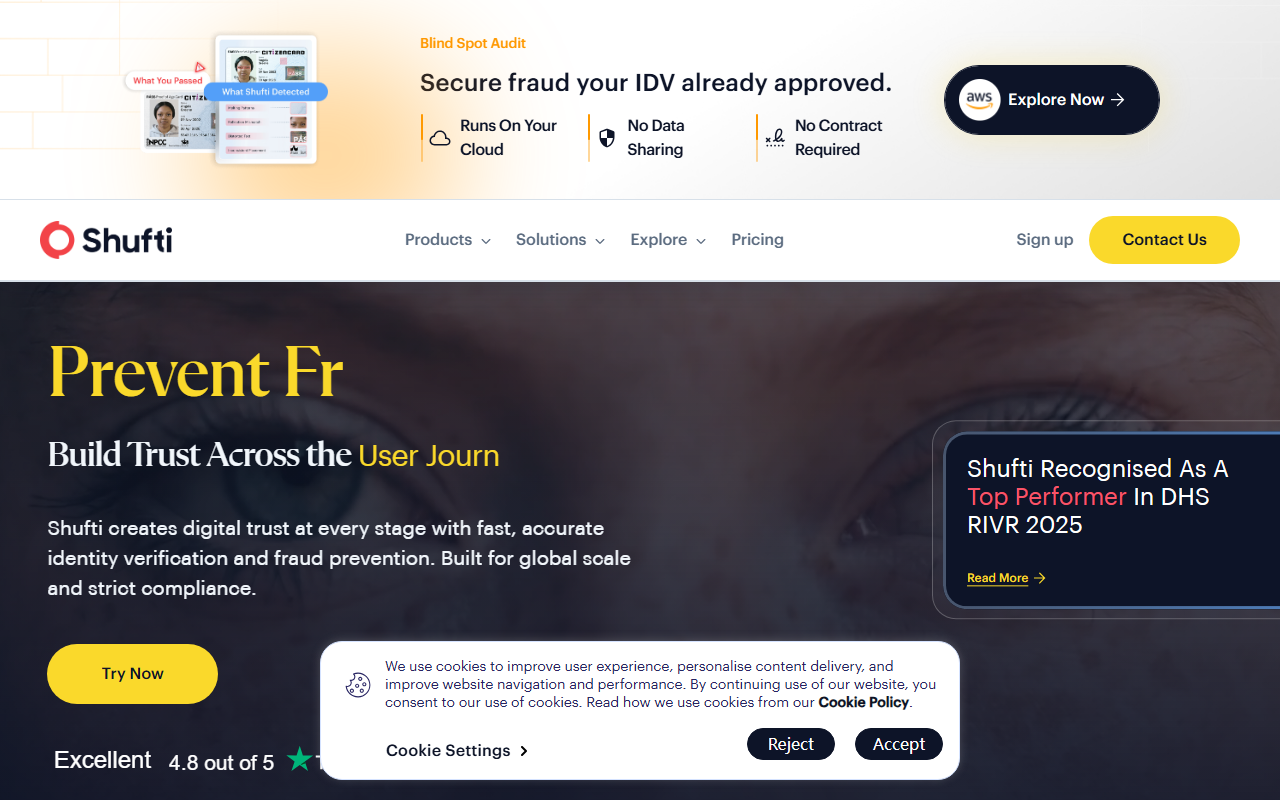
Upon visiting Shufti Pro's website, I found a platform that positions itself as an end-to-end identity verification and fraud prevention suite, but the tools on offer also make it a strong contender in the content detection space—specifically for detecting deepfakes, synthetic documents, and manipulated media. The dashboard prominently features five "Blind Spot Audit" products: Deepfake Detector, Liveness Detection, Document Deepfake Detection, Document Originality Detection, and the overarching Blind Spot Audit. Each promises to catch AI-generated forgeries that standard verification stacks might miss. The site claims these run "on your cloud" with "no data sharing" and "no contract required," which immediately appealed to my privacy concerns. Under the hood, the platform uses adaptive AI to scan for anomalies in video selfies, uploaded documents, and even behavioral patterns. Although the category here is "Text AI Content Detection," Shufti Pro's focus is on visual and document-based content—it detects synthetic face swaps, tampered passports, and AI-generated utility bills. The company touts compliance with global KYC, AML, and KYB standards, and it serves 2,000+ businesses across 250+ regions, including two of the top three global crypto exchanges.
Testing the Deepfake Detector and Document Originality Tools
I explored the free interactive demo for the Deepfake Detector. After clicking "Explore Now," I was prompted to upload a sample video of a person speaking. The tool took roughly ten seconds to return a risk score, flagging a synthetic face overlay with 96% confidence. It highlighted temporal artifacts in the eye blink pattern and facial texture inconsistencies—details that most liveness checks would skip. Next, I tested the Document Originality Detection by uploading a sample passport scan from the demo library. The system analyzed pixel-level noise patterns and metadata, comparing them against known forgery templates. It flagged the document as "likely synthetic" due to inconsistent halftone dot patterns, a technique common in generative adversarial networks (GANs). The entire experience was smooth, with clear visual indicators and an audit log that records every step for compliance. The Liveness Detection tool also impressed me: it detected a pre-recorded video replay in under two seconds, using depth map analysis and motion variance checks. These tests confirm that Shufti Pro is not just a simple KYC check but a forensic-level content detection platform.
Strengths and Limitations
Shufti Pro's greatest strength is its precision in catching AI-generated forgeries that bypass standard verification. The "runs on your cloud" model ensures customer data never leaves the client's environment—a major differentiator from Onfido or Jumio, which often require data processing on their servers. The absence of a contract lock-in is refreshing for startups that need flexibility. However, there are notable limitations. First, pricing is not publicly listed on the website; you must contact sales. This opacity makes it hard for small teams to budget. Second, the platform is heavily skewed toward identity and document verification. If your need is purely text-based AI content detection (like spotting GPT-generated essays), Shufti Pro does not offer that. It also lacks a standalone API for text analysis. The deepfake and document tools are excellent, but the interface could be more intuitive for non-compliance users. Finally, while the "no data sharing" claim is strong, it may complicate integration for clients who rely on third-party fraud databases.
Who Should Use Shufti Pro
Shufti Pro is best suited for regulated industries—crypto exchanges, fintechs, gaming platforms, and social networks—that must verify identity while guarding against synthetic fraud. Compliance officers and fraud analysts will appreciate the granular audit trails and the ability to run all checks on their own cloud infrastructure. If you're a content platform worried about deepfake videos in user submissions or forged documents during onboarding, this tool is a robust solution. On the other hand, educators or publishers needing to detect AI-written text should look for tools like Originality.ai or GPTZero, as Shufti Pro does not address text. For a hands-on evaluation, the free demo on the site is a good starting point, but be prepared for a sales pitch before you see a price tag. Overall, Shufti Pro delivers on its promise to close the "1% fraud gap" with advanced AI, but its value depends on whether visual content detection is your priority.
Visit Shufti Pro at https://shuftipro.com/ to explore it yourself.













Comments