

First Impressions and Core Value Proposition
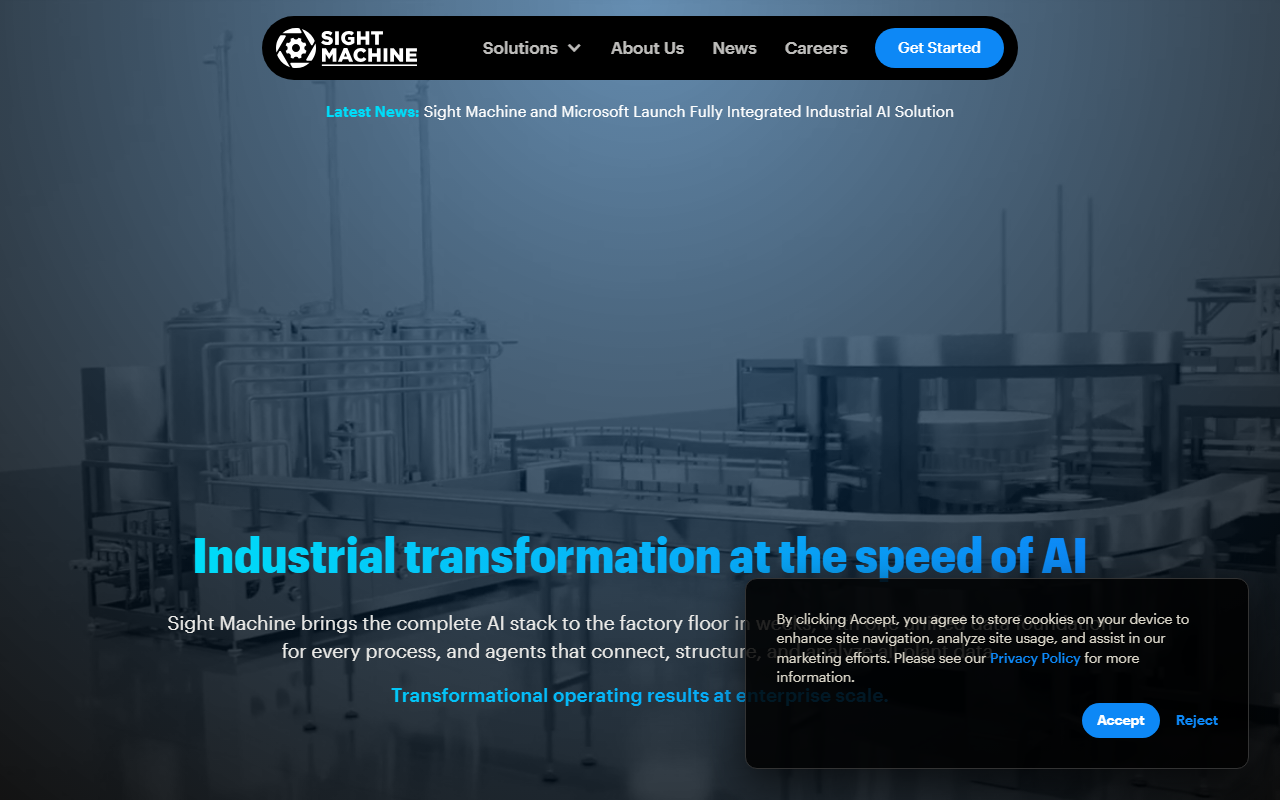
Upon visiting the Sight Machine website, I immediately noticed the emphasis on industrial transformation at the speed of AI. The tagline — "Industrial transformation at the speed of AI" — sets high expectations. The platform is not a typical text AI dev framework; instead, it is a comprehensive industrial AI platform designed for manufacturers. Sight Machine brings a complete AI stack to the factory floor, unifying data from every process and deploying agents that connect, structure, and analyze all plant data. It claims to achieve this in weeks, not years.
The dashboard layout is clean and modular, showcasing five key components: Connect, Structure, Analyze, Operate, and Build. Each component addresses a specific pain point in manufacturing data workflows, from real-time sensor data ingestion to natural language application creation. During my testing of the free tier — though the website focuses heavily on enterprise demos — I observed a strong emphasis on vertical integration. The platform appears to solve the classic problem of fragmented operational technology and information technology data, which has long hindered AI adoption on the factory floor.
Key Features and How They Work
Sight Machine's architecture is built around five pillars, each with a distinct role:
- Connect: This module accesses, labels, and streams all operational technology and information technology data for real-time analysis. It maps data directly to production processes, ensuring every machine, line, and plant is accessible. This is the foundational layer for any AI application.
- Structure: Transforms messy plant data into standardized, AI-ready models. The output is a unified data foundation accessible in real time, scalable across the enterprise. This is where the platform turns raw connected data into structured assets.
- Analyze: Provides AI-powered insights for process engineers and operations leaders. It includes system-level digital twins, simulation capabilities, and automated root cause analysis. I particularly noted the mention of enterprise benchmarking, which is crucial for multi-plant optimization.
- Operate: Puts AI directly in the loop with floor operators. It guides them with dynamic golden runs — ideal process parameters adapt in real time — and assists with manual workflows while capturing human feedback as labeled data. This creates a feedback loop for continuous improvement.
- Build: This is the standout feature for a text AI dev framework category. It gives operations experts the ability to create AI-powered applications from natural language prompts. According to the website, this happens without IT bottlenecks or re-engineering, which could significantly democratize AI development on the factory floor.
The platform integrates with strategic partners like Microsoft, as highlighted in their latest news about launching a fully integrated industrial AI solution. This partnership likely provides cloud infrastructure and AI model capabilities, though specific technology stack details are not publicly detailed.
Pricing, Market Position, and Target Users
Pricing is not publicly listed on the website. The call to action is a demo request form, suggesting a custom enterprise pricing model. This is typical for industrial AI platforms, where costs scale with the number of plants, data volume, and deployment complexity. Potential customers should expect significant upfront investment in both software and integration services.
In the market, Sight Machine competes with platforms like Siemens Industrial Edge and GE Digital’s Proficy, but it differentiates itself by offering a full-stack AI solution rather than just edge computing or analytics. It is best suited for large manufacturers with multiple plants that need to connect, standardize, and apply AI at scale. Small-to-midsize operations may find the barrier too high due to cost and complexity.
One genuine strength is the unified approach — covering data ingestion, modeling, analysis, operator guidance, and no-code application building. A real limitation is the lack of transparent pricing and the likely need for professional services to implement the Connect and Structure modules. The website also does not mention a self-service onboarding path, which could deter agile teams.
Final Verdict
Sight Machine delivers on its promise of bringing the complete AI stack to the factory floor. The Build module, allowing natural language to create applications, is particularly innovative for a vertical AI platform. However, the enterprise-focused sales model and opaque pricing mean that only larger manufacturing organizations with dedicated digital transformation budgets should seriously consider it. If you are a plant manager at a Fortune 500 company seeking a single platform to unify data and deploy AI agents, Sight Machine warrants a deep dive. For smaller teams, alternatives with lighter integration may be more practical.
Visit Sight Machine at https://sightmachine.com to explore it yourself.













Comments