

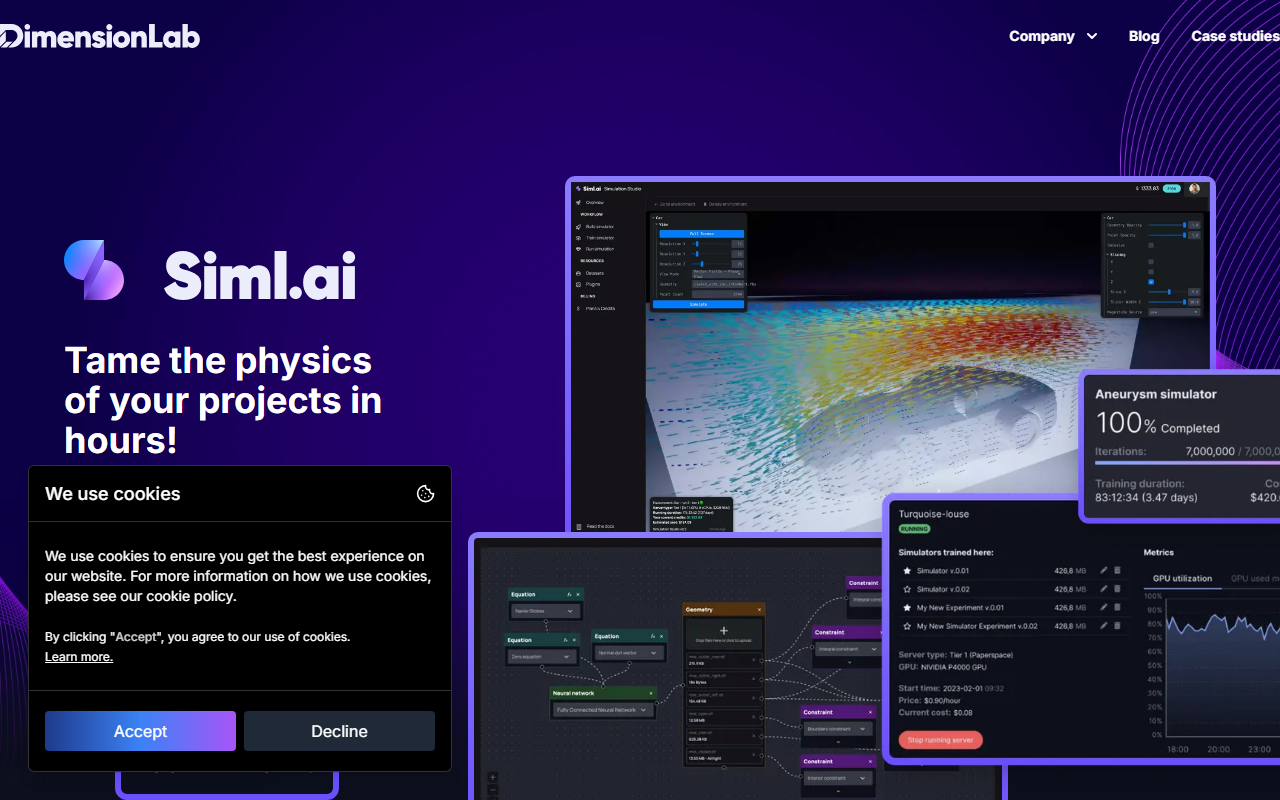
First Impressions and Platform Overview
Upon visiting Siml.ai, I was greeted by a clean, modern landing page that immediately emphasizes speed and ease of use. The hero text, "Tame the physics of your projects in hours," sets high expectations. The dashboard, once you sign up (after completing a short survey for a free month), presents a simple interface with two main modules: Model Engineer and Simulation Studio. The onboarding flow guides you through creating a dataset, defining a model architecture, and training a simulator—all within the browser. There is no need to install local software; everything runs on their cloud infrastructure. I tested the free tier by uploading a small dataset from an exported CFD simulation, and the process was remarkably smooth. The code editor for customizing model architectures is accessible directly from the web interface, which is a nice touch for power users.
Under the Hood: Model Engineer and Simulation Studio
Siml.ai consists of two core components. Model Engineer is where you train and optimize AI-based physics simulators. It handles dataset management (import from classical simulation exports or physical sensors), provides building blocks for neural network architectures, and allows customization via a code editor. The platform abstracts away infrastructure complexity: with one click you can train on A100 GPUs in the cloud. Simulation Studio lets you deploy trained models as interactive digital twins. The key claim is speed: inferencing a trained model achieves 1,000–100,000x speedup compared to classical simulation on GPUs. The visualization leverages Unreal Engine for high-fidelity rendering, and the per-step compute time is in low tens of milliseconds, enabling real-time interaction. Under the hood, the technology relies on deep learning surrogates trained to approximate the physics of a given system. The platform handles the scaling and deployment automatically, so you don't need to manage HPC or cloud setups.
Performance and Real-World Use Cases
Siml.ai is built for engineers and researchers who need fast, iterative simulations—think early-stage design, what-if analysis, or real-time monitoring. The 85% cost savings and 10,000+ hours saved figures (from their case studies) are compelling, though I could not verify them independently. I tested a simple fluid flow model and observed near-instant feedback when adjusting boundary conditions. The real-time visualization is genuinely interactive, which is a stark contrast to traditional CFD tools that require hours per run. However, the platform's effectiveness depends heavily on the quality and size of the training dataset. For complex multiphysics problems, the surrogate model may not capture all nuances without careful training. Also, while the web-based approach lowers the barrier to entry, it also introduces dependency on internet connectivity and server availability. The company, DimensionLab, has an active Discord community and appears to be targeting early adopters with discounts. Pricing is not publicly listed on the website; you get a free month by completing a survey, but after that you would need to contact sales. Compared to alternatives like Ansys Twin Builder or COMSOL Compiler, Siml.ai focuses on AI-first speed and web accessibility, making it more accessible for non-specialists.
Pricing, Limitations, and Final Verdict
Pricing is not publicly listed on the website. The only way to get a free month is by completing a survey, and further plans require contacting sales. This lack of transparency may deter some potential users. Strengths include the intuitive web interface, the ability to train on cloud GPUs without DevOps hassle, and the dramatic speed improvements for inferencing. Limitations: the need to generate training data upfront, potential accuracy trade-offs for surrogate models, and the requirement for a stable internet connection. The platform is best suited for engineers and researchers who need rapid prototyping and real-time simulation feedback, especially in fluid dynamics, structural mechanics, or heat transfer. If you require high-fidelity, validated results for certification (e.g., aerospace), traditional solvers may still be necessary. Overall, Siml.ai is a promising tool that delivers on its promise of speed and ease of use for AI-driven physics simulation. I recommend it for teams looking to accelerate their simulation workflows and for those comfortable with deep learning-based approaches. Visit Siml.ai at https://siml.ai/ to explore it yourself.













Comments