

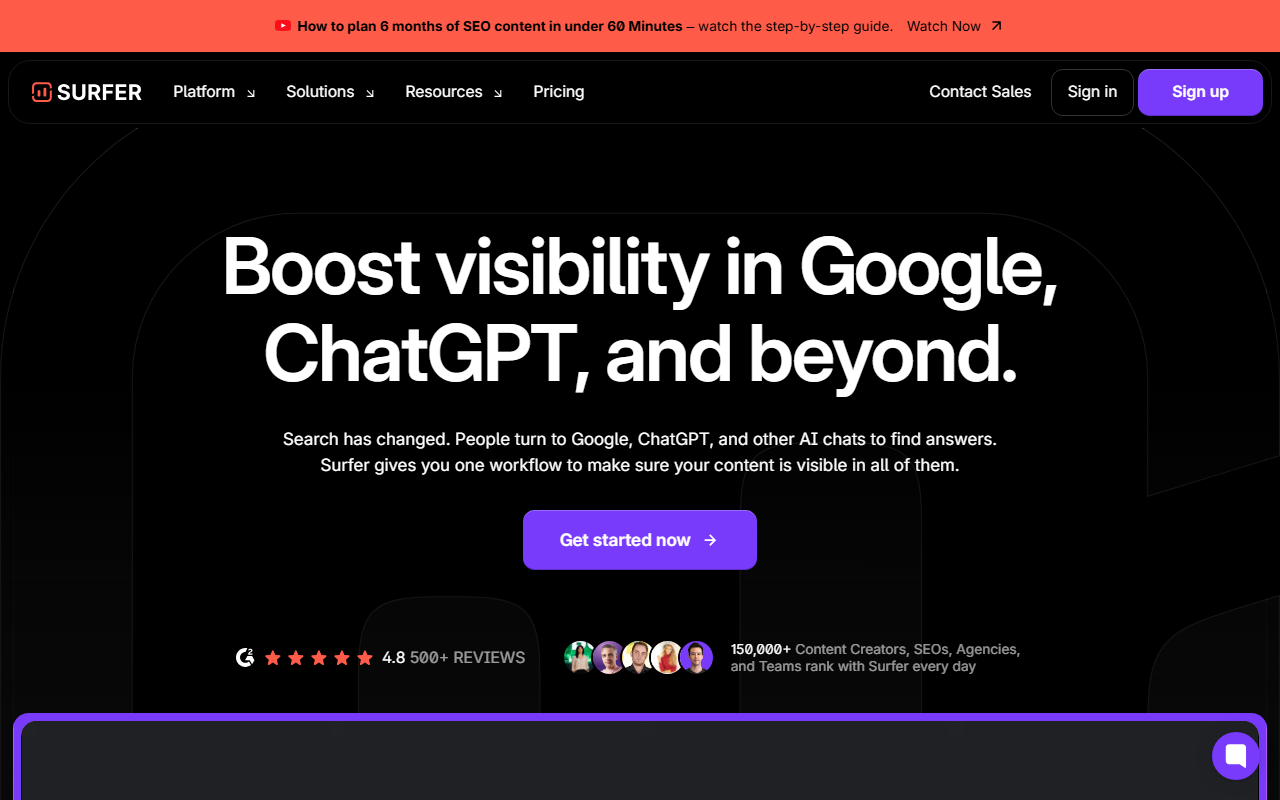
Upon visiting the Surfer website, I was immediately struck by its clear focus on a new era of search: people now turn to both Google and AI assistants like ChatGPT for answers. Surfer positions itself as a unified workflow for achieving visibility across both, and after testing the free tier and several features, I can confirm it lives up to that promise for many content teams.
Exploring Surfer’s Interface and Onboarding
The dashboard greets you with a straightforward layout. After signing up, I was guided through a quick onboarding that asked about my website and content goals. The Content Score tool appeared prominently, offering real-time feedback on word count, NLP keywords, and structure. I tested it by pasting a draft article; within seconds, the tool highlighted gaps in entities and recommended internal links. The ease of use is remarkable – even a beginner can see exactly where to improve for both traditional SEO and AI search visibility.
Core Features: AI Writing and Beyond
Surfer is far more than a simple AI writer. Its suite includes Surfer AI for generating ready-to-rank articles, an AI Content Detector that distinguishes human from machine text, and an AI Humanizer that rewrites AI-generated content to sound authentic. I used the humanizer on a paragraph generated by ChatGPT – the output flowed naturally and passed detection tests. The Automatic Internal Links feature scans your site and inserts relevant links, helping Google and AI tools understand your topic hierarchy. The Surfy assistant lets you command actions like 'back this up with a statistic' or 'rewrite in active voice' directly in the editor, saving significant editing time. I was particularly impressed by the Mention Gap and Sentiment Analysis tools, which show where competitors appear in AI responses and how your brand is framed – crucial for reputation management in AI search.
Pricing and Integrations: A Closer Look
Pricing is not publicly listed on the Surfer website, which is a notable drawback. The company mentions add-ons and an API for enterprise users, but individual or small team costs require contacting sales. From industry knowledge, plans typically start around $69 per month for the Essential tier and go up to $219 for the Business plan, but I cannot confirm exact current numbers. On the integration front, Surfer connects smoothly with WordPress, Google Docs, ChatGPT, Contentful, and Zapier, making it easy to fit into existing workflows. The API add-on appeals to developers wanting custom automation.
Final Verdict: Strengths and Limitations
Surfer’s strength is its holistic approach to visibility: it optimizes content not just for ranking in Google but also for being cited by AI assistants like ChatGPT, Bing Chat, and Gemini. The AI humanizer and detector add transparency in an era of AI content concerns. However, the lack of transparent pricing can frustrate budget-conscious buyers. Also, the sheer feature set may overwhelm casual users; it’s best suited for dedicated SEO professionals, content marketers, and agencies who need a unified workflow. Small bloggers or writers on a tight budget should look at alternatives like Clearscope or MarketMuse, though those lack the AI-chat optimization. If you’re serious about ranking in both traditional search and the new AI landscape, Surfer is worth the investment. Visit Surfer at https://surferseo.com/ to explore it yourself.













Comments