
First Impressions and Onboarding Flow
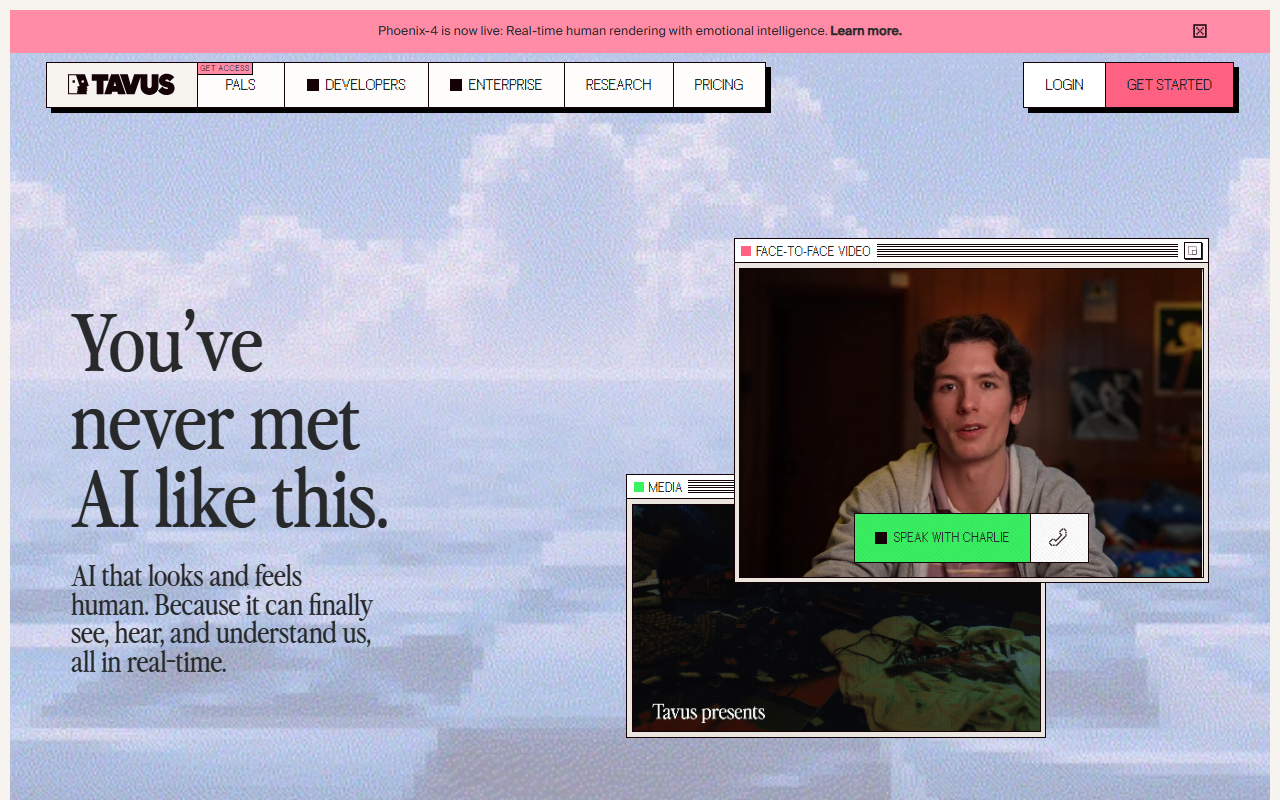
Upon visiting Tavus at tavus.io, I was greeted by a clean, modern homepage that immediately pushes you to choose an account type: Developer or PALs. This dual-path onboarding is clever — it signals that Tavus serves two very different audiences. I selected the Developer account to explore the APIs, while also noting the PALs option for personal AI companions. The dashboard is not yet fully public without login, but the site offers a "Speak with Daniel" demo clip that showcases a face-to-face video interaction with an AI human. The rendering is strikingly lifelike: the avatar maintains eye contact, micro-expressions shift naturally, and there is no noticeable delay in response. For a tool that claims under 500ms end-to-end latency, the demo feels instantaneous.
Technical Architecture and Core Models
Tavus describes itself as a "human computing company" and provides three proprietary models: Phoenix-4 for rendering, Raven-1 for perception, and Sparrow-1 for emotional understanding. Phoenix-4 is a gaussian-diffusion rendering model that synthesizes high-fidelity facial behavior in real time, capable of controlling motion and identity with temporal consistency. Raven-1 unifies object recognition, emotion detection, and adaptive attention — essentially giving the AI a form of sight. Sparrow-1 is a transformer-based dialogue model that captures conversational timing and turn-level structure across voice, language, and gesture. These models work together to power what Tavus calls "conversational video agents." Developers can access these via REST APIs, with white-label deployment and production-grade infrastructure. I found the documentation on the site to be thorough, offering quickstart guides for integrating video agents into existing products.
Pricing, Use Cases, and Market Position
Pricing is not publicly listed on the website. Tavus directs enterprises to book a demo and developers to explore APIs, suggesting a custom pricing model. This lack of transparency can be a barrier for individuals or small teams who want to quickly estimate costs. For context, competitors like Synthesia offer per-minute video generation at a flat subscription, while D-ID provides API-based video avatars with tiered credits. Tavus differentiates itself by emphasizing real-time interactivity and emotional intelligence — not just pre-rendered avatars. The main use cases appear to be customer-facing conversational agents for sales, support, healthcare, and education, as well as personal AI companions (PALs) for casual interaction. The company is San Francisco–based, positions itself as an AI research lab, and claims backing from innovative companies (logos shown on site include familiar tech brands, though no funding details are given).
Strengths, Limitations, and Final Verdict
Tavus’s greatest strength is the realism of its real-time video rendering. The Phoenix-4 model produces avatars that feel genuinely human, with emotional nuance that goes beyond what I’ve seen from other video AI tools. The low latency (













Comments